
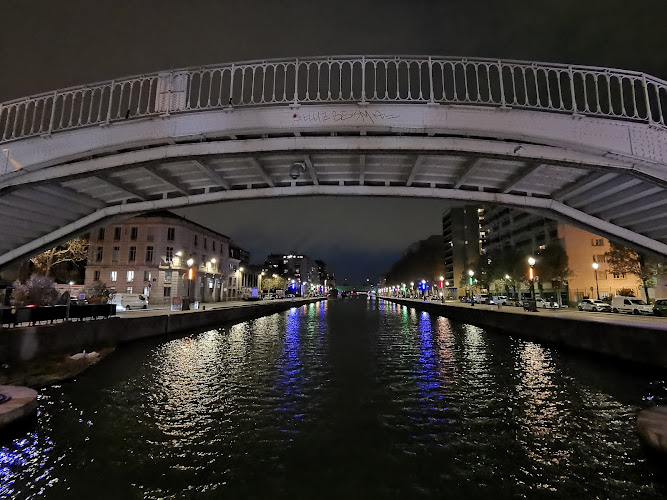
In the heart of the 19th arrondissement, where the Bassin de la Villette meets the Canal de l’Ourcq, stands a remarkable piece of engineering history that most Parisians pass by without a second glance. The Pont Levant de la Rue de Crimée, Paris’s last operational lift bridge, continues to rise and fall as it has for nearly 140 years, carrying on a tradition of innovation and practical ingenuity.
A pioneer of hydraulic engineering
Inaugurated on August 2, 1885, this bridge holds the distinction of being Paris’s first hydraulically operated lift bridge and only the third of its kind built in France. Designed by architect Félix Eugène Edmond Humblot in collaboration with engineer L. Le Chatelier, the bridge represented a revolutionary approach to urban infrastructure when it replaced an earlier structure.
What made this bridge truly groundbreaking was its hydraulic mechanism, powered by pressurized water from the Paris drinking water system. Hidden in the sewers below, this ingenious system consumed approximately 2 cubic meters of water for each operation—a marvel of 19th-century engineering that used the city’s own water pressure to lift an 85-ton structure.
The bridge in action
With approximately 9,000 operations per year, the Pont Levant de la Rue de Crimée remains a working piece of infrastructure. When boats need to pass through, the bridge rises majestically, temporarily halting road traffic—five minutes for smaller vessels and up to twenty minutes for heavier convoys. Today, the bridge is operated remotely from the control room at the first lock on the Saint-Denis Canal, a testament to how historic infrastructure can be modernized while preserving its essential character.
For pedestrians, the engineers provided an elegant solution: a fixed footbridge alongside the lifting structure ensures continuous passage even when the main bridge is raised, allowing life in the neighborhood to flow uninterrupted.
Preservation and modernization
Recognizing its historical significance, the bridge was registered as a historical monument in 1993. A major renovation in 2011 saw the installation of modern hydraulic systems while carefully preserving the bridge’s original character and appearance. This thoughtful modernization ensures that the bridge can continue serving its community for decades to come while maintaining its status as a living piece of industrial heritage.
Despite its remarkable history and continued operation, the Pont Levant de la Rue de Crimée remains surprisingly discreet, almost invisible in the urban landscape of the 19th arrondissement. Yet for those who take the time to observe, it offers a unique spectacle—especially when catching it in operation, watching this massive structure rise gracefully to allow boats passage along the canal.
The bridge serves as a powerful reminder of Paris’s industrial past and the ingenuity of 19th-century engineers who created solutions that continue to serve the city today. It represents not just a means of crossing water, but a connection between Paris’s past and present, between innovation and tradition.
Key features
- Built in 1885, Paris’s first hydraulically operated lift bridge
- Weighs 85 tons and performs approximately 9,000 lifting operations annually
- Originally powered by the Paris drinking water system’s pressure
- Registered as a historical monument since 1993
- Modernized in 2011 while preserving its historic character
- Remotely operated from the Saint-Denis Canal control room
- Features a parallel pedestrian footbridge for continuous access
Visiting the bridge
- Location: Connecting Quai de l’Oise to Quai de la Marne, 19th arrondissement
- Best viewing times: Early morning or late afternoon when boat traffic is more frequent
- Nearby attractions: Bassin de la Villette, Parc de la Villette, Canal de l’Ourcq
- Photography tip: The bridge offers spectacular photo opportunities when raised, with the canal and urban landscape as backdrop
Engineering legacy
The Pont Levant de la Rue de Crimée stands as more than just a bridge—it’s a testament to the vision of 19th-century engineers who created infrastructure designed to last. In an age of planned obsolescence, this bridge continues to perform its daily duty, connecting communities and allowing commerce to flow along Paris’s waterways. For visitors interested in industrial heritage, engineering marvels, or simply the hidden corners of Paris, this last lift bridge offers a unique glimpse into the city’s working history.