
<\!-- wp:heading -->
Napoleon\u2019s triumphal vision realized at the heart of imperial Paris
<\!-- /wp:heading --><\!-- wp:paragraph -->
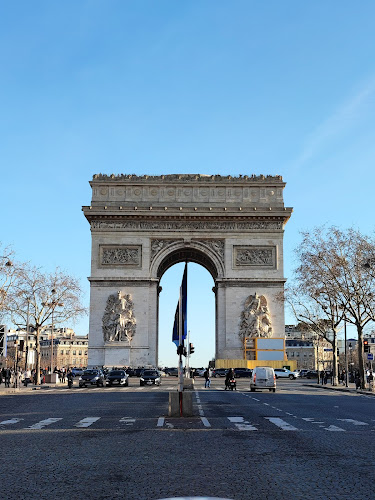
At the summit of the Champs-Élysées, where three arrondissements converge in the star-shaped Place Charles de Gaulle, the Arc de Triomphe de l\u2019Étoile stands as the ultimate expression of Napoleonic ambition and French military glory. This monumental triumphal arch, rising 50 meters high and spanning 45 meters wide, represents more than architectural achievement—it embodies the imperial vision that sought to place Paris at the center of European civilization.
<\!-- /wp:paragraph --><\!-- wp:paragraph -->
Commissioned by Napoleon I on February 18, 1806, following his decisive victory at Austerlitz, the arch was conceived as a tribute to the Grande Armée and a statement of French supremacy in European affairs. The emperor\u2019s instruction to his Minister of the Interior reflects his understanding that military victories required architectural commemoration to achieve lasting cultural impact.
<\!-- /wp:parameter --><\!-- wp:heading {"level":3} -->
Chalgrin\u2019s neoclassical masterpiece
<\!-- /wp:heading --><\!-- wp:parameter --><\!-- wp:paragraph -->
Architect Jean-François-Thérèse Chalgrin designed the arch with deliberate reference to Roman triumphal architecture, particularly the Arch of Titus and Arch of Constantine. However, Chalgrin\u2019s design transcends mere imitation, creating a structure whose scale and sculptural richness surpass its ancient models while establishing new standards for monumental architecture.
<\!-- /wp:paragraph --><\!-- wp:paragraph -->
The arch\u2019s proportions and decorative program demonstrate how neoclassical architecture could serve contemporary political purposes while honoring historical precedents. The integration of ancient Roman architectural vocabulary with French artistic tradition created a monument that speaks simultaneously to imperial ambition and national cultural achievement.
<\!-- /wp:paragraph --><\!-- wp:heading {"level":3} -->
Construction across three decades and political regimes
<\!-- /wp:heading --><\!-- wp:paragraph -->
The arch\u2019s construction, beginning in 1806 and concluding in 1836, spanned the Napoleonic Empire, Bourbon Restoration, and July Monarchy. When Chalgrin died in 1811, only a small portion had been completed, and Napoleon\u2019s abdication in 1814 further slowed progress, creating uncertainty about the monument\u2019s completion.
<\!-- /wp:paragraph --><\!-- wp:paragraph -->
The final inauguration on July 29, 1836, under King Louis-Philippe, demonstrated how architectural projects can transcend their original political context to serve broader national purposes. Remarkably, Napoleonu2019s remains passed beneath the completed arch in 1840 during their transfer from Saint Helena to Les Invalides, creating a poetic closure to the emperoru2019s relationship with his monument.
<\!-- /wp:paragraph --><\!-- wp:heading {"level":3} -->
Memorial function and eternal remembrance
<\!-- /wp:heading --><\!-- wp:parameter --><\!-- wp:paragraph -->
Beyond its original commemorative purpose, the arch evolved into a national shrine honoring all French military sacrifice. The Tomb of the Unknown Soldier, installed beneath the arch after World War I, with its eternal flame rekindled daily, transforms the monument from celebration of specific victories into universal memorial for fallen defenders of France.
<\!-- /wp:paragraph --><\!-- wp:paragraph -->
The names of French victories and generals engraved on the arch\u2019s inner and outer surfaces create a comprehensive record of French military history, making the monument both architectural achievement and historical document. This dual function ensures the arch\u2019s continued relevance as both tourist destination and place of national remembrance.
<\!-- /wp:paragraph --><\!-- wp:heading {"level":3} -->
Urban planning centerpiece and visual axis
<\!-- /wp:heading --><\!-- wp:paragraph -->
The archu2019s strategic placement at the summit of the Champs-Élysées creates one of the worldu2019s most spectacular urban vistas, extending from le Louvre through Place de la Concorde to La Défense. This historical axis, linking ancient royal palace to modern business district, demonstrates how great les monuments can organize urban space across centuries.
<\!-- /wp:paragraph --><\!-- wp:paragraph -->
The star-shaped plaza surrounding the arch, with its twelve radiating avenues, showcases Haussmann\u2019s understanding of how monumental architecture can serve both symbolic and practical urban planning functions. The resulting configuration makes the arch visible from multiple directions while creating one of Paris\u2019s most dramatic urban spaces.
<\!-- /wp:paragraph --><\!-- wp:heading {"level":3} -->
Enduring symbol of French grandeur
<\!-- /wp:heading --><\!-- wp:paragraph -->
Today, the Arc de Triomphe continues to serve its original purpose as a symbol of French military valor while functioning as one of Paris\u2019s most important ceremonial spaces. State ceremonies, military parades, and commemorative events regularly utilize the arch\u2019s symbolic power, ensuring its continued relevance in French national life.
<\!-- /wp:paragraph --><\!-- wp:paragraph -->
For visitors to Paris, the arch offers both spectacular city views and profound historical connection to the events that shaped modern France. Climbing to the observation deck provides not just panoramic vistas but also perspective on how Napoleon\u2019s imperial vision continues to define Parisian urban space and French national identity. The Arc de Triomphe stands as proof that the most successful monuments transcend their original purpose to become eternal symbols of national character and cultural achievement.
<\!-- /wp:paragraph -->