
<\!-- wp:heading -->
Europe\u2019s tallest medieval keep and France\u2019s last surviving royal residence
<\!-- /wp:heading --><\!-- wp:paragraph -->
On the eastern edge of Paris in the 12th arrondissement, the Château de Vincennes stands as France\u2019s most complete medieval royal residence and home to Europe\u2019s tallest surviving keep. Built largely between 1361 and 1369, this fortress served as the preferred residence of French kings from the 14th to 16th centuries, creating a fortified sanctuary that demonstrates how medieval monarchs balanced security concerns with royal comfort and ceremonial grandeur.
<\!-- /wp:paragraph --><\!-- wp:paragraph -->
The château\u2019s evolution from a modest 12th-century hunting lodge for Louis VII to Charles V\u2019s grand royal residence reflects the growing sophistication of French royal architecture and the increasing need for fortified positions during the Hundred Years\u2019 War. This transformation created one of medieval Europe\u2019s most impressive architectural ensembles.
<\!-- /wp:paragraph --><\!-- wp:heading {"level":3} -->
The monumental donjon: medieval engineering triumph
<\!-- /wp:heading --><\!-- wp:paragraph -->
The château\u2019s crowning achievement is its magnificent donjon, rising 52 meters (172 feet) to claim the title of Europe\u2019s tallest medieval keep. Completed in 1369-70, this massive central tower represented the pinnacle of 14th-century fortification technology while providing royal apartments that combined defensive necessity with residential luxury.
<\!-- /wp:paragraph --><\!-- wp:paragraph -->
The donjon\u2019s unprecedented height and sophisticated construction techniques established new standards for medieval military architecture while demonstrating French royal resources and engineering capabilities. The tower\u2019s survival makes it an irreplaceable document of medieval building techniques and royal lifestyle.
<\!-- /wp:paragraph --><\!-- wp:heading {"level":3} -->
Comprehensive fortification system
<\!-- /wp:heading --><\!-- wp:paragraph -->
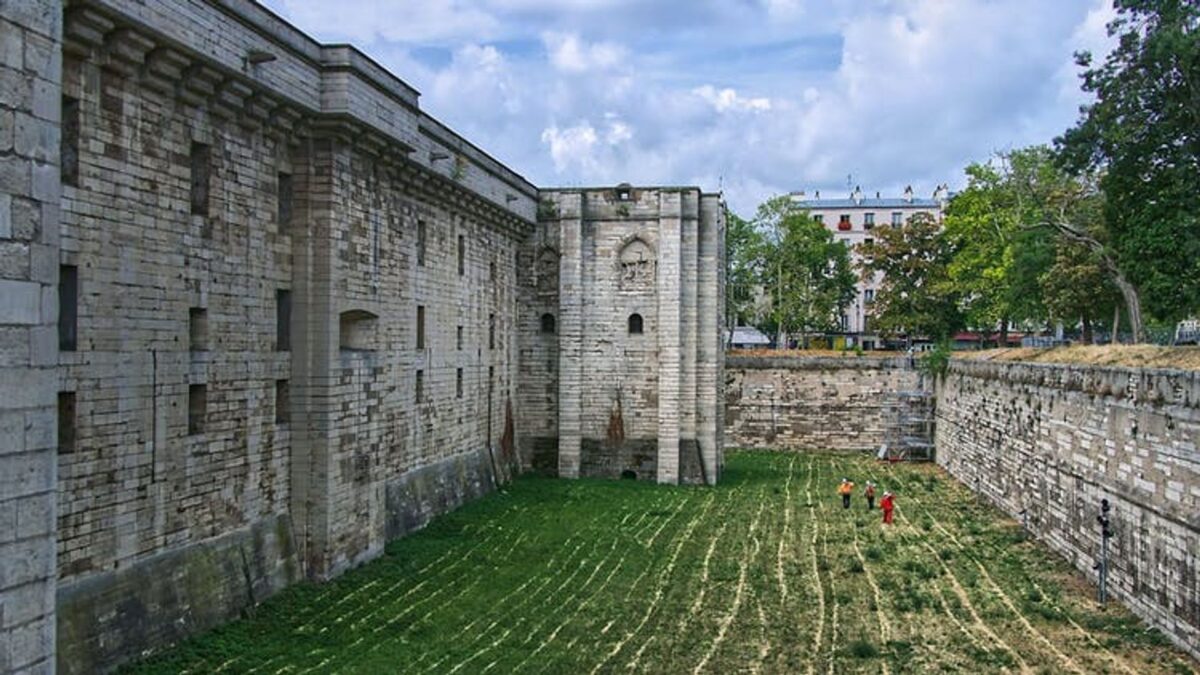
The château forms a rectangular perimeter exceeding one kilometer in length (330m × 175m), making it one of the largest medieval constructions ever attempted. Six towers and three gates, each originally rising 42 meters high, create a fortification system surrounded by a deep stone-lined moat that demonstrates medieval military engineering at its most sophisticated.
<\!-- /wp:paragraph --><\!-- wp:paragraph -->
This comprehensive defensive system reflected the château\u2019s dual function as royal residence and military stronghold, providing security during periods of political instability while maintaining the ceremonial spaces necessary for royal court life and diplomatic functions.
<\!-- /wp:paragraph --><\!-- wp:heading {"level":3} -->
Sainte-Chapelle de Vincennes and Flamboyant Gothic artistry
<\!-- /wp:heading --><\!-- wp:paragraph -->
The châteauu2019s Sainte-Chapelle, begun in 1379 but not completed until 1552, represents an exceptional example of Flamboyant Gothic architecture with perfectly preserved stained-glass windows created to house relics of the Passion of Christ. This chapel demonstrates how royal religious architecture evolved to serve both spiritual and political purposes within fortified complexes.
<\!-- /wp:paragraph --><\!-- wp:paragraph -->
The lengthy construction period reflects changing architectural tastes and political circumstances while creating a unified sacred space that honors both divine authority and royal power. The chapel\u2019s artistic program reinforces the château\u2019s role as a center of both temporal and spiritual authority.
<\!-- /wp:paragraph --><\!-- wp:heading {"level":3} -->
From royal sanctuary to notorious prison
<\!-- /wp:heading --><\!-- wp:paragraph -->
From the 15th to 19th centuries, the donjon served as a state prison, housing infamous figures including Fouquet, the Marquis de Sade (who spent seven years here writing “Justine”), and Mirabeau. This transformation from royal residence to place of detention reflects changing French attitudes toward royal authority and the practical reuse of medieval fortifications for state security purposes.
<\!-- /wp:paragraph --><\!-- wp:paragraph -->
The prison function demonstrates how medieval architecture could adapt to serve different governmental needs while maintaining its essential character as a symbol of state power and authority.
<\!-- /wp:paragraph --><\!-- wp:heading {"level":3} -->
Architectural preservation and contemporary access
<\!-- /wp:heading --><\!-- wp:paragraph -->
Today, the Château de Vincennes offers visitors comprehensive access to medieval royal architecture and military engineering through guided tours of state rooms, fortifications, and the magnificent donjon. The château\u2019s preservation allows contemporary audiences to experience the scale and sophistication of medieval royal life while understanding the defensive concerns that shaped fortress design.
<\!-- /wp:paragraph --><\!-- wp:paragraph -->
For visitors to Paris interested in medieval architecture, royal history, or military fortification, the Château de Vincennes provides an unparalleled encounter with authentic medieval royal residence that remains substantially intact. The combination of Europe\u2019s tallest keep, comprehensive fortification system, and beautiful Flamboyant Gothic chapel creates one of France\u2019s most complete medieval architectural ensembles, demonstrating how royal builders could achieve both defensive effectiveness and residential magnificence within unified architectural vision.
<\!-- /wp:paragraph -->