
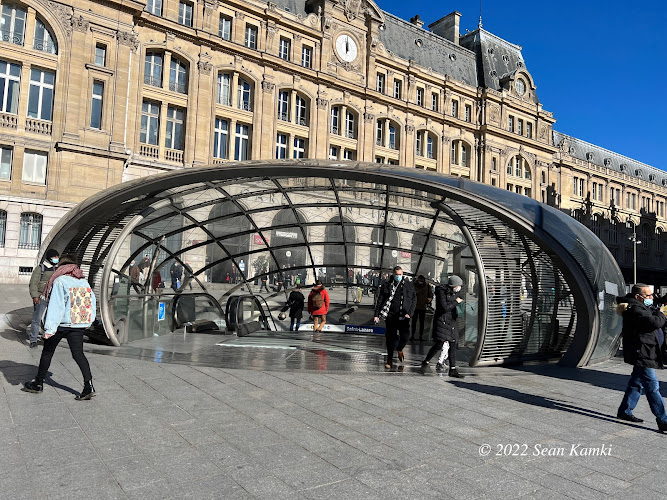
Description
The Édicule Guimard of the Saint-Lazare station, Rue de Rome in Paris, France is a historical and architectural landmark. Designed by the architects Édouard Guimard and Émile Louis Laugier, and built in 1894, it is one of the most important examples of the Art Nouveau architectural style. The Édicule Guimard of the Saint-Lazare station is located in the 8th arrondissement of Paris, France and is a must-visit destination for anyone interested in the history and architecture of Paris.
Principales caractéristiques
The Édicule Guimard of the Saint-Lazare station is a remarkable example of Art Nouveau architecture, designed by Hector Guimard. Its distinctive floral and organic motifs make it a must-see for architecture enthusiasts and art lovers. The monument holds historical significance as it represents the innovative design style of the early 20th century.
Accessibilité et commodités
The museum is equipped with accessibility features to accommodate visitors with disabilities, including wheelchair access and facilities. Amenities include restrooms, and visitors can avail themselves of audio guides to enhance their experience. Additionally, the museum offers a gift shop where visitors can find unique souvenirs related to Art Nouveau and the monument itself.
Planifier votre visite
To avoid crowds, it is recommended to visit the monument during off-peak hours, typically early morning or late afternoon. Visitors usually spend around 1-2 hours exploring the monument and its surroundings. A suggested itinerary includes exploring the Art Nouveau architectural details of the monument, followed by a leisurely stroll through the surrounding neighborhood to appreciate other Art Nouveau structures in the area.
An Art Nouveau Detail at Saint-Lazare
The Édicule Guimard of the Saint-Lazare station brings Art Nouveau design into the everyday setting of a Paris Métro entrance. On Rue de Rome, its green cast-iron forms and amber glass lanterns reward a closer look amid the movement around the station. It is a compact architectural stop rather than a monument with an interior sightseeing route.
Designed by Hector Guimard for the Paris Métro around 1900, the entrance belongs to the surviving examples of his distinctive approach to transport architecture. Organic curves give the ironwork a plant-like character, making a functional street structure feel carefully composed. Its interest lies in that combination: infrastructure designed to serve passengers while giving the emerging Métro a recognisable visual identity.
Rue de Rome and the Saint-Lazare Neighborhood
The entrance is on Rue de Rome in the 8th arrondissement, beside one of Paris’s major transport hubs. Expect a working station district, with commuters, traffic and busy crossings rather than a quiet monument square. Look specifically for the Métro entrance: the main railway station and the Guimard structure are different architectural subjects.
This stop fits naturally into a walk through the shopping streets toward the department-store district and Opéra. The surrounding streets offer a useful contrast between Guimard’s flowing ironwork and the more regular lines of Parisian stone façades. The Seine is not immediately beside Saint-Lazare, so treat a riverside walk as a separate leg rather than an extension around the corner.
Ce qu'il faut chercher
- Organic cast iron: Follow the curves of the green metalwork to see how Guimard gives an industrial material a naturalistic appearance.
- Amber glass lanterns: Their colour provides a contrast with the green structure and is a characteristic element of this design.
- Architecture at street level: Consider the entrance as part of the pavement and passenger route, not as an isolated sculpture.
- A focused stop: The entrance suits Art Nouveau enthusiasts, photographers and walkers who enjoy small architectural details without planning a lengthy indoor visit.
Planning Your Stop
Choose daylight for studying the ironwork and glass. If your schedule allows, try mid-morning outside the main commuting rush; pedestrian activity still depends on station traffic. Keep the visit flexible and brief, allowing time to look from more than one angle without blocking the stairs or passenger flow.
Plan this as an exterior architecture stop, not a timed museum visit. For photographs, step aside from the entrance and wait for a clear view rather than stopping people on the stairs. If you also intend to use the Métro, check current transport information separately, including any accessibility arrangements you need.
Questions fréquemment posées
Who designed the entrance?
Hector Guimard designed it for the Paris Métro around 1900, using the organic forms associated with Art Nouveau.
Where is it located?
It is on Rue de Rome in the 8th arrondissement, in the Saint-Lazare station area.
Is it a museum visit?
No. The subject is a Métro entrance whose architectural details are viewed from the street. Combine it with a neighborhood walk.