
Photo Gallery
[su_content_slider style="dark" autoplay="0"] [su_content_slide]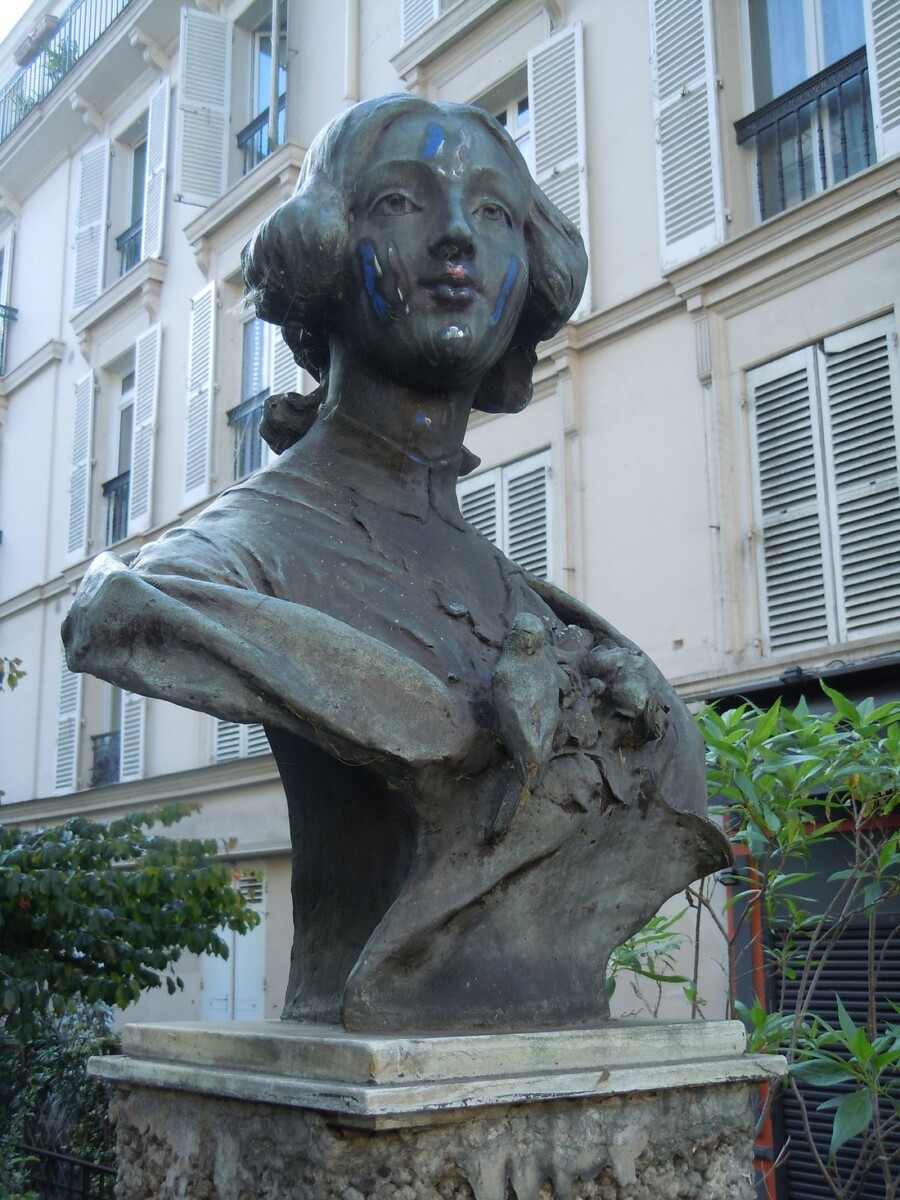 [/su_content_slide]
[su_content_slide]
[/su_content_slide]
[su_content_slide] [/su_content_slide]
[su_content_slide]
[/su_content_slide]
[su_content_slide] [/su_content_slide]
[/su_content_slider]
[/su_content_slide]
[/su_content_slider]
Top-Rated Tours in Paris
The Buste de Clotilde de Vaux is a small bronze monument in Square Clotilde de Vaux, in Paris’s 11th arrondissement. Add it to a walk around Boulevard Beaumarchais for a documented link to Auguste Comte and the history of positivism. Use the passage between 47 rue Amelot and 56 boulevard Beaumarchais to find it.
What is the Buste de Clotilde de Vaux?
The Buste de Clotilde de Vaux is a bronze portrait monument to Clotilde de Vaux (1815-1846), known for her connection to philosopher Auguste Comte. The City of Paris received the work in 1989 from Brazilian positivists; the monument catalogue identifies its sculptor as Decio Villares.
Quick fact | Verified detail |
|---|---|
Emplacement | Square Clotilde de Vaux, passage between 47 rue Amelot and 56 boulevard Beaumarchais, 11th arrondissement |
Ouvrages d'art | Bronze bust of Clotilde de Vaux |
Sculptor | Decio Villares (1851-1931) |
City ownership | Ville de Paris |
Gift to Paris | 1989, from Brazilian positivists |
Useful Metro stop | Chemin Vert, line 8 |
Where is the bust, and how do you find it?
The bust stands in Square Clotilde de Vaux, a small passage linking the area around rue Amelot and Boulevard Beaumarchais. The official monument record gives the passage between 47 rue Amelot and 56 boulevard Beaumarchais as the current location. Chemin Vert on Metro line 8 is the practical starting point; enter the full address in your map app before setting out.
This is a brief outdoor heritage stop, best paired with a walk through the nearby Marais or Bastille area. For larger landmark planning, use our Paris monuments guide et Metro stations guide.
Who was Clotilde de Vaux?
Clotilde de Vaux was born in Paris in 1815 and died there in 1846. The City of Paris and the Maison d’Auguste Comte describe how she met Comte in 1844. Their correspondence and her death shaped his later religious positivism, which is why her name appears in Parisian public space and in the history of Comte’s thought.
The Maison d’Auguste Comte records 183 letters exchanged in a little more than a year. It also describes Clotilde’s work to support herself through writing after an unhappy marriage. Her 1844 novel Lucie is part of the documented record; sweeping claims about a large body of poetry or public literary fame are not needed to understand the monument.
Année | Documented event |
|---|---|
1815 | Clotilde de Vaux is born in Paris. |
1835 | She marries Amedee de Vaux. |
1839 | Her husband flees to Belgium after accusations of misappropriating public funds, according to the Maison d’Auguste Comte. |
1844 | She meets Auguste Comte and publishes Lucie. |
1845 | Comte writes to her and their intense correspondence begins. |
1846 | Clotilde de Vaux dies in Paris. |
What can you see at the monument?
The City of Paris identifies the sculpture as a bronze by Decio Villares, a Brazilian artist who lived from 1851 to 1931. Its public-art description draws attention to the composed pose, simple hairstyle, flowers, and bird on Clotilde’s bodice. Those details give the work a more useful reading point than a generic claim that it is a major attraction.
The location is part of the experience. The monument catalogue calls it Square Clotilde de Vaux and gives a passage between rue Amelot and Boulevard Beaumarchais. Pause to read the plaque and view the bust, then continue your walk. The catalogue’s 2023 and 2025 field-survey notes make it a stronger source for the work’s current location than unsourced map snippets or generic review text.
Why does this modest monument matter?
The work has a specific international history: Brazilian positivists offered it to Paris in 1989. That detail connects a quiet 11th-arrondissement monument with the wider afterlife of Comte’s ideas in Brazil. The monument catalogue also confirms that the City of Paris owns it and recorded it in a 2025 field survey.
Clotilde’s importance in this context comes from Comte’s response to their relationship and to her death. The City of Paris says that his later religious positivism developed after her death. The Maison d’Auguste Comte preserves objects and correspondence connected with that history. This makes the bust useful for readers interested in Paris beyond the familiar museum circuit.
Two other sites can help visitors separate the people, artworks, and places involved. The Auguste Comte monument at Place de la Sorbonne is a different work. It includes a representation of Clotilde de Vaux within a larger monument to Comte. The Buste de Clotilde de Vaux in the 11th arrondissement is the Villares bronze documented on this page.
The Maison d’Auguste Comte is at 10 rue Monsieur-le-Prince in the 6th arrondissement. Its site lists Tuesday and Wednesday opening hours of 2 p.m. to 5 p.m., with an adult admission price of EUR 4. Check its official page before travelling, since opening times can change. The house preserves objects associated with Comte and Clotilde, including a chair identified as hers.
Site | What it adds | How to use it |
|---|---|---|
Square Clotilde de Vaux | The Villares bronze bust donated in 1989 | Use the 11th-arrondissement passage address |
Place de la Sorbonne | A separate monument to Auguste Comte that includes a figure of Clotilde | Use it to understand the public commemoration of Comte |
Maison d’Auguste Comte | Objects and biography connected with Comte and Clotilde | Check the museum’s own opening details before visiting |
How can you add the bust to a Paris itinerary?
Add the square to a flexible walking route through the 11th arrondissement, then continue toward the Marais or Bastille according to your plans. The bust works best as a short, focused stop for readers interested in public art, women commemorated in Paris, or the history of ideas. If your time is limited, prioritize the exact location and the two or three verified details above over a long detour.
For broader planning, see our things to do in Paris guide and the nearby Maison Colbert member of Melia Collection hotel profile. ParisTopTen may earn a commission, at no extra cost to you, when you book through selected partner links. If you are adding major attractions to the same day, compare current options for the Persienne.
You can also browse Paris travel ideas on TripAdvisor or review current Paris attraction options on TripAdvisor.
Sources and update method
Last updated July 21, 2026. This page was checked against the Musee d’Orsay monument catalogue, le City of Paris public-art record, et le Maison d’Auguste Comte biography. Check a current transit map before travelling because service conditions can change.