
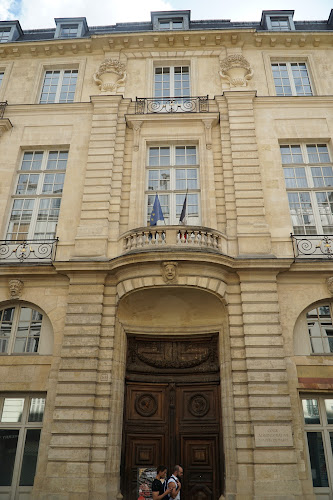
Hôtel de Beauvais
Hôtel de Beauvais is a Paris Tribunal Administratif landmark located in the 4 arrondissement. Royal favor builds baroque masterpiece At 68 rue François Miron in the heart of the Marais, Hôtel de Beauvais stands as one of the most intriguing aristocratic mansions in Paris, where royal scandal and architectural genius combined to create a baroque […]
Hôtel de Beauvais is a Paris Tribunal Administratif landmark located in the 4 arrondissement.
Royal favor builds baroque masterpiece
At 68 rue François Miron in the heart of the Marais, Hôtel de Beauvais stands as one of the most intriguing aristocratic mansions in Paris, where royal scandal and architectural genius combined to create a baroque masterpiece. Built between 1654 and 1660 by Antoine Le Pautre for Catherine Bellier, Baroness de Beauvais—Anne of Austria\s trusted chambermaid and confidante—this extraordinary residence demonstrates how royal favor could transform servants into aristocrats capable of commissioning architectural wonders.
Catherine “Catheau la Borgnesse” and royal secrets
Catherine Bellier, known as “Catheau la Borgnesse,” served as first chambermaid to Queen Anne of Austria and earned exceptional royal favor through her loyalty and discretion. According to court legend, the Queen rewarded Catherine with the funds to build this magnificent mansion in gratitude for successfully completing a most delicate mission: ensuring the young Louis XIV\s introduction to adult pleasures.
This scandalous but essential court service transformed a chambermaid into a baroness with sufficient wealth to commission one of Paris\s most sophisticated private residences, demonstrating how proximity to royal power could create opportunities for dramatic social advancement in 17th-century France.
Antoine Le Pautre\s architectural innovation
Royal architect Antoine Le Pautre faced the challenge of creating a grand residence on an irregular and enclosed plot, responding with innovative design solutions that turned constraints into opportunities. Le Pautre\s genius lay in creating an original building with a uniquely shaped cour d\honneur that respects symmetry principles while accommodating the awkward site.
The architect played masterfully with the plot\s asymmetry, creating undulating façades that transform potential architectural problems into distinctive beauty. The façade features ram heads (béliers) as decorative elements, a clever architectural pun referencing Catherine Bellier\s maiden name while adding sculptural interest to the baroque composition.
Baroque splendor and architectural mastery
From royal residence to judicial palace
Heritage preservation and public access
Essential information
- Construction: 1654-1660
- Architect: Antoine Le Pautre (royal architect)
- Original owners: Pierre de Beauvais and Catherine Bellier, Baroness de Beauvais
- Royal connection: Catherine Bellier, Anne of Austria\s first chambermaid
- Emplacement: 68 rue François Miron, 4th arrondissement
- Architectural style: French baroque, irregular plot adaptation
- Current use: Administrative Court of Appeal of Paris
- Heritage status: Historic monument (2004)
Visiting context
- Public access: Heritage Days and special events
- Architectural highlights: Unique irregular courtyard, undulating façades, ram head decorations
- Historical significance: Built with royal favor, testament to social mobility
- Cultural context: Example of court intrigue translating to architectural commission
- Preservation status: Extensive restoration for judicial use (1995)