
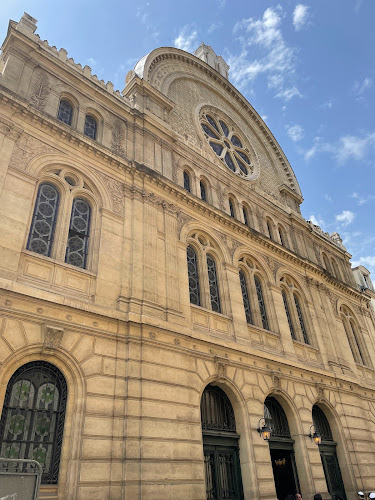
Synagogue de la rue des Tournelles
Tournelles Synagogue is a Paris Attractions landmark located in the 4 arrondissement. Eiffel’s iron innovation meets Sephardic tradition At 21 bis rue des Tournelles in the heart of the Marais, Synagogue des Tournelles stands as Paris’s second-largest synagogue and a remarkable testament to Jewish integration and architectural innovation. Built in 1876 during the Second Empire […]
Tournelles Synagogue is a Paris Attractions landmark located in the 4 arrondissement.
Eiffel’s iron innovation meets Sephardic tradition
At 21 bis rue des Tournelles in the heart of the Marais, Synagogue des Tournelles stands as Paris’s second-largest synagogue and a remarkable testament to Jewish integration and architectural innovation. Built in 1876 during the Second Empire and featuring pioneering iron construction from Gustave Eiffel’s workshops—over a decade before his famous tower—this extraordinary synagogue demonstrates how Jewish communities achieved architectural prominence while preserving religious tradition within the evolving cultural landscape of 19th-century Paris.
Second Empire integration and Napoleon III’s legacy
Construction began under Napoleon III and was completed shortly after the Empire’s fall, symbolizing the integration of French Jews into the booming society and economy of the Second Empire. This architectural achievement built upon Napoleon I’s foundational work creating the Consistoire system that established official Jewish religious organization in France.
The synagogue’s completion in 1876, dedicated on September 15 during Jewish New Year celebrations, represented the culmination of Jewish emancipation that enabled communities to build magnificent religious architecture rivaling Christian churches in scale and artistic sophistication.
Gustave Eiffel’s engineering innovation in sacred space
Designed by Marcellin-Emmanuel Varcollier, a pupil of Louis-Pierre Baltard, the synagogue showcases pioneering metal construction with visible iron inner structure built in Gustave Eiffel’s workshops more than ten years before his Tower. The two rows of galleries, made entirely of iron and cast iron, provide both structural support and decorative ornament.
This innovative use of industrial materials demonstrates how Jewish communities embraced cutting-edge engineering while maintaining traditional liturgical requirements. The iron construction enabled the large spans necessary for congregational worship while creating distinctive architectural identity that honored both modern French technical achievement and ancient Jewish religious practice.
Architectural splendor and religious symbolism
The synagogue’s Romanesque Revival and Byzantine Revival façade features a magnificent stained-glass rose window and sculptures depicting Torah scrolls with Hebrew text, creating architectural dialogue between Jewish religious symbolism and European artistic traditions. The large nave accommodates 1,340 worshippers, while the Holy Ark protected by double wrought-iron doors creates focal point for liturgical worship.
The two-floor interior design reflects both practical congregational needs and traditional Jewish architectural principles, where separate seating areas maintain religious requirements while the innovative iron galleries create unprecedented spatial effects within synagogue design.
From Ashkenazi foundation to Sephardic transformation
Originally consecrated to the Ashkenazi rite in 1876, the synagogue welcomed Jewish refugees from Alsace and Lorraine after 1871, and later from Poland, Russia, and Central Europe fleeing persecution. This period established the synagogue as a crucial sanctuary for Eastern European Jewish communities seeking refuge in Paris.
About a century later, demographic shifts transformed Tournelles into a Sephardic temple serving the Constantinian rite, reflecting the arrival of North African Jewish communities from Morocco, Tunisia, and Algeria during the 1950s and 1960s. This transition demonstrates how synagogue architecture can adapt to serve different Jewish traditions while maintaining its essential religious function.
Marais Jewish heritage and community continuity
The synagogue exists within the broader context of the Marais’s Jewish quarter, which has housed Paris’s most significant Jewish community since the 13th century. The Pletzl area welcomed tens of thousands of Eastern European Jews until World War II, creating a vibrant Yiddish-speaking community that established the neighborhood’s enduring Jewish character.
Today’s diverse Sephardic congregation continues this tradition of Jewish life in the Marais, maintaining religious practice and cultural heritage within architectural spaces that connect contemporary worship to over a century of Jewish presence in this historic neighborhood.
Essential information
- Construction: 1876 (Second Empire)
- Architect: Marcellin-Emmanuel Varcollier
- Engineering: Gustave Eiffel’s workshops (iron construction)
- Capacité: 1,340 worshippers (second-largest synagogue in Paris)
- Original dedication: Ashkenazi rite (1876)
- Current use: Sephardic Constantinian rite
- Emplacement: 21 bis rue des Tournelles, 4th arrondissement
- Architectural style: Romanesque and Byzantine Revival
Architectural and cultural features
- Innovation: Pioneering iron galleries predating tour Eiffel
- Decorative elements: Stained-glass rose window, Torah scroll sculptures
- Community evolution: From Eastern European Ashkenazi to North African Sephardic
- Marais context: Central to historic Parisian Jewish quarter
- Religious significance: Major Orthodox congregation serving diverse traditions
Jewish architectural heritage
Synagogue des Tournelles embodies the successful integration of Jewish communities into French architectural and cultural life, where Gustave Eiffel’s engineering innovation served religious tradition while creating spaces that honored both Jewish heritage and French technical excellence. This remarkable synagogue demonstrates how religious architecture can embrace contemporary technology while preserving ancient liturgical traditions, creating sacred spaces that serve evolving communities across generations. For Jewish heritage enthusiasts, architectural historians, or anyone interested in how immigrant communities create lasting cultural institutions, the Tournelles synagogue offers an extraordinary encounter with Jewish architectural achievement, where Second Empire engineering meets Sephardic tradition beneath iron galleries that transformed synagogue design while maintaining the essential spiritual character that has anchored Jewish life in the Marais for over 700 years.