
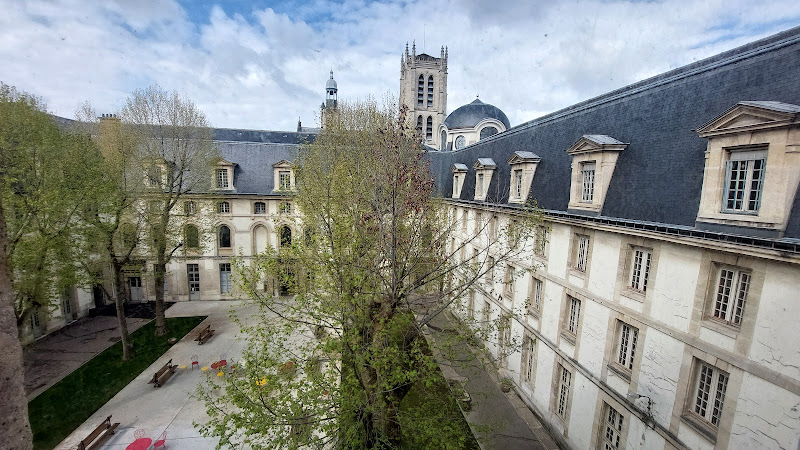
Lycée Henri-IV
Lycée Henri-IV is a Paris Lycée landmark located in the 5 arrondissement. Table of ContentsThe prestigious lycée built upon Clovis\u2019s abbey and Sainte Geneviève\u2019s legacyThe Clovis Tower and medieval architectural heritageRevolutionary transformation and Napoleonic educational visionContemporary academic excellence and grandes écoles preparationSacred heritage and intellectual continuityNearby in 5 The prestigious lycée built upon Clovis\u2019s abbey […]
Lycée Henri-IV is a Paris Lycée landmark located in the 5 arrondissement.
<\!-- wp:heading -->
Table des matières
- The prestigious lycée built upon Clovis\u2019s abbey and Sainte Geneviève\u2019s legacy
- The Clovis Tower and medieval architectural heritage
- Revolutionary transformation and Napoleonic educational vision
- Contemporary academic excellence and grandes écoles preparation
- Sacred heritage and intellectual continuity
- Nearby in 5
The prestigious lycée built upon Clovis\u2019s abbey and Sainte Geneviève\u2019s legacy
<\!-- /wp:heading --><\!-- wp:paragraph -->
At 23 rue Clovis in the 5th arrondissement, Lycée Henri-IV occupies one of Paris\u2019s most historically layered sites, where over 1,500 years of French educational and spiritual tradition converge within the buildings of the former Abbey Sainte-Geneviève. Founded in 510 when Clovis established a sanctuary dedicated to apostles Peter and Paul, this location has served continuous educational missions from medieval monasticism through contemporary academic excellence, making it one of France\u2019s most prestigious and historically significant schools.
<\!-- /wp:paragraph --><\!-- wp:paragraph -->
The school\u2019s evolution from Clovis\u2019s royal abbey to Napoleon\u2019s Lycée Napoléon (1804) to the current Lycée Henri-IV (renamed in 1815) demonstrates how educational institutions can maintain excellence while adapting to serve changing political and social contexts. This continuity makes the school a living monument to French educational tradition and intellectual achievement.
<\!-- /wp:paragraph --><\!-- wp:heading {"level":3} -->
The Clovis Tower and medieval architectural heritage
<\!-- /wp:heading --><\!-- wp:paragraph -->
The school\u2019s most famous feature is the Clovis Tower, the surviving remnant of the abbey church rebuilt around 1180, which stands as a testament to the site\u2019s medieval religious heritage and architectural continuity. This Romanesque tower, combined with the 13th-century refectory, 1746 cloister, and 18th-century staircase, creates a comprehensive architectural ensemble that spans nearly a millennium of French building tradition.
<\!-- /wp:paragraph --><\!-- wp:parameter --><\!-- wp:paragraph -->
The preservation of these medieval and early modern architectural elements within a functioning contemporary school demonstrates how educational institutions can honor their historical heritage while serving modern academic needs, creating environments where students can experience tangible connections to French cultural and spiritual tradition.
<\!-- /wp:paragraph --><\!-- wp:heading {"level":3} -->
Revolutionary transformation and Napoleonic educational vision
<\!-- /wp:heading --><\!-- wp:parameter --><\!-- wp:paragraph -->
The abbey\u2019s secularization during the Revolution and subsequent assignment to education from 1796—first as the École Centrale du Panthéon, then as Lycée Napoléon in 1804—reflects revolutionary commitment to transforming religious institutions to serve republican educational purposes. This transformation demonstrates how sacred spaces could be adapted to secular learning while maintaining their essential character as places dedicated to knowledge and intellectual development.
<\!-- /wp:paragraph --><\!-- wp:parameter --><\!-- wp:paragraph -->
Napoleon\u2019s choice of this historic site for one of his educational institutions reflects understanding of how ancient learning traditions could enhance contemporary academic missions while providing students with inspiring environments that connect them to France\u2019s intellectual and spiritual heritage.
<\!-- /wp:paragraph --><\!-- wp:heading {"level":3} -->
Contemporary academic excellence and grandes écoles preparation
<\!-- /wp:heading --><\!-- wp:parameter --><\!-- wp:paragraph -->
Today, with 2,600 students, Lycée Henri-IV maintains its position alongside Lycée Louis-le-Grand as one of France\u2019s most prestigious and demanding secondary schools, renowned for exceptional baccalauréat results and successful preparation for grandes écoles entrance examinations. This academic excellence continues the institution\u2019s historical mission of intellectual leadership while adapting to contemporary educational challenges.
<\!-- /wp:paragraph --><\!-- wp:parameter --><\!-- wp:paragraph -->
The school\u2019s location on Montagne Sainte-Geneviève, surrounded by the Sorbonne, Panthéon, and other major educational institutions, reinforces its role within the Latin Quarter\u2019s concentrated intellectual ecosystem while maintaining direct connection to the patron saint of Paris through its architectural heritage.
<\!-- /wp:paragraph --><\!-- wp:heading {"level":3} -->
Sacred heritage and intellectual continuity
<\!-- /wp:heading --><\!-- wp:parameter --><\!-- wp:paragraph -->
The burial of Clovis (511) and Saint Geneviève (512) at this site establishes its profound significance in French religious and royal history, creating sacred foundations that continue to influence the school\u2019s character and mission. The preservation of medieval architectural elements within contemporary educational use demonstrates how ancient spiritual dedication to learning can inspire ongoing academic excellence.
<\!-- /wp:paragraph --><\!-- wp:parameter --><\!-- wp:paragraph -->
For visitors to Paris interested in French educational history, medieval architecture, or the intersection of sacred and secular learning traditions, Lycée Henri-IV offers an exceptional encounter with 1,500 years of continuous dedication to knowledge and intellectual development. The school proves that great educational institutions emerge when ancient learning traditions meet contemporary academic excellence, creating environments where historical heritage inspires ongoing intellectual achievement while honoring the spiritual and cultural foundations that have shaped French civilization.
<\!-- /wp:paragraph -->