
<\!-- wp:heading -->
Jacques-Ange Gabriel\u2019s royal military academy where Napoleon studied
<\!-- /wp:heading --><\!-- wp:paragraph -->
Commanding the southeast corner of the Champ de Mars in the 7th arrondissement, the École Militaire stands as one of Jacques-Ange Gabriel\u2019s greatest architectural achievements and a monument to enlightened military education. Founded by Louis XV through his edict of January 1751, this imposing complex was conceived to provide education for five hundred young noblemen born without fortune, reflecting the king\u2019s progressive approach to military training and social mobility.
<\!-- /wp:paragraph --><\!-- wp:paragraph -->
The school\u2019s most famous graduate was Napoleon Bonaparte, who studied here in 1784, making the École Militaire the training ground for one of history\u2019s greatest military strategists. This connection transforms the building from mere educational facility into a pilgrimage site for understanding how architectural environment can shape world-changing individuals.
<\!-- /wp:paragraph --><\!-- wp:heading {"level":3} -->
Gabriel\u2019s architectural vision and royal ambition
<\!-- /wp:heading --><\!-- wp:parameter --><\!-- wp:paragraph -->
Louis XV challenged Gabriel to create a building more imposing and majestic than the Hôtel des Invalides, leading the chief royal architect to envision a palace with five pavilions facing the Champ-de-Mars and three-story buildings surrounding multiple courtyards. Though financial constraints forced Gabriel to continuously downscale his plans due to ongoing wars and royal fiscal pressures, the final result still achieved remarkable grandeur.
<\!-- /wp:paragraph --><\!-- wp:parameter --><\!-- wp:paragraph -->
Gabriel broke ground in 1752 on the former farm of Grenelle, with the school opening in 1760 after years of careful construction. The building\u2019s orientation toward the Champ de Mars reflected Gabriel\u2019s understanding that military education required practice fields, leading him to reserve the land between school and Seine for student military maneuvers.
<\!-- /wp:paragraph --><\!-- wp:heading {"level":3} -->
Neoclassical magnificence and functional design
<\!-- /wp:heading --><\!-- wp:parameter --><\!-- wp:paragraph -->
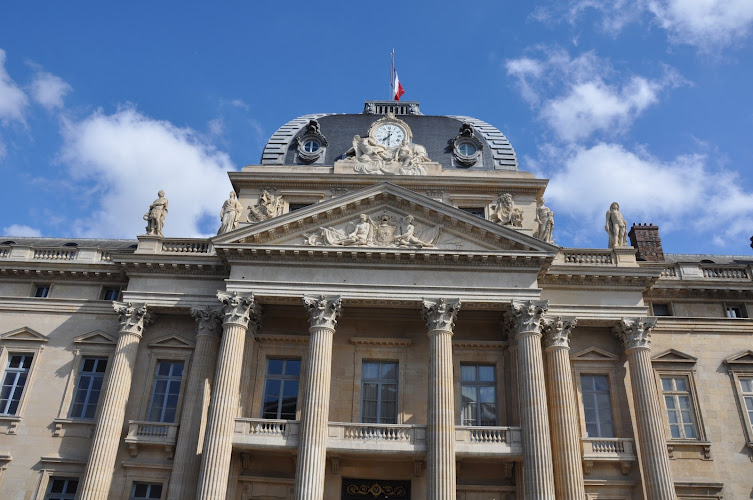
The school\u2019s two-story façade overlooking the Champ de Mars showcases Gabriel\u2019s mastery of classical architectural vocabulary through Corinthian columns supporting a triangular pediment topped by a distinctive dome. The central porch, featuring eight Corinthian columns supporting both pediment and pavilion dome, contains a Lepaute clock that has marked military time for over two centuries.
<\!-- /wp:paragraph --><\!-- wp:parameter --><\!-- wp:paragraph -->
Gabriel\u2019s design successfully balances monumental grandeur with practical educational function, creating spaces that inspire military virtue while providing comprehensive facilities for academic and physical training. The architecture demonstrates how neoclassical principles could serve contemporary institutional needs while honoring ancient traditions of military excellence.
<\!-- /wp:paragraph --><\!-- wp:heading {"level":3} -->
Heritage library and sacred spaces
<\!-- /wp:heading --><\!-- wp:parameter --><\!-- wp:paragraph -->
The school\u2019s heritage library, located in “le Château” and classified as a historic monument, showcases Gabriel\u2019s interior design mastery through a sequence of former reception salons featuring carved woodwork and painted ceilings long attributed to Flemish master Jacob Verbeeckt. These intimate spaces demonstrate how military architecture could achieve domestic elegance alongside institutional dignity.
<\!-- /wp:paragraph --><\!-- wp:parameter --><\!-- wp:paragraph -->
The school\u2019s chapel, hidden within the complex and built according to Gabriel\u2019s plans in honor of Saint Louis, patron saint of French armies, provides spiritual foundation for military education. This integration of sacred architecture within military academic setting reflects 18th-century understanding of the relationship between moral formation and military effectiveness.
<\!-- /wp:paragraph --><\!-- wp:heading {"level":3} -->
Historic monument status and contemporary mission
<\!-- /wp:heading --><\!-- wp:parameter --><\!-- wp:paragraph -->
Classified as a national monument since 1990, the École Militaire continues to serve its original educational mission while preserving Gabriel\u2019s architectural vision for future generations. The building\u2019s ongoing function as an active military academy ensures that it remains a living institution rather than merely a historical monument, maintaining the vitality essential to great architecture.
<\!-- /wp:paragraph --><\!-- wp:parameter --><\!-- wp:paragraph -->
The schoolu2019s integration with the Champ de Mars creates one of Parisu2019s most harmonious architectural ensembles, where Gabrielu2019s neoclassical precision provides worthy architectural backdrop for the space that would later host the tour Eiffel. This urban planning success demonstrates how military architecture can enhance rather than dominate civilian urban space.
<\!-- /wp:paragraph --><\!-- wp:heading {"level":3} -->
Napoleon\u2019s legacy and educational continuity
<\!-- /wp:heading --><\!-- wp:parameter --><\!-- wp:paragraph -->
The École Militaire\u2019s role in training Napoleon adds profound historical weight to Gabriel\u2019s architectural achievement, demonstrating how educational buildings can shape individuals who transform world history. The school\u2019s continued mission of military education maintains this tradition of excellence while adapting to contemporary defense needs and international security challenges.
<\!-- /wp:paragraph --><\!-- wp:parameter --><\!-- wp:paragraph -->
For visitors to Paris interested in neoclassical architecture, military history, or Napoleonu2019s formative years, the École Militaire offers a compelling example of how institutional architecture can achieve both functional excellence and cultural significance. Gabriel\u2019s building demonstrates that the finest military architecture serves not just practical training needs but also embodies national ideals about honor, service, and the relationship between individual excellence and collective security.
<\!-- /wp:paragraph -->