
<\!-- wp:heading -->
A unique Gothic-Renaissance synthesis housing Sainte Geneviève\u2019s shrine and Paris\u2019s only surviving rood screen
<\!-- /wp:heading --><\!-- wp:paragraph -->
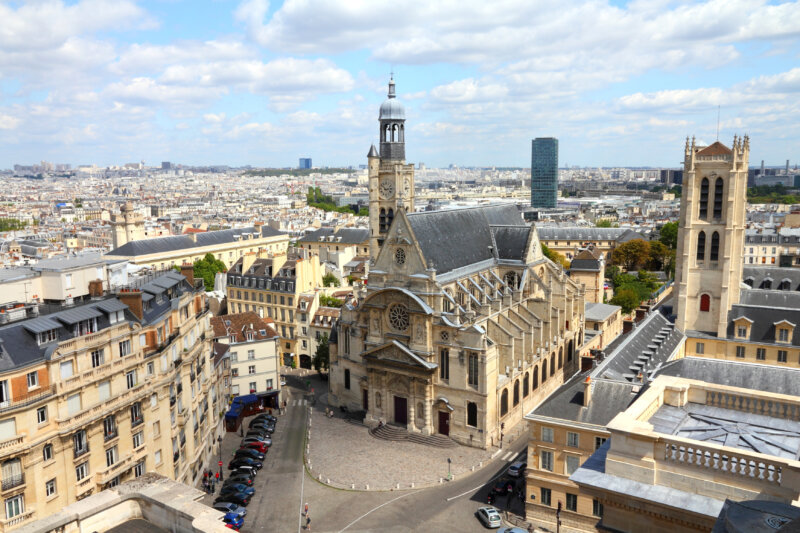
On Montagne Sainte-Geneviève in the 5th arrondissement, near the Panthéon, the Église Saint-Étienne-du-Mont stands as one of Paris\u2019s most architecturally fascinating churches and the spiritual heart of devotion to the city\u2019s patron saint. Built over 134 years from 1492 to 1623, this remarkable structure embodies the architectural transition from Gothic to Renaissance, creating a unique synthesis that demonstrates how religious buildings could adapt to evolving aesthetic sensibilities while maintaining their essential spiritual functions.
<\!-- /wp:paragraph --><\!-- wp:paragraph -->
The church\u2019s evolution from Gothic foundations through Gothic Flamboyant elaborations to Renaissance refinements creates a comprehensive architectural narrative that spans crucial periods in French cultural development, making it an essential destination for understanding how sacred architecture evolved during the French Renaissance.
<\!-- /wp:paragraph --><\!-- wp:heading {"level":3} -->
The miraculous rood screen: Paris\u2019s only surviving example
<\!-- /wp:heading --><\!-- wp:paragraph -->
The churchu2019s most treasured architectural feature is its magnificent rood screen, the sole surviving example in Paris, designed by Antoine Beaucorps and carved by Father Biard in 1545. This extraordinary stone screen, crossing the nave with support from spiral staircases on either side, combines Gothic structural purpose with Renaissance decorative sensibility, creating one of French religious architecture\u2019s most remarkable artistic achievements.
<\!-- /wp:paragraph --><\!-- wp:parameter --><\!-- wp:paragraph -->
The screen\u2019s survival through centuries when most rood screens were demolished during liturgical reforms makes it an irreplaceable document of 16th-century religious art and architectural craftsmanship. The richly carved stone panels demonstrate how French artisans could integrate Renaissance artistic principles with traditional Gothic spatial organization, creating unified sacred environments that serve both liturgical and aesthetic purposes.
<\!-- /wp:paragraph --><\!-- wp:heading {"level":3} -->
Sainte Geneviève\u2019s shrine and pilgrimage tradition
<\!-- /wp:heading --><\!-- wp:parameter --><\!-- wp:paragraph -->
The church houses the shrine of Saint Geneviève, patron saint of Paris, whose original tomb and relics were tragically destroyed during the French Revolution when fire consumed the Abbey of Sainte-Geneviève. The surviving fragments—including her burial stone encased in gold lattice and minor relics housed in a glass cylinder—were transferred to Saint-Étienne-du-Mont, making it the primary center for devotion to Paris\u2019s protective saint.
<\!-- /wp:paragraph --><\!-- wp:parameter --><\!-- wp:paragraph -->
The 19th-century chasse (reliquary) of chiseled and gilded copper, containing fragments of her original tomb, maintains the pilgrimage tradition that has drawn Parisians to seek Saint Geneviève\u2019s intercession for over 1,500 years. This continuity demonstrates how religious institutions can preserve spiritual traditions through historical upheavals while adapting to serve contemporary devotional needs.
<\!-- /wp:paragraph --><\!-- wp:heading {"level":3} -->
Notable burials and intellectual heritage
<\!-- /wp:heading --><\!-- wp:parameter --><\!-- wp:paragraph -->
The church serves as the final resting place for two giants of French intellectual life: mathematician and philosopher Blaise Pascal and playwright Jean Racine, whose tombs create a cultural pilgrimage destination for visitors interested in French classical achievement. The cemetery also contains the grave of Jean-Paul Marat, adding revolutionary history to the church\u2019s cultural significance.
<\!-- /wp:parameter --><\!-- wp:parameter --><\!-- wp:paragraph -->
This concentration of significant burials reflects the churchu2019s historical role as a spiritual and intellectual center within the Quartier latin, serving both religious community needs and broader cultural functions that attracted Franceu2019s most distinguished figures.
<\!-- /wp:paragraph --><\!-- wp:heading {"level":3} -->
<\!-- /wp:heading --><\!-- wp:parameter --><\!-- wp:paragraph -->
The church\u2019s distinctive curved axis from nave to transept creates unique spatial experiences that enhance both liturgical function and architectural interest. This geometric innovation, combined with the building\u2019s fusion of Gothic structural elements with Renaissance decorative treatments, demonstrates how French architects could create original solutions while honoring established traditions.
<\!-- /wp:paragraph --><\!-- wp:parameter --><\!-- wp:paragraph -->
The architectural synthesis achieved through 134 years of construction shows how extended building campaigns, rather than creating stylistic confusion, can produce unified sacred spaces that embody the evolution of French artistic sensibility while maintaining spiritual coherence and liturgical effectiveness.
<\!-- /wp:paragraph --><\!-- wp:heading {"level":3} -->
Living heritage and spiritual continuity
<\!-- /wp:heading --><\!-- wp:parameter --><\!-- wp:paragraph -->
Today, Saint-Étienne-du-Mont continues to serve both its spiritual mission as an active parish church and its cultural function as a repository of French religious and artistic heritage. The preservation of the unique rood screen, combined with ongoing devotion to Saint Geneviève, demonstrates how religious buildings can maintain their essential character while serving contemporary spiritual and cultural needs.
<\!-- /wp:paragraph --><\!-- wp:parameter --><\!-- wp:paragraph -->
For visitors to Paris interested in Gothic-Renaissance architecture, French religious heritage, or the evolution of sacred spaces, Saint-Étienne-du-Mont offers an exceptional encounter with architectural innovation and spiritual tradition. The church proves that great religious architecture emerges when architectural excellence serves spiritual purpose, creating sacred environments that inspire both aesthetic appreciation and religious devotion while preserving important connections to patron saints and cultural heroes who embody community values and historical identity.
<\!-- /wp:paragraph -->