
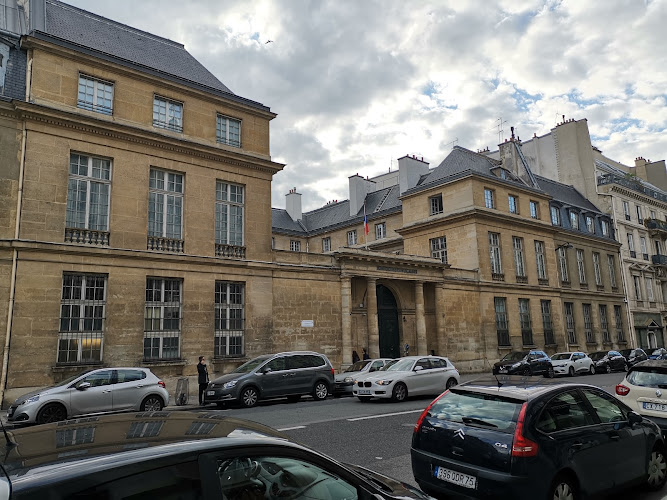
Hôtel Colbert
11 Rue de l'Hôtel Colbert is a Paris historic landmark located in the 5 arrondissement. The 18th-century mansion honoring Louis XIV\u2019s visionary finance minister At the corner of rue de l\u2019Hôtel Colbert and rue de la Bûcherie in the 5th arrondissement, the Hôtel Colbert stands as a distinguished architectural monument to one of France\u2019s most […]
11 Rue de l'Hôtel Colbert is a Paris historic landmark located in the 5 arrondissement.
<\!-- wp:heading -->
The 18th-century mansion honoring Louis XIV\u2019s visionary finance minister
<\!-- /wp:heading --><\!-- wp:paragraph -->
At the corner of rue de l\u2019Hôtel Colbert and rue de la Bûcherie in the 5th arrondissement, the Hôtel Colbert stands as a distinguished architectural monument to one of France\u2019s most influential statesmen and a refined example of 18th-century Parisian residential architecture. Named after Jean-Baptiste Colbert, Louis XIV\u2019s first Minister of State and the financial architect of the Grand Siècle, this historic mansion embodies the sophisticated urban culture that emerged during France\u2019s golden age of cultural and economic achievement.
<\!-- /wp:paragraph --><\!-- wp:paragraph -->
The mansion\u2019s location in the heart of the Sorbonne district reflects Colbert\u2019s enduring connection to intellectual and educational life, demonstrating how the great minister\u2019s vision of comprehensive national development encompassed not just economic policy but also cultural and educational advancement that would define French excellence for centuries.
<\!-- /wp:paragraph --><\!-- wp:heading {"level":3} -->
18th-century architectural refinement and decorative artistry
<\!-- /wp:heading --><\!-- wp:paragraph -->
The mansion\u2019s four-story elevation above ground level showcases typical 18th-century French architectural sophistication through carefully proportioned façades enhanced with distinctive decorative elements. The sculpted flower garlands surmounting first-floor windows and the cords adorning second-floor openings demonstrate the period\u2019s mastery of ornamental stonework and attention to decorative detail that distinguished aristocratic residences.
<\!-- /wp:paragraph --><\!-- wp:parameter --><\!-- wp:paragraph -->
These architectural refinements reflect the cultural sophistication that characterized the era following Colbert\u2019s transformative influence on French arts, crafts, and architectural standards, showing how his policies promoting excellence in design and manufacturing continued to influence French residential architecture long after his death.
<\!-- /wp:paragraph --><\!-- wp:heading {"level":3} -->
Colbert\u2019s legacy and the Grand Siècle
<\!-- /wp:heading --><\!-- wp:parameter --><\!-- wp:paragraph -->
Jean-Baptiste Colbert\u2019s role as the “promoter of the Grand Siècle” extended far beyond financial administration to encompass comprehensive cultural policy that transformed France into Europe\u2019s leading center of arts, crafts, and architectural excellence. His establishment of royal academies, support for French manufacturing, and promotion of classical architectural standards created the cultural foundation that would make Paris a global center of taste and refinement.
<\!-- /wp:paragraph --><\!-- wp:parameter --><\!-- wp:paragraph -->
The mansion bearing his name serves as a tangible reminder of how individual visionary leadership can create lasting cultural change that influences architecture, urban planning, and artistic development across generations of French builders and designers.
<\!-- /wp:paragraph --><\!-- wp:heading {"level":3} -->
Historic monument preservation and cultural heritage
<\!-- /wp:heading --><\!-- wp:parameter --><\!-- wp:paragraph -->
The inscription of the mansionu2019s façades and roofs as historic les monuments in 1957 acknowledges both its architectural significance and its role in commemorating one of French historyu2019s most transformative figures. This protection ensures that future generations can appreciate authentic examples of 18th-century residential architecture while understanding the cultural and economic policies that made such architectural refinement possible.
<\!-- /wp:paragraph --><\!-- wp:parameter --><\!-- wp:paragraph -->
The mansionu2019s survival within the rapidly changing Quartier latin demonstrates the importance of preserving architectural heritage that connects contemporary Paris to the Grand Siècleu2019s cultural achievements and the visionary leadership that established French excellence in arts and architecture.
<\!-- /wp:parameter --><\!-- wp:heading {"level":3} -->
Architectural testimony to French cultural achievement
<\!-- /wp:heading --><\!-- wp:parameter --><\!-- wp:paragraph -->
Although not open for public visits, the Hôtel Colbert serves as an important landmark for tourist walks through this historic district, providing visual connections to the era when French cultural and economic policy achieved unprecedented coordination and excellence. The 19th-century addition of a laundry in the courtyard reflects the building\u2019s adaptation to changing domestic needs while maintaining its essential character.
<\!-- /wp:paragraph --><\!-- wp:parameter --><\!-- wp:paragraph -->
For visitors to the Latin Quarter interested in Louis XIV\u2019s reign, French economic history, or 18th-century architecture, the Hôtel Colbert offers visual encounter with the architectural legacy of one of France\u2019s most important ministers. The mansion demonstrates how great statesmen can influence not just policy but also cultural development, creating conditions for architectural excellence that enhance urban life while preserving important connections to the individuals whose vision shaped French civilization during its most influential period.
<\!-- /wp:paragraph -->