
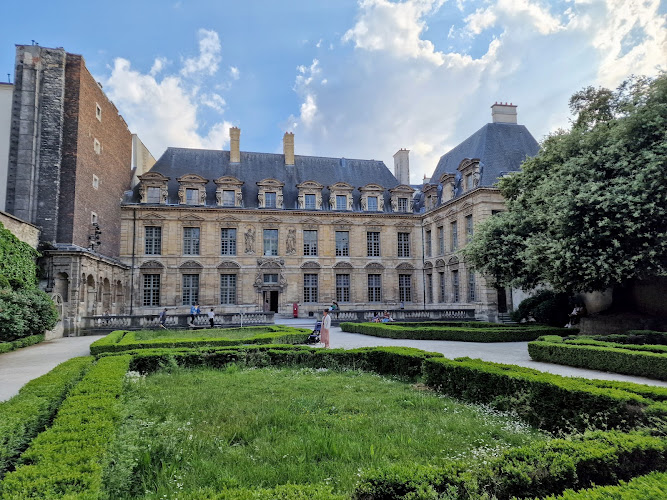
Where finance built a palace for a royal minister
At 62 rue Saint-Antoine in the 4th arrondissement, Hôtel de Sully stands as one of the Marais\s most magnificent private mansions, where 17th-century financial success created architectural splendor worthy of royal ministers. Built between 1624 and 1630 for wealthy financier Mesme Gallet and later owned by Maximilien de Béthune, Duc de Sully—Henri IV\s trusted minister—this extraordinary mansion demonstrates how private wealth and political power combined to create domestic architecture that rivaled royal palaces.
Architectural masterpiece by master craftsmen
Commissioned by financier Mesme Gallet, the mansion was constructed by master mason Jean Notin, probably following designs by Jean Androuet du Cerceau, one of France\s most accomplished Renaissance architects. The strategic location was chosen to provide direct access to Place Royale (now Place des Vosges) through the mansion\s garden, creating a private connection to Paris\s most prestigious square.
The mansion exemplifies the Louis XIII style at its peak, showcasing French Renaissance-Mannerist architecture with an abundance of decorative sculptures and allegorical reliefs. The design demonstrates how wealthy Parisians could commission domestic architecture that competed with royal residences in sophistication and artistic excellence.
Duc de Sully\s political and personal legacy
In 1634, the mansion was acquired by Maximilien de Béthune, Duc de Sully, Henri IV\s former minister and trusted confidant, who gave the mansion his name and commissioned extensive interior decorations. Though 74 years old when he purchased the property, Sully lived there until his death in 1641, ensuring the mansion reflected the taste and status appropriate for one of France\s most important political figures.
Sully\s ownership connected the mansion to the highest levels of French political life, where royal ministers conducted affairs of state while enjoying the refined domestic spaces that their positions and wealth allowed them to create. The Sully family retained ownership until 1752, spanning over a century of aristocratic residence.
Allegorical gardens and architectural poetry
The mansion\s two beautifully decorated courtyards feature late-Renaissance allegorical reliefs representing the seasons and elements, transforming functional architecture into artistic meditation on nature and time. The garden façade depicts Spring and Summer through Flora and Ceres, while the elegant orangery building at the garden\s end, framed by pavilions built in 1624, creates a sophisticated outdoor room.
The terrace overlooking the garden reflects 17th-century fashion for outdoor living and formal landscape design, while the pavilion providing access to Place des Vosges demonstrates how aristocratic residences were integrated into the broader urban fabric of noble Paris.
Modern preservation and cultural mission
Today, the Hôtel de Sully houses the headquarters of the Centre des Les monuments Nationaux, the organization responsible for preserving Frances most important historic monuments. This function creates perfect continuity with the mansion\s aristocratic heritage, where appreciation for architectural beauty and cultural preservation continues to guide the building\s mission.
Though the interiors are generally closed to the public, visitors can explore the two courtyards and admire the stately façades, while the garden connection to Place des Vosges creates a unique opportunity to experience the aristocratic lifestyle of movement between private mansion and public square.
Secret passage to royal grandeur
The mansion\s garden passage to Place des Vosges, accessible daily from 9am to 7pm, offers one of Paris\s most enchanting architectural experiences. This private route allows visitors to walk from the intimate scale of aristocratic domestic architecture to the grand public theater of Henri IV\s royal square, experiencing the full spectrum of 17th-century urban design.
Essential information
- Construction: 1624-1630
- Original owner: Mesme Gallet (financier)
- Famous owner: Maximilien de Béthune, Duc de Sully (1634-1641)
- Architect: Jean Androuet du Cerceau (attributed)
- Builder: Jean Notin (master mason)
- Emplacement: 62 rue Saint-Antoine, 4th arrondissement
- Current use: Centre des Monuments Nationaux headquarters
Visiting experience
- Accéder: Garden passage to Place des Vosges (9am-7pm daily)
- Courtyards: Two decorated courtyards with allegorical sculptures
- Jardin: Formal 17th-century design with orangery
- Architectural style: Louis XIII, French Renaissance-Mannerist
- Cultural significance: Connection between private aristocratic and public royal architecture
Aristocratic architectural legacy
The Hôtel de Sully represents the pinnacle of 17th-century French domestic architecture, where financial success and political influence created living spaces that served as both comfortable homes and artistic statements. This magnificent mansion demonstrates how great architecture can embody social history, political power, and aesthetic achievement within spaces designed for daily life. For architecture enthusiasts, history lovers, or anyone seeking to understand how aristocratic culture shaped Parisian urban development, the Hôtel de Sully offers an extraordinary encounter with the intersection of private luxury and public grandeur, where the garden passage to Place des Vosges provides a unique journey through the layered architectural heritage that defines the timeless elegance of the Marais district.