
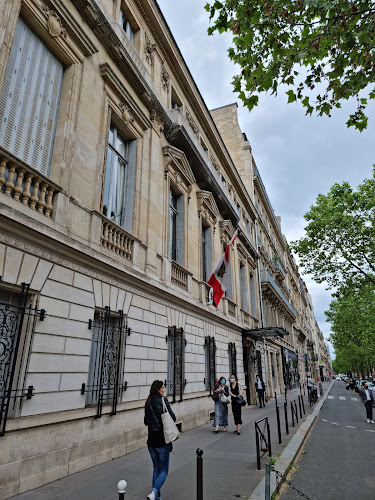
Diplomatic elegance in Haussmannian grandeur
At 50 avenue Kléber in the prestigious 16th arrondissement, the Peruvian Embassy occupies one of Paris’s most distinguished diplomatic residences, where 19th-century architectural refinement meets contemporary cultural diplomacy. Housed in the historic Hôtel Lafont de la Vernède, built in 1880 by architect Julien Bayard, this elegant hôtel particulier demonstrates how private aristocratic architecture has successfully adapted to serve international diplomatic missions while maintaining its essential character and neighborhood prestige.
Hôtel Lafont de la Vernède and architectural heritage
Originally constructed in 1880 by Julien Bayard for the Lafont de la Vernède family, the mansion exemplifies the sophisticated residential architecture that characterized the development of the 16th arrondissement during the Third Republic. The building’s elegant proportions and refined detailing reflect the architectural standards expected in one of Paris’s most exclusive neighborhoods.
In 1912, Uruguayan Ambassador Rafael de Miero purchased the hôtel and commissioned architect Émile Hochereau to undertake remodeling that adapted the space for diplomatic entertaining while respecting the building’s original architectural character. This early 20th-century intervention demonstrates how diplomatic needs could enhance rather than compromise historic architecture.
Diplomatic succession and Peruvian acquisition
In 1916, Ambassador de Miero transferred the property to Peruvian diplomat Count Pablo Sixto de Mimbela, who used it as his personal residence until his death. This transition established the building’s connection to Peruvian diplomacy and demonstrated how elegant private residences could serve high-level international representation while maintaining residential comfort and social prestige.
The Peruvian Government’s 1957 purchase of the mansion ensured its preservation as diplomatic property while creating permanent representation for Peru in one of Europe’s most important diplomatic capitals. This acquisition reflects Peru’s commitment to maintaining prestigious representation within Paris’s international community.
Contemporary diplomatic and cultural mission
Under Ambassador Rolando Javier Ruiz Rosas Cateriano, who also serves as ambassador to Monaco, the embassy maintains active diplomatic relations while promoting Peruvian culture through exhibitions, literary events, and cultural programming. This dual mission demonstrates how diplomatic residences can serve both political and cultural functions that strengthen international understanding.
The embassy’s cultural activities, including art exhibitions and literary programs, transform the historic mansion into a bridge between Peruvian heritage and French cultural appreciation, proving that diplomatic architecture can serve educational missions that benefit both official relations and public cultural exchange.
Avenue Kléber prestige and neighborhood context
The embassy’s location on avenue Kléber places it within one of Paris’s most prestigious diplomatic corridors, where numerous embassies and consulates occupy elegant Haussmannian buildings that create appropriate settings for international representation. This concentration of diplomatic missions reflects the avenue’s continuing importance to global diplomacy.
The neighborhood’s luxury boutiques, elegant restaurants, and proximity to major cultural institutions create an environment that enhances diplomatic entertaining while providing appropriate prestige for representing Peru’s interests within the sophisticated context of Parisian international society.
Essential information
- Building construction: 1880
- Original architect: Julien Bayard
- Diplomatic remodeling: 1912 (Émile Hochereau)
- Peruvian acquisition: 1957
- Emplacement: 50 avenue Kléber, 16th arrondissement
- Current ambassador: Rolando Javier Ruiz Rosas Cateriano
- Historical name: Hôtel Lafont de la Vernède
- Diplomatic scope: Peru to France and Monaco
Cultural and diplomatic functions
- Cultural programming: Art exhibitions, literary events
- Diplomatic services: Consular section at 25 rue de l’Arcade
- Public engagement: Active cultural outreach and programming
- Architectural preservation: Historic mansion serving diplomatic needs
- Neighborhood prestige: Avenue Kléber diplomatic corridor
Diplomatic architecture and cultural bridge
The Peruvian Embassy embodies the successful adaptation of aristocratic Parisian architecture for international diplomatic service, where Julien Bayard’s 19th-century design continues to provide appropriate setting for contemporary Peru-France relations. This remarkable building demonstrates how historic private residences can serve public diplomatic missions while preserving architectural heritage and neighborhood character. For diplomatic architecture enthusiasts, Peru culture admirers, or anyone interested in how historic buildings adapt to serve international relations, the embassy offers an inspiring example of cultural diplomacy, where elegant Haussmannian architecture continues to facilitate understanding between nations while promoting Peruvian artistic heritage within the sophisticated context of Paris’s premier diplomatic neighborhood.