Viaduc d’Austerlitz
Viaduc d'Austerlitz is a Paris Attractions landmark located in the 12 arrondissement. A single-span engineering marvel bridging Seine waters for metro innovation Spanning the Seine between Gare d\u2019Austerlitz and Quai de la Rapée in the 12th and 13th arrondissements, the Viaduc d\u2019Austerlitz stands as a remarkable testament to early 20th-century engineering ingenuity and the Paris […]
Viaduc d'Austerlitz is a Paris Attractions landmark located in the 12 arrondissement.
<\!-- wp:heading -->
A single-span engineering marvel bridging Seine waters for metro innovation
<\!-- /wp:heading --><\!-- wp:paragraph -->
Spanning the Seine between Gare d\u2019Austerlitz and Quai de la Rapée in the 12th and 13th arrondissements, the Viaduc d\u2019Austerlitz stands as a remarkable testament to early 20th-century engineering ingenuity and the Paris Métro\u2019s ambitious expansion across natural barriers. Completed in 1904 by engineer Louis Biette working with Fulgence Bienvenüe, this 140-meter single-span steel bridge achieved a record-breaking span among Parisian des ponts while solving the complex challenge of maintaining Seine navigation.
<\!-- /wp:paragraph --><\!-- wp:paragraph -->
Designed by architect Jean-Camille Formigé, who also created the Pont de Bir-Hakeim and various Parisian cultural landmarks, the viaduct represents more than utilitarian infrastructure—it embodies the Belle Époque\u2019s faith in technology\u2019s power to enhance urban life while respecting natural and navigational constraints.
<\!-- /wp:paragraph --><\!-- wp:heading {"level":3} -->
Revolutionary engineering solution and structural innovation
<\!-- /wp:heading --><\!-- wp:paragraph -->
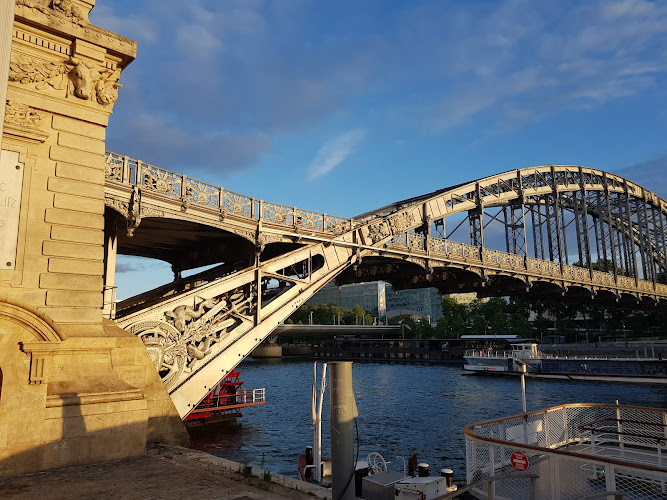
The viaduct\u2019s most remarkable achievement lies in its single-span design, necessitated by Seine navigation authorities\u2019 prohibition against placing piers within the river. The Levallois-Perret construction firm\u2019s solution utilized two reversed steel parabolic arcs joined at three strategic points—two near riverbanks and one at the apex—supporting a suspended deck 8.5 meters wide hovering 11 meters above water.
<\!-- /wp:paragraph --><\!-- wp:paragraph -->
This engineering approach required elevating the arcs above the deck and anchoring them to massive stone abutments measuring 22 by 18 meters, creating a structural system that balanced aesthetic elegance with unprecedented engineering performance. The design established new standards for urban transportation infrastructure while maintaining visual harmony with the Seine\u2019s historic bridges.
<\!-- /wp:paragraph --><\!-- wp:heading {"level":3} -->
Formigé\u2019s architectural artistry and decorative program
<\!-- /wp:heading --><\!-- wp:paragraph -->
Jean-Camille Formigé\u2019s decorative treatment transforms necessary engineering into artistic achievement through marine-themed reliefs featuring dolphins, seashells, and seaweed that celebrate the bridge\u2019s relationship to its aquatic environment. These sculptural elements demonstrate how functional infrastructure can achieve aesthetic excellence while honoring its environmental context.
<\!-- /wp:paragraph --><\!-- wp:paragraph -->
The footings\u2019 decoration with Paris\u2019s coat of arms establishes the viaduct\u2019s civic significance while maintaining visual connection to broader Parisian architectural traditions. Formigé\u2019s approach proves how decorative programs can enhance engineering achievements without compromising structural integrity or functional efficiency.
<\!-- /wp:paragraph --><\!-- wp:heading {"level":3} -->
Historic monument recognition and contemporary illumination
<\!-- /wp:heading --><\!-- wp:paragraph -->
The viaduct\u2019s classification as a historical monument in 1986 acknowledges its significance in the evolution of urban transportation and its architectural contribution to Parisian infrastructure. This recognition reflects growing appreciation for industrial heritage and the understanding that transportation infrastructure can achieve cultural significance through design excellence.
<\!-- /wp:paragraph --><\!-- wp:paragraph -->
Since January 18, 2000, the viaduct has been illuminated nightly during metro circulation hours as part of the Paris Métrou2019s centennial celebrations. The installation received the “Modern Heritage” prize in the “Lights and Les monuments” competition, demonstrating how contemporary lighting design can enhance historical infrastructure while creating new urban spectacles.
<\!-- /wp:paragraph --><\!-- wp:heading {"level":3} -->
Metro expansion legacy and urban connectivity
<\!-- /wp:heading --><\!-- wp:paragraph -->
As one of the first metal bridges constructed specifically for the Paris Métro, the Viaduc d\u2019Austerlitz represents a crucial milestone in the network\u2019s development from central Paris experiment to comprehensive urban transportation system. The bridge\u2019s success in spanning the Seine enabled Line 5\u2019s extension to serve both Left and Right Bank destinations efficiently.
<\!-- /wp:paragraph --><\!-- wp:paragraph -->
For visitors to Paris interested in engineering history, transportation infrastructure, or Belle Époque innovation, the Viaduc d\u2019Austerlitz offers a compelling example of how practical challenges can inspire architectural solutions that serve both functional and aesthetic purposes. The bridge demonstrates that the finest infrastructure projects emerge when engineering expertise meets artistic vision, creating structures that enhance urban life while contributing to the city\u2019s architectural heritage and cultural identity.
<\!-- /wp:paragraph -->