
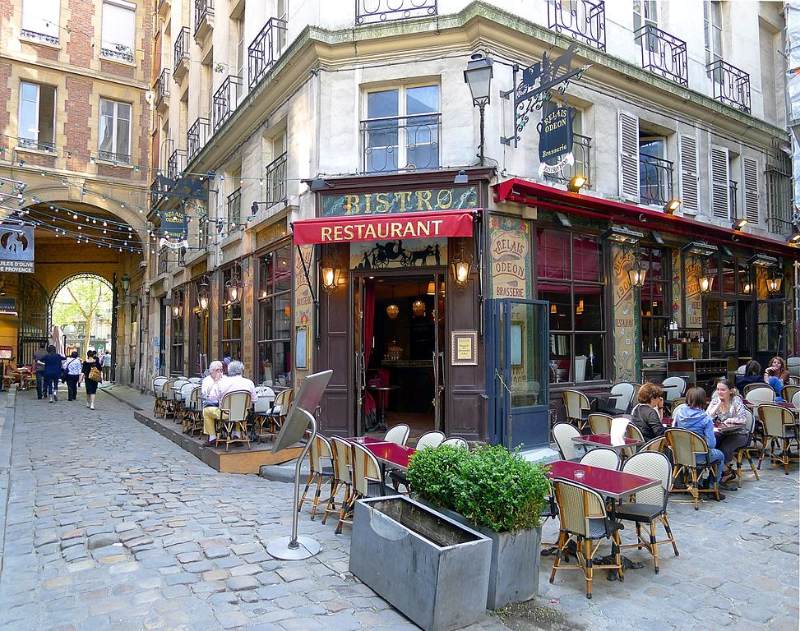
Cour du Commerce-Saint-André
59 Cr du Commerce Saint-André is a Paris historic landmark located in the 6 arrondissement. The revolutionary passage where Marat published, Danton lived, and the guillotine was born Hidden at 130 Boulevard Saint-Germain in the 6th arrondissement, the Cour du Commerce-Saint-André represents one of Paris\u2019s most historically charged spaces and a remarkably preserved glimpse into […]
59 Cr du Commerce Saint-André is a Paris historic landmark located in the 6 arrondissement.
<\!-- wp:heading -->
The revolutionary passage where Marat published, Danton lived, and the guillotine was born
<\!-- /wp:heading --><\!-- wp:paragraph -->
Hidden at 130 Boulevard Saint-Germain in the 6th arrondissement, the Cour du Commerce-Saint-André represents one of Paris\u2019s most historically charged spaces and a remarkably preserved glimpse into revolutionary France. Dating back to 1734 and built along the location of King Philippe Auguste\u2019s 12th-century walls, this almost-secret passage served as the epicenter of French revolutionary activity, where radical journalism, political plotting, and one of history\u2019s most infamous inventions converged to change the course of world history.
<\!-- /wp:paragraph --><\!-- wp:paragraph -->
This pedestrian-only walkway offers an enchanting glimpse of pre-Haussmann Paris, preserving the intimate urban scale that characterized the city before Napoleon III\u2019s 1852 modernization transformed the medieval streetscape into the broad boulevards we know today.
<\!-- /wp:paragraph --><\!-- wp:heading {"level":3} -->
Marat\u2019s printing press and radical journalism
<\!-- /wp:heading --><\!-- wp:paragraph -->
At Number 8, Jean-Paul Marat lived and operated the printing press where he published “L\u2019Ami du Peuple” (The People\u2019s Friend), the most celebrated radical newspaper of the French Revolution. A bell, still visible today above the roof of nearby Café Procope, was rung to announce that the latest edition was ready, creating a communication network that spread revolutionary ideas throughout Paris.
<\!-- /wp:paragraph --><\!-- wp:paragraph -->
Marat\u2019s residence and printing operation in this intimate passage demonstrates how revolutionary media could emerge from modest spaces when guided by passionate conviction and journalistic innovation. The survival of these physical spaces allows contemporary visitors to experience authentic revolutionary environments where world-changing ideas were conceived and disseminated.
<\!-- /wp:paragraph --><\!-- wp:heading {"level":3} -->
Danton\u2019s residence and revolutionary leadership
<\!-- /wp:heading --><\!-- wp:paragraph -->
Georges Danton lived at Number 20 (now disappeared due to Boulevard Saint-Germain construction) from 1789 until his arrest at home on March 30, 1794, just six days before his execution. A statue on Boulevard Saint-Germain marks the exact spot where this revolutionary giant was arrested, creating a permanent memorial to one of the Revolution\u2019s most charismatic and tragic figures.
<\!-- /wp:paragraph --><\!-- wp:paragraph -->
Danton\u2019s residence in this passage placed him at the heart of revolutionary intellectual and political life, demonstrating how the cramped quarters of old Paris facilitated the intense personal relationships and frequent encounters that characterized revolutionary politics.
<\!-- /wp:paragraph --><\!-- wp:heading {"level":3} -->
The guillotine\u2019s birthplace: Schmidt\u2019s workshop
<\!-- /wp:heading --><\!-- wp:paragraph -->
In a macabre historical irony, Number 9 housed carpenter Schmidt\u2019s workshop where Joseph Ignace Guillotin developed his most infamous invention. The first guillotine tests were conducted in this very passage, beginning with bales of straw and progressing to live sheep, before the device was perfected for its grim revolutionary purpose.
<\!-- /wp:paragraph --><\!-- wp:paragraph -->
This proximity of revolutionary journalism, political leadership, and execution technology within a single small passage demonstrates the concentrated intensity of revolutionary Paris, where momentous historical developments occurred within intimate urban spaces that forced constant interaction between the personalities shaping French history.
<\!-- /wp:paragraph --><\!-- wp:heading {"level":3} -->
Le Procope and revolutionary gatherings
<\!-- /wp:heading --><\!-- wp:paragraph -->
The passage\u2019s connection to the legendary Café Procope created a comprehensive revolutionary ecosystem where Maximilien Robespierre, Danton, and Marat met to plot the Revolution while earlier intellectual giants like Rousseau, Voltaire, Benjamin Franklin, Thomas Jefferson, and young Napoleon Bonaparte had established traditions of political and philosophical discourse.
<\!-- /wp:paragraph --><\!-- wp:paragraph -->
This continuity from Enlightenment intellectual gathering to revolutionary political action demonstrates how spaces dedicated to free discourse can evolve to serve changing historical needs while maintaining their essential character as places where ideas are developed and tested through public conversation.
<\!-- /wp:paragraph --><\!-- wp:heading {"level":3} -->
Pre-Haussmann urban preservation
<\!-- /wp:heading --><\!-- wp:paragraph -->
The passage\u2019s survival as one of Paris\u2019s most authentic examples of pre-Haussmann urban fabric allows contemporary visitors to experience the cramped, intimate scale of revolutionary Paris, where physical proximity facilitated the intense personal and political relationships that characterized this extraordinary historical period.
<\!-- /wp:paragraph --><\!-- wp:paragraph -->
For visitors to Paris interested in French revolutionary history, urban archaeology, or the physical environments where modern democracy was born, the Cour du Commerce-Saint-André offers an unparalleled encounter with authentic revolutionary spaces. The passage proves that great historical sites achieve lasting significance by preserving the intimate human environments where extraordinary individuals created ideas and institutions that transformed civilization, demonstrating how modest urban spaces can serve as crucibles for world-changing political and social innovation.
<\!-- /wp:paragraph -->