Art Nouveau Meets Urban Transportation
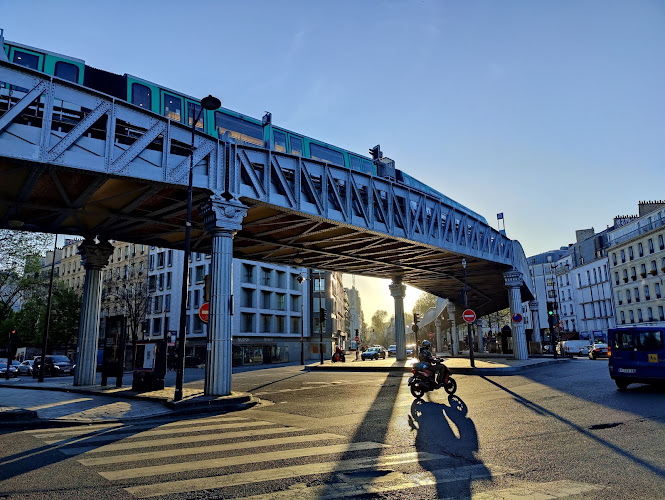
The Jaurès metro station entrance represents an important connection to Hector Guimard’s revolutionary Art Nouveau designs that transformed Paris’s urban landscape between 1900 and 1913. While the current entrance may have evolved from its original form, it stands as part of the broader legacy of Guimard’s Metro style that defined Parisian public transportation aesthetics.
Guimard’s Revolutionary Vision
Hector Guimard was commissioned to design the first generation of entrances for the Paris Métro, creating what became known as the “style Métro.” His innovative approach replaced traditional masonry designs with elegant cast iron and glass structures that embodied the flowing, organic principles of Art Nouveau.
Using modular structural elements, Guimard developed five distinct entrance types, ranging from simple railings (entourages) to elaborate covered pavilions (édicules). Each entrance shared the same distinctive green paint—meant to resemble bronze patina—and featured signs bearing “Métropolitain” in Guimard’s specially designed typeface.
The Metro Design Legacy
Guimard’s metro entrances fell into several categories:
- Entourages: Simple but elegant railings (154 built)
- Édicule B: Three-sided glass-roofed structures with projecting canopies
- Édicule A: Similar structures without canopies
- Pavilions: Free-standing station buildings with waiting rooms
Historical Context at Jaurès
The Jaurès station, serving Line 2, 5, and 7bis, opened in the early years of the Metro system when Guimard’s designs were being implemented across the network. While the station has undergone modernization over the decades, it remains connected to the artistic vision that made Paris Metro entrances internationally recognized as masterpieces of functional Art Nouveau design.
The station honors Jean Jaurès (1859-1914), the French socialist leader and pacifist who was assassinated on the eve of World War I. This naming reflects the democratic ideals that Guimard’s accessible, beautiful public design sought to embody.
Importance architecturale
Guimard’s Metro entrances represented a radical departure from 19th-century architectural conventions. His designs demonstrated that public infrastructure could be both functional and aesthetically revolutionary, introducing Art Nouveau’s organic forms and natural motifs to everyday urban experiences.
The characteristic elements of Guimard’s designs included:
- Flowing, plant-inspired ironwork
- Distinctive orange and green “Métropolitain” signage
- Integration of function with artistic beauty
- Modular construction allowing for cost-effective reproduction
Evolution and Preservation
Of Guimard’s original 141 entrance structures, 86 survive today and are protected as historical les monuments. While many stations have been modernized, the remaining examples preserve the artistic vision that made the Paris Metro an internationally celebrated example of applied Art Nouveau design.
The preservation of these entrances reflects recognition that public transportation design can be culturally significant, influencing how cities approach the aesthetic quality of infrastructure.
Impact culturel
Guimard’s Metro designs became synonymous with Parisian style, influencing Art Nouveau movements across Europe and establishing the principle that everyday urban infrastructure deserved artistic consideration. His work at stations like Jaurès contributed to Paris’s reputation as a city where functional design and artistic beauty coexist.
The “style Métro” became so iconic that it influenced subsequent generations of public design, demonstrating how thoughtful aesthetics could enhance civic life and urban identity.
Pertinence contemporaine
While the Jaurès station entrance has evolved with modern transportation needs, it remains part of the network that Guimard envisioned as an underground art gallery. The station continues to serve as a testament to the belief that public spaces should inspire as well as transport.
Today’s visitors can appreciate how Guimard’s vision influenced not just metro design but broader approaches to public architecture that prioritize both functionality and beauty.
Planifier votre visite
The Jaurès metro station is easily accessible via Lines 2, 5, and 7bis. While exploring the station, visitors can observe how contemporary design integrates with the broader Metro network that Guimard helped establish. The station provides access to the Canal Saint-Martin area, where the artistic spirit of Guimard’s era continues in the neighborhood’s galleries, cafés, and creative spaces.
Consider combining your visit with exploration of other surviving Guimard entrances, particularly the famous “dragonfly” édicule at Porte Dauphine or the relocated structure at Abbesses station.