
<\!-- wp:heading -->
Paris\u2019s oldest church transformed into a Byzantine sanctuary in the Latin Quarter
<\!-- /wp:heading --><\!-- wp:paragraph -->
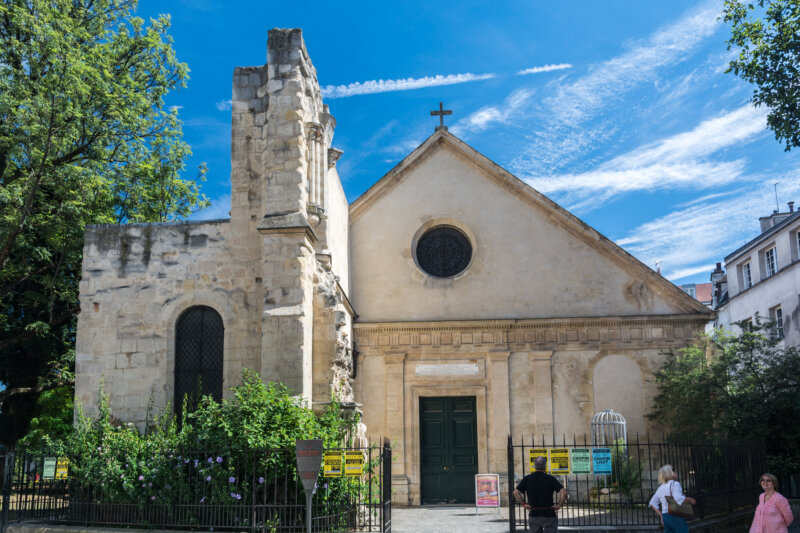
In the heart of the Latin Quarter in the 5th arrondissement, the Église Saint-Julien-le-Pauvre stands as Paris\u2019s oldest surviving church and a unique testament to the evolution of Christian worship from medieval pilgrimage site to contemporary Melkite Greek Catholic sanctuary. Built between 1165 and 1240 on the foundations of a 6th-century Merovingian oratory, this remarkable building embodies twelve centuries of continuous Christian presence while showcasing how ancient sacred spaces can adapt to serve new liturgical traditions.
<\!-- /wp:paragraph --><\!-- wp:paragraph -->
The church\u2019s transformation in 1889 into France\u2019s first Melkite Greek Catholic parish created a unique synthesis of Western medieval architecture with Eastern Christian liturgical practice, demonstrating how historic religious buildings can embrace new cultural and spiritual identities while preserving their essential sacred character.
<\!-- /wp:paragraph --><\!-- wp:heading {"level":3} -->
Romanesque-Gothic architectural synthesis
<\!-- /wp:heading --><\!-- wp:paragraph -->
The church\u2019s construction spanning the 12th and 13th centuries captures the architectural transition from Romanesque to Gothic styles, beginning with Romanesque foundations and evolving into predominantly Gothic forms with large 12th-century buttresses visible from the exterior. This architectural evolution creates a compact yet sophisticated sacred space that demonstrates medieval builders\u2019 mastery of both structural innovation and aesthetic refinement.
<\!-- /wp:paragraph --><\!-- wp:paragraph -->
The modest scale that earned the church its “le-Pauvre” (the Poor) designation reflects medieval understanding that spiritual significance need not require monumental size, proving that intimate sacred spaces can achieve profound architectural and spiritual impact through careful proportions and authentic devotional atmosphere.
<\!-- /wp:paragraph --><\!-- wp:heading {"level":3} -->
Byzantine iconostasis and Eastern Christian liturgy
<\!-- /wp:heading --><\!-- wp:paragraph -->
The church\u2019s most distinctive feature is its beautiful iconostasis, inaugurated on April 30, 1891, which separates the nave from the sanctuary according to Eastern Christian tradition. This elaborate screen, featuring glowing icons in dim candlelight, creates an atmospheric worship environment that follows the rite of Saint John Chrysostom as practiced in Christianity\u2019s earliest centuries.
<\!-- /wp:paragraph --><\!-- wp:paragraph -->
The integration of Byzantine liturgical elements within Gothic architectural framework demonstrates how ancient buildings can accommodate new worship traditions while enhancing rather than diminishing their spiritual atmosphere and cultural significance.
<\!-- /wp:paragraph --><\!-- wp:heading {"level":3} -->
Pilgrimage heritage and hospitality tradition
<\!-- /wp:heading --><\!-- wp:paragraph -->
The church\u2019s origins as part of a Merovingian hospice that sheltered pilgrims without funds establishes its historical mission of providing spiritual and practical support for travelers, a tradition that continues through its welcome to visitors interested in experiencing Eastern Christian worship within medieval Western architectural settings.
<\!-- /wp:paragraph --><\!-- wp:paragraph -->
This hospitality tradition, extending from 6th-century pilgrims to contemporary visitors, demonstrates how religious institutions can maintain their essential charitable and spiritual missions while adapting to serve diverse cultural and liturgical needs across centuries of social change.
<\!-- /wp:paragraph --><\!-- wp:heading {"level":3} -->
Unique cultural synthesis and urban sanctuary
<\!-- /wp:heading --><\!-- wp:paragraph -->
The church\u2019s position in Square René Viviani, beneath Paris\u2019s oldest tree and with views of Notre-Dame, creates one of the city\u2019s most romantically charged sacred spaces. This urban setting demonstrates how small religious buildings can achieve disproportionate cultural and spiritual significance through strategic placement and authentic spiritual atmosphere.
<\!-- /wp:paragraph --><\!-- wp:paragraph -->
For visitors to Paris interested in early Christian history, Byzantine liturgy, or the evolution of sacred architecture, Saint-Julien-le-Pauvre offers an exceptional encounter with the oldest Christian site in Paris while experiencing living Eastern Christian tradition within authentic medieval Western architectural setting. The church proves that great religious buildings achieve lasting significance by maintaining spiritual authenticity while adapting to serve new communities, creating sacred spaces where ancient and contemporary faith traditions can flourish together in mutual enrichment.
<\!-- /wp:paragraph -->