
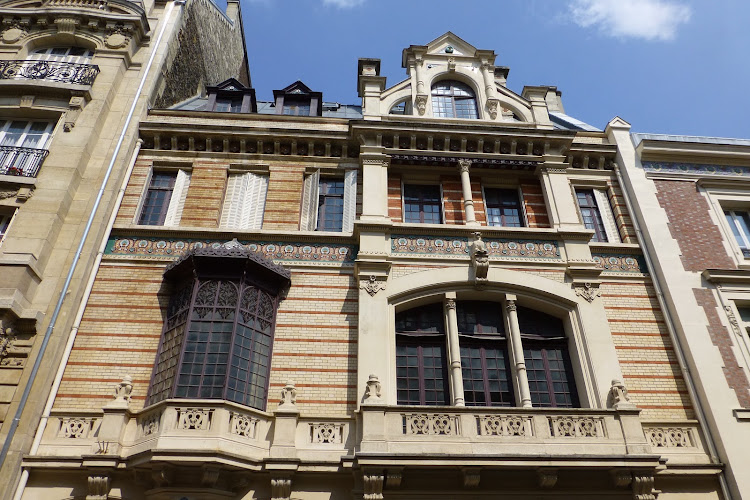
At 9 rue Fortuny in the 17th arrondissement stands a magnificent example of 19th-century Parisian architecture that once served as a prestigious fashion and aesthetics school. This eclectic mansion, now protected as a historic monument, represents a fascinating chapter in Paris’s educational and fashion history, where generations of students learned the arts of haute couture and beauty in a setting of extraordinary architectural splendor.
## From Private Mansion to Fashion Institution
Built in 1891 for M. Thibault-Morel (also known as Benjamin Morel) by architect Adrien-Paul Gouny, this hôtel particulier exemplifies the eclectic architectural movement of late 19th-century Paris. The building masterfully combines references to medieval, Renaissance, and 18th-century styles while incorporating contemporary decorative techniques that were revolutionary for their time.
The facade showcases remarkable polychrome ceramics by Paul Loebnitz and polychromatic brickwork that creates a visual feast for architecture enthusiasts. These decorative elements demonstrate the late 19th century’s fascination with color and ornamentation, making the building a standout example of Parisian residential architecture from this period.
## A Temple of Fashion Education
For decades, this elegant mansion housed the Lycée professionnel d’esthétique et haute-couture, known as Lycée Mario Fortuny. The school established itself as a premier institution for training future professionals in the fashion and beauty industries, taking advantage of the building’s refined atmosphere to create an inspiring educational environment.
Students pursuing careers in aesthetics received hands-on training in the mansion’s elegant rooms. Final-year students performed body and facial treatments under close professor supervision, learning their craft in surroundings that reflected the luxury and sophistication their future clients would expect.
The haute couture program utilized the building’s spacious workshops and ateliers, where aspiring designers learned traditional French dressmaking techniques alongside modern fashion innovation. The historic setting provided constant inspiration, with architectural details serving as references for design elements and decorative techniques.
## Architectural Treasures
In 1997, the building received historic monument protection, recognizing its exceptional architectural value. The protected elements include:
– Street and courtyard facades with their intricate decorative elements
– The atmospheric carriage passage that once welcomed elegant equipages
– Ground floor kitchens that retain their original layout
– The magnificent main staircase and its ornate cage
– First-floor reception rooms with period details
– The former stables and carriage houses at the rear, now converted spaces
Each element tells the story of Parisian domestic architecture at its most refined, creating an environment where students could appreciate the relationship between fashion, beauty, and architectural elegance.
## The Mariano Fortuny Connection
The street itself honors Catalan painter Mariano Fortuny i Marsal (1838-1874), known for his orientalist paintings and influence on decorative arts. Opened in 1876 on land that belonged to painter Louis Godefroy Jadin, rue Fortuny developed as an artistic quarter, making it a fitting location for a school dedicated to aesthetic education.
The connection to Fortuny added cultural resonance to the school’s mission. Mariano Fortuny’s son, also named Mariano, became famous as a fashion designer and inventor of the Fortuny pleat, creating a poetic link between the street’s namesake and the fashion education that took place within the building.
## Sustainability and Ethical Fashion Pioneer
Before sustainability became a mainstream concern, the Lycée Fortuny emphasized environmentally friendly practices and social responsibility in fashion education. Students learned not just technical skills but also the importance of ethical production methods and sustainable design principles.
This forward-thinking approach positioned graduates to lead the industry toward more responsible practices, making the school a pioneer in combining traditional craftsmanship with modern environmental consciousness.
## Transformation and Legacy
In 2010, the building’s educational chapter ended when the Île-de-France regional council took ownership. The site briefly served as a film location for director Albert Dupontel, who shot scenes for “9 mois ferme” and “Au revoir là-haut” in its atmospheric interiors.
The region sold the building in 2019 for €12.5 million, and it now houses a digital technology company—a transformation that reflects Paris’s evolution while preserving architectural heritage.
## Visiting the Former Lycée
**Address:** 9 rue Fortuny, 75017 Paris
**Metro:** Malesherbes (Line 3) or Wagram (Line 3)
**Current Status:** Private offices (exterior viewing only)
**Architectural Period:** 1891, Eclectic style
**Historic Monument:** Protected since 1997
While the building no longer functions as a school, its facade remains a testament to the marriage of architectural beauty and educational purpose. Architecture enthusiasts can admire the polychrome ceramics, ornate brickwork, and overall composition that made this an inspiring setting for fashion education.
## Educational Heritage in Stone
The former Lycée Fortuny demonstrates how architectural settings can enhance educational experiences. Students who trained within these walls absorbed not just technical skills but also an appreciation for beauty, craftsmanship, and the relationship between environment and creativity.
Though fashion students no longer climb the ornate staircase or practice their craft in the elegant salons, the building’s legacy continues. It stands as a reminder of Paris’s commitment to excellence in fashion education and the belief that beautiful surroundings can inspire beautiful creations.
## A Monument to Craft and Creativity
Today, the building at 9 rue Fortuny represents multiple layers of Parisian history: 19th-century architectural innovation, 20th-century fashion education, and 21st-century adaptive reuse. Each era has left its mark while respecting the essential character that makes this building special.
For those interested in fashion history, architectural heritage, or the evolution of Parisian education, this monument offers a tangible connection to the city’s role in shaping global fashion and beauty standards. Its walls once echoed with the creative energy of students learning to transform fabric and enhance beauty—a legacy that enriches our understanding of Paris as a capital of style and sophistication.