
<\!-- wp:heading -->
Victor Laloux\u2019s Belle Époque station transformed into the world\u2019s premier Impressionist sanctuary
<\!-- /wp:heading --><\!-- wp:paragraph -->
On the Left Bank of the Seine in the 7th arrondissement, the Musée d\u2019Orsay occupies one of Paris\u2019s most successful architectural transformations, where Victor Laloux\u2019s magnificent Belle Époque railway station has become the world\u2019s largest repository of Impressionist and Post-Impressionist masterpieces. Built between 1898 and 1900 for the Paris Exposition Universelle, this former Gare d\u2019Orsay demonstrates how visionary adaptive reuse can preserve architectural heritage while creating entirely new cultural functions.
<\!-- /wp:paragraph --><\!-- wp:paragraph -->
Laloux\u2019s triumph in the station design competition reflected his understanding of how modern infrastructure could achieve both practical efficiency and aesthetic grandeur. His decision to mask the building\u2019s metal framework behind an elegant white limestone façade ensured harmony with the prestigious 7th arrondissement while creating one of the most beautiful railway terminals ever constructed.
<\!-- /wp:paragraph --><\!-- wp:heading {"level":3} -->
From railway cathedral to artistic shrine
<\!-- /wp:heading --><\!-- wp:paragraph -->
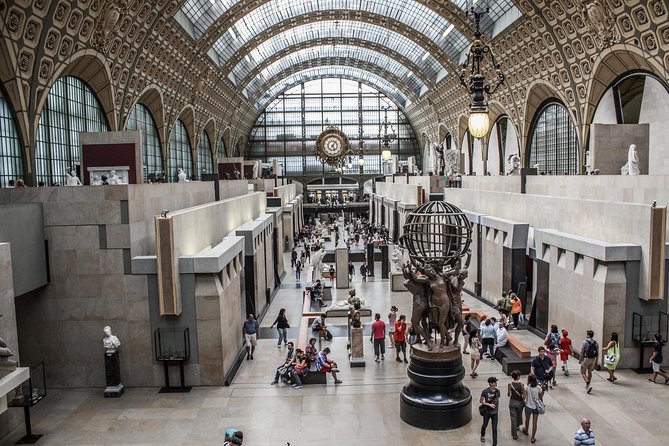
The museum\u2019s transformation, initiated by President Valéry Giscard d\u2019Estaing in 1977 and completed with the opening on December 9, 1986, preserved Laloux\u2019s soaring spaces while creating ideal conditions for art display. The original massive metal framework and delicate glass decorative elements now provide natural illumination for artistic masterpieces, demonstrating how industrial architecture can enhance rather than compete with fine art.
<\!-- /wp:paragraph --><\!-- wp:paragraph -->
The building\u2019s central nave, once alive with steam locomotives and departing passengers, now hosts the world\u2019s most comprehensive collection of Impressionist works. This transformation from transportation hub to cultural destination reflects Paris\u2019s genius for reinventing historic structures while maintaining their essential architectural character.
<\!-- /wp:paragraph --><\!-- wp:heading {"level":3} -->
The world\u2019s greatest Impressionist collection
<\!-- /wp:heading --><\!-- wp:paragraph -->
The museum houses the largest collection of Impressionist and Post-Impressionist masterpieces in the world, featuring works by Claude Monet, Édouard Manet, Edgar Degas, Auguste Renoir, Paul Cézanne, Georges Seurat, Alfred Sisley, Paul Gauguin, and Vincent van Gogh. These collections, spanning French art from 1848 to 1914, were assembled from dispersed holdings previously scattered among the Louvre, Orangerie, and Modern Art museums.
<\!-- /wp:paragraph --><\!-- wp:paragraph -->
The museum\u2019s focus on 19th-century French art creates a comprehensive narrative of artistic evolution during one of history\u2019s most innovative periods. Visitors encounter not just individual masterpieces but the complete story of how French artists revolutionized painting, sculpture, decorative arts, and photography during the Belle Époque.
<\!-- /wp:paragraph --><\!-- wp:heading {"level":3} -->
Belle Époque architectural innovation preserved
<\!-- /wp:heading --><\!-- wp:paragraph -->
Laloux\u2019s original design balanced cutting-edge engineering with traditional architectural beauty, creating a station that served practical transportation needs while providing passengers with an inspiring environment. The building\u2019s success in achieving both functions made it an ideal candidate for museum conversion, as the spaces designed for human circulation and natural lighting proved perfect for art display.
<\!-- /wp:paragraph --><\!-- wp:paragraph -->
The preservation of original architectural elements—soaring ceilings, grand halls, and intricate metalwork—ensures that visitors experience both the building\u2019s railway heritage and its current artistic mission. This dual identity creates a unique museum environment where architectural history enhances rather than distracts from artistic appreciation.
<\!-- /wp:paragraph --><\!-- wp:heading {"level":3} -->
Global cultural destination and visitor experience
<\!-- /wp:heading --><\!-- wp:paragraph -->
With 3.2 million visitors in 2022, the Musée d\u2019Orsay ranks as the world\u2019s sixth-most-visited art museum and France\u2019s second-most-visited after the Louvre. This remarkable attendance reflects both the universal appeal of Impressionist art and the success of the museum\u2019s architectural setting in creating memorable visitor experiences.
<\!-- /wp:paragraph --><\!-- wp:paragraph -->
The museum\u2019s recovery from pandemic-related closures demonstrates the enduring global fascination with French Impressionist art and the power of great architecture to enhance cultural programming. The building\u2019s natural lighting and spacious galleries provide ideal conditions for appreciating the subtle color relationships and atmospheric effects that define Impressionist achievement.
<\!-- /wp:paragraph --><\!-- wp:heading {"level":3} -->
Architectural preservation as cultural catalyst
<\!-- /wp:heading --><\!-- wp:paragraph -->
The Musée d\u2019Orsay\u2019s success demonstrates how sensitive adaptive reuse can create cultural institutions that honor both architectural heritage and contemporary artistic missions. Laloux\u2019s Belle Époque design, originally created to facilitate urban transportation, now facilitates cultural transportation—carrying visitors into the revolutionary world of 19th-century French art.
<\!-- /wp:paragraph --><\!-- wp:paragraph -->
For visitors to Paris, the museum offers a unique synthesis of architectural and artistic achievement, where the beauty of the building enhances appreciation of the masterpieces it contains. The Musée d\u2019Orsay proves that the finest cultural institutions emerge when great architecture meets exceptional collections, creating destinations that celebrate both human creativity and the spaces designed to honor it.
<\!-- /wp:paragraph -->