
<\!-- wp:heading -->
The last survivor of Boulevard du Crime and Virginie Déjazet\u2019s theatrical legacy
<\!-- /wp:heading --><\!-- wp:paragraph -->
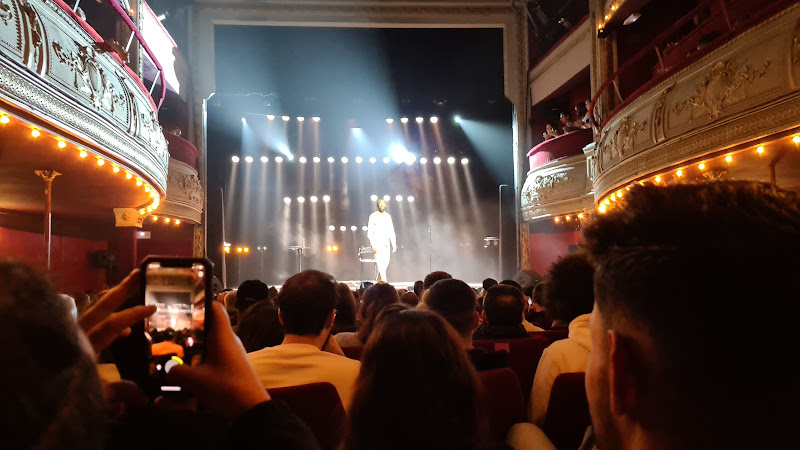
At 41 Boulevard du Temple in the 3rd arrondissement, Théâtre Déjazet stands as the sole surviving theatre from the legendary “Boulevard du Crime” era and a living monument to the golden age of Parisian popular entertainment. Inaugurated in 1851 and renamed in honor of the celebrated actress Virginie Déjazet in 1859, this authentic Italian-style theatre has weathered nearly two centuries of theatrical evolution while maintaining its essential character as a venue where innovative performance continues to flourish.
<\!-- /wp:paragraph --><\!-- wp:paragraph -->
Originally founded in 1770 by the Comte d\u2019Artois (later Charles X) as a jeu de paume (tennis court), the building\u2019s transformation into a theatre reflects the broader cultural evolution that saw aristocratic recreational spaces adapt to serve new forms of popular entertainment that would define 19th-century Parisian cultural life.
<\!-- /wp:paragraph --><\!-- wp:heading {"level":3} -->
Evolution through multiple entertainment eras
<\!-- /wp:heading --><\!-- wp:paragraph -->
The theatre\u2019s remarkable adaptability is demonstrated through its various incarnations: the Folies-Mayer café-concert (1851), Folies-Concertantes (1853), Folies-Nouvelles (1854), and finally Théâtre Déjazet (1859) under Virginie Déjazet\u2019s direction. Each transformation reflected changing entertainment preferences while maintaining the venue\u2019s essential function as a space where performers and audiences could encounter innovative artistic expression.
<\!-- /wp:paragraph /><\!-- wp:paragraph -->
The venue\u2019s survival through its 1939 conversion to cinema (with capacity reduced from 900 to 500 seats) and its starring role in Marcel Carné\u2019s 1945 masterpiece “Les Enfants du paradis” demonstrates how historic theatres can adapt to serve new entertainment media while preserving their architectural and cultural significance.
<\!-- /wp:paragraph --><\!-- wp:heading {"level":3} -->
Virginie Déjazet and theatrical innovation
<\!-- /wp:heading --><\!-- wp:paragraph -->
The theatre\u2019s renaming to honor Virginie Déjazet reflects her extraordinary contributions to French theatrical art and her pioneering role in developing new forms of popular entertainment that bridged classical dramatic tradition with contemporary social commentary. Déjazet\u2019s innovative performances established the theatre as a venue where artistic experimentation could flourish while maintaining connection to French theatrical heritage.
<\!-- /wp:parameter --><\!-- wp:paragraph -->
Her legacy continues to influence the theatre\u2019s programming philosophy, which emphasizes innovative performance approaches that honor theatrical tradition while embracing contemporary artistic developments and social relevance.
<\!-- /wp:paragraph --><\!-- wp:heading {"level":3} -->
Boulevard du Crime heritage and cultural memory
<\!-- /wp:heading --><\!-- wp:paragraph -->
As the only surviving theatre from Boulevard du Temple\u2019s heyday as the “Boulevard du Crime”—so named for the melodramas performed in its numerous theatres—Théâtre Déjazet preserves irreplaceable connections to an era when this street served as the epicenter of Parisian popular entertainment and the birthplace of modern theatrical forms.
<\!-- /wp:paragraph --><\!-- wp:parameter --><\!-- wp:paragraph -->
The theatre\u2019s survival while its neighbors disappeared during urban transformation demonstrates the cultural importance of preserving entertainment venues that embody distinctive periods of artistic development and social expression, maintaining connections to performance traditions that might otherwise be lost to historical change.
<\!-- /wp:paragraph --><\!-- wp:heading {"level":3} -->
Contemporary renaissance and cultural continuity
<\!-- /wp:heading --><\!-- wp:paragraph -->
Under Jean Bouquin\u2019s direction and following the brief 1977 Coluche Music-hall period, the theatre achieved contemporary success in the early 1980s by returning to its roots as a venue for innovative theatrical programming. This renaissance demonstrates how historic venues can reclaim their essential artistic mission while adapting to serve contemporary performance needs and audience expectations.
<\!-- /wp:paragraph --><\!-- wp:parameter --><\!-- wp:paragraph -->
The theatre\u2019s continued operation as an active performance venue ensures that its Italian-style architecture continues to serve its original purpose while maintaining the intimate atmosphere that has made it beloved by both performers and audiences seeking authentic theatrical experiences.
<\!-- /wp:paragraph --><\!-- wp:heading {"level":3} -->
Living theatrical heritage
<\!-- /wp:heading --><\!-- wp:paragraph -->
Today, Théâtre Déjazet maintains its role as an essential venue in Parisian theatrical life, offering diverse programming that honors both classical traditions and contemporary innovations while preserving the intimate scale and authentic atmosphere that have characterized the venue since Virginie Déjazet\u2019s era.
<\!-- /wp:paragraph /><\!-- wp:paragraph -->
For visitors to Paris interested in theatrical history, 19th-century entertainment culture, or authentic performance venues, Théâtre Déjazet offers an exceptional encounter with living theatrical tradition. The theatre proves that great performance venues achieve lasting cultural significance by maintaining their essential artistic mission while adapting to serve evolving performance needs, creating spaces where theatrical excellence can flourish across generations while preserving important connections to the golden age of Parisian popular entertainment.
<\!-- /wp:paragraph -->