
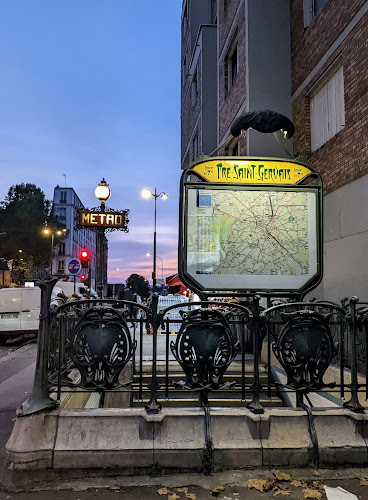
Édicule Guimard of the Pré Saint-Gervais station
Pré-Saint-Gervais is a Paris Station De Métro landmark located in the 19 arrondissement. Table of ContentsThe last survivor of Guimard’s Art Nouveau revolutionGuimard’s vision for the Paris MetroArtistic revolution meets practical transportationFrom controversy to beloved iconArchitectural heritage and protectionLiving art in everyday useEssential informationVisiting experienceArt Nouveau legacyNearby in 19 The last survivor of Guimard’s Art […]
Pré-Saint-Gervais is a Paris Station De Métro landmark located in the 19 arrondissement.
Table des matières
- The last survivor of Guimard’s Art Nouveau revolution
- Guimard’s vision for the Paris Metro
- Artistic revolution meets practical transportation
- From controversy to beloved icon
- Architectural heritage and protection
- Living art in everyday use
- Essential information
- Visiting experience
- Art Nouveau legacy
- Nearby in 19
The last survivor of Guimard’s Art Nouveau revolution
In the northeastern reaches of Paris, the Édicule Guimard of the Pré Saint-Gervais station stands as one of the most precious remnants of the Belle Époque’s architectural revolution. This extraordinary Metro entrance, designed by Hector Guimard in the early 1900s, represents not just transportation infrastructure but a masterpiece of Art Nouveau design that transformed the mundane act of descending into the subway into an encounter with artistic genius.
Guimard’s vision for the Paris Metro
Hector Guimard received his commission to design Metro entrances after the Paris Metropolitan Railway Company was disappointed with the results of their 1899 design competition. Guimard’s revolutionary approach combined mass-produced materials—cast iron, stone, enameled lava, and glass—with organic Art Nouveau forms that broke dramatically with the Haussmannian architectural tradition dominating Paris.
The Pré Saint-Gervais édicule exemplifies Guimard’s genius for transforming industrial materials into natural forms. The structure’s sinuous ironwork, inspired by plant stems and organic growth patterns, demonstrated how modern manufacturing could serve artistic expression. Each element—from the characteristic curved supports to the elegant glass canopy—flowed seamlessly into the next, creating unified sculptural compositions.
Artistic revolution meets practical transportation
What made Guimard’s Metro entrances truly revolutionary was their integration of cutting-edge artistic aesthetics with functional urban infrastructure. The Pré Saint-Gervais station features Guimard’s characteristic ornate metalwork and delicate curves, where every functional element—handrails, supports, lighting fixtures—becomes part of an organic sculptural ensemble.
The entrance design reflected Art Nouveau’s core philosophy: that beauty should permeate all aspects of daily life, transforming ordinary experiences into encounters with art. Guimard understood that millions of Parisians would interact with these structures daily, making them some of the most influential pieces of public art in the city.
From controversy to beloved icon
When first installed, Guimard’s Metro entrances faced mixed reception from Parisians. Critics deemed them “un-French” and overly elaborate, preferring more conventional architectural approaches. However, the artistic vision and functional elegance of these structures gradually won public appreciation, and they became beloved symbols of Parisian sophistication and Belle Époque creativity.
The Pré Saint-Gervais édicule survived decades of urban change, wartime threats, and modernization pressures that led to the destruction of many original Guimard structures. Its preservation represents the evolution of public taste and the eventual recognition of Art Nouveau’s contribution to Parisian identity.
Architectural heritage and protection
Today, the Édicule Guimard of the Pré Saint-Gervais station is protected as a historic monument, recognizing its irreplaceable contribution to Paris’s architectural heritage. The structure stands among the 86 remaining Guimard Metro entrances that have achieved monument status, ensuring their preservation for future generations.
The édicule’s protection reflects broader recognition of Art Nouveau’s significance in architectural history and the importance of preserving examples of functional art that enhanced daily urban life. These structures prove that public infrastructure can embody the highest artistic aspirations while serving practical community needs.
Living art in everyday use
What makes the Pré Saint-Gervais édicule particularly special is its continued function as an active Metro entrance. Unlike museum pieces, this work of art remains integrated into the daily lives of Parisians, allowing contemporary travelers to experience Guimard’s vision as originally intended. Every descent through this entrance connects riders to the Belle Époque ideals of beauty in functionality.
Essential information
- Designer: Hector Guimard
- Construction period: Early 1900s (Belle Époque)
- Architectural style: Art Nouveau
- Matériaux: Cast iron, stone, enameled lava, glass
- Heritage status: Protected historic monument
- Current use: Active Metro entrance serving Line 7bis
- Historical significance: Represents Art Nouveau revolution in public design
Visiting experience
- Emplacement: Pré Saint-Gervais Metro station, 19th arrondissement
- Best appreciation: External viewing of ornate metalwork and curved forms
- La photographie: Detailed ironwork offers excellent close-up opportunities
- Historical context: One of surviving examples of original Guimard Metro design
- Functional art: Experience Art Nouveau while using public transportation
Art Nouveau legacy
The Édicule Guimard of the Pré Saint-Gervais station embodies the Art Nouveau belief that beauty should enhance every aspect of daily life. This remarkable structure demonstrates how visionary design can transform utilitarian infrastructure into beloved urban art, where the simple act of taking the Metro becomes an encounter with Belle Époque creativity. For visitors interested in architectural history, Art Nouveau aesthetics, or the evolution of public design, this surviving masterpiece offers an opportunity to experience Guimard’s revolutionary vision in its original context, where every curve and detail continues to welcome Parisians into the underground with the same artistic grace that inspired the city over a century ago.