
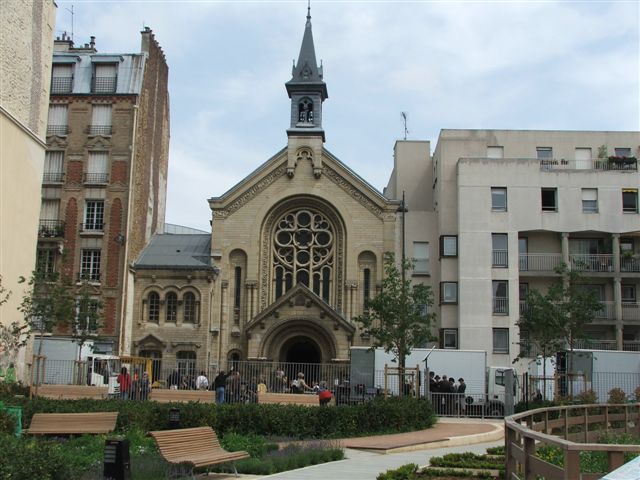
Description
The Église du Bon-Secours in the 11th arrondissement of Paris is a hidden gem that is often overlooked by tourists. This small, brick church was built in the late 18th century and exudes simplicity and charm. Despite its unassuming exterior, the church is a testament to the history and culture of the area. One of the most striking features of the Église du Bon-Secours is its size. At only 30 meters wide, the church is a refreshing change from the grandiose architecture that dominates much of Paris. Inside, visitors will find a peaceful and intimate space that is perfect for quiet reflection and contemplation. In addition to its architectural beauty, the Église du Bon-Secours also has a rich history. The church has served as a place of worship for the local community for over two centuries, and its walls have witnessed countless weddings, funerals, and other important events. Despite its historical significance, the Église du Bon-Secours remains a place of quiet simplicity and understated elegance. Whether you are a history buff, an architecture enthusiast, or simply looking for a peaceful spot to escape the hustle and bustle of Paris, this charming church is definitely worth a visit.
Key Features:
- The Église du Bon-Secours, located in the 11th arrondissement, is a historic church with a unique blend of architectural styles, including elements of both Baroque and neoclassical design.
- Visitors can explore the church's rich history, which dates back to the 17th century, and admire its ornate interior, featuring intricate woodwork and stunning stained glass windows.
Accessibility and Amenities:
- The museum is equipped with accessibility features to accommodate visitors with disabilities, including wheelchair access and accessible restrooms.
- Amenities at the Église du Bon-Secours include restroom facilities and a gift shop offering a selection of religious and historical souvenirs. Visitors can also avail themselves of informative audio guides to enhance their experience.
Planning Your Visit:
- To avoid crowds, it's best to visit the Église du Bon-Secours during weekday mornings or late afternoons.
- On average, visitors spend approximately 45 minutes to an hour exploring the church and its surroundings. A suggested itinerary includes visiting nearby attractions such as local cafes and shops to complement the experience.
Église du Bon-Secours: an 18th-century church in eastern Paris
Église du Bon-Secours is an 18th-century church at 20 rue Titon in Paris’s 11th arrondissement. Its classical façade gives the building a composed, formal presence on a street defined more by everyday neighbourhood life than by monumental sightseeing. It rewards visitors who enjoy noticing the smaller-scale religious and architectural landmarks that help explain Paris beyond its headline sites.
The church’s significance lies in that local role as much as in its age. Bon-Secours serves the surrounding community as a parish church, placing it within the continuing religious life of the arrondissement rather than presenting it as a detached historic display. Approach it with the expectations of a working place of worship: the façade is the clearest architectural feature to observe, while access and activity can depend on the church’s current programme.
Location and neighbourhood context
Rue Titon sits in the 11th arrondissement, an eastern Paris district whose dense network of streets mixes homes, independent shops, cafés and local services. This is a useful stop for travellers walking through the arrondissement at an unhurried pace, especially those interested in the transition from grand central Paris to the more lived-in quarters east of the city centre.
The immediate setting is urban rather than parkland or riverfront, so frame a visit as part of a neighbourhood walk rather than a destination requiring a long standalone itinerary. Allow time to explore the surrounding streets, then return to the church frontage to appreciate how its classical order contrasts with the close-grained fabric of the 11th. The address is the most reliable point to use when planning your route.
Visitor highlights
- An 18th-century landmark: a concise stop for visitors building a picture of Parisian religious architecture beyond the city’s largest churches.
- A classical façade: the principal feature noted for the church, best appreciated slowly from rue Titon.
- A local perspective on the 11th: the church suits walkers who prefer residential streets and community landmarks to a tightly scheduled circuit of major monuments.
- A reflective stop: its parish role makes it particularly appropriate for respectful, quiet visitors.
Practical planning tips
Visit in daylight if your priority is observing the exterior and placing the building within its street setting. Keep the stop flexible: churches may have restricted access outside worship, ceremonies or parish activity, and arrangements can change. Before setting out, consult the church’s official website for current information and follow any guidance posted on site.
Allow extra time only if you are combining Bon-Secours with a wider walk in the 11th; the appeal is in close observation and context, not in rushing through a checklist. Dress and behave as you would in an active religious building, keep voices low, and avoid interrupting services or private events. Photography, where permitted, should always remain discreet.
Frequently asked questions
Where is Église du Bon-Secours?
It stands at 20 rue Titon in the 11th arrondissement of Paris.
What is the church known for?
It is known as an 18th-century church with a classical façade and an ongoing parish role in the local community.
Can visitors enter Église du Bon-Secours?
Access may depend on the day’s worship and parish programme. Check the official church website before your visit and respect any instructions on arrival.