
<\!-- wp:heading -->
Michel Noblet\u2019s 17th-century water point and Marie de Médicis\u2019 aqueduct legacy
<\!-- /wp:heading --><\!-- wp:paragraph -->
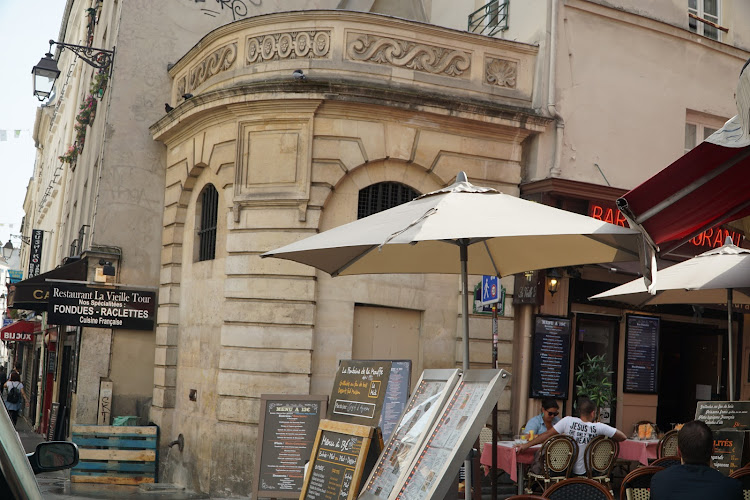
At the corner of rue Mouffetard and rue du Pot-de-Fer in the 5th arrondissement, the Fontaine du Pot-de-Fer stands as a charming survivor of 17th-century Parisian water infrastructure and a testament to the ambitious hydraulic engineering projects that transformed urban life during the Ancien Régime. Built in 1671 by Michel Noblet, royal architect and guardian of the city\u2019s fountains, this elegant neighborhood fountain represents one of the exclusive network of water points fed by Marie de Médicis\u2019 revolutionary aqueduct system.
<\!-- /wp:paragraph --><\!-- wp:parameter --><\!-- wp:paragraph -->
The fountain\u2019s creation replaced a medieval well that had served the corner since 1624, demonstrating how 17th-century urban planning could enhance neighborhood amenities while connecting local communities to comprehensive water supply systems that served broader municipal needs and royal hydraulic ambitions.
<\!-- /wp:paragraph --><\!-- wp:heading {"level":3} -->
Marie de Médicis\u2019 aqueduct and exclusive water access
<\!-- /wp:heading --><\!-- wp:parameter --><\!-- wp:paragraph -->
The fountain\u2019s connection to the Médicis aqueduct (also known as the Arcueil or Rungis waters aqueduct) placed it among only fifteen water points fed by this impressive construction project begun in 1613 on Marie de Médicis\u2019 orders. This exclusive access made the fountain a rare and precious water source for the Saint-Médard borough, later the Saint-Marceau quarter annexed to Paris in 1730.
<\!-- /wp:paragraph --><\!-- wp:parameter --><\!-- wp:paragraph -->
The aqueduct\u2019s engineering achievement, bringing fresh water from distant sources to serve Parisian neighborhoods, demonstrates royal commitment to urban improvement while creating infrastructure that would serve community needs for centuries after its original construction and royal patronage.
<\!-- /wp:paragraph --><\!-- wp:heading {"level":3} -->
Noblet\u2019s architectural design and decorative sophistication
<\!-- /wp:heading --><\!-- wp:parameter --><\!-- wp:paragraph -->
Michel Noblet\u2019s design features simple yet elegant construction with double façade meeting at a rounded corner, creating quarter-circle plan topped by terrace that demonstrates sophisticated understanding of how urban fountains could achieve both functional water distribution and aesthetic distinction within neighborhood settings.
<\!-- /wp:paragraph --><\!-- wp:parameter --><\!-- wp:paragraph -->
The decorative program includes shallow rustication on each façade, round arches pierced by windows, and elaborate cornice decorated with shells, waves, and volutes. The projecting cornice\u2019s rusticated balustrade adorned with friezes of shells, volutes, and stylized flowers creates comprehensive artistic environments that elevate utilitarian infrastructure to neighborhood landmarks worthy of architectural appreciation.
<\!-- /wp:paragraph --><\!-- wp:heading {"level":3} -->
Historic monument preservation and neighborhood identity
<\!-- /wp:heading --><\!-- wp:parameter --><\!-- wp:paragraph -->
The fountain\u2019s 1925 listing as Historic Monument and 1975 site protection for its historic and picturesque character acknowledges both architectural achievement and crucial role in documenting Parisian water infrastructure development while preserving important connections to royal urban planning initiatives that shaped neighborhood character and community life.
<\!-- /wp:paragraph --><\!-- wp:parameter --><\!-- wp:paragraph -->
The angular cartouche decorated with mosaics by street artist Invader demonstrates how historic monuments can accommodate contemporary artistic expression while maintaining essential character as neighborhood focal points that connect residents to both historical heritage and contemporary cultural life.
<\!-- /wp:paragraph --><\!-- wp:heading {"level":3} -->
Contemporary challenges and community heritage
<\!-- /wp:heading --><\!-- wp:parameter --><\!-- wp:paragraph -->
While the fountain\u2019s water flow—reduced to a small tap on rue Mouffetard that disappeared in 2018—reflects contemporary challenges in maintaining historic water infrastructure, the monument\u2019s survival as neighborhood landmark demonstrates how architectural heritage can maintain cultural significance even when original function changes or disappears.
<\!-- /wp:paragraph --><\!-- wp:parameter --><\!-- wp:paragraph -->
For visitors to the Latin Quarter interested in 17th-century urban planning, royal water infrastructure, or neighborhood architectural heritage, the Fontaine du Pot-de-Fer offers insight into how royal hydraulic projects served local community needs while creating beautiful urban amenities. The fountain proves that great urban infrastructure emerges when royal vision meets neighborhood requirements, creating monuments that serve both practical needs and cultural identity while establishing lasting architectural landmarks that enhance neighborhood character and community pride across centuries of urban development and social change.
<\!-- /wp:paragraph -->