
<\!-- wp:heading -->
The Duke of Chartres\u2019 English fantasy garden with Ledoux\u2019s neoclassical rotonde
<\!-- /wp:heading --><\!-- wp:paragraph -->
At the junction of Boulevard de Courcelles, Rue de Prony, and Rue Georges Berger in the 8th arrondissement, Parc Monceau represents one of Paris\u2019s most elegant public gardens and a fascinating document of 18th-century landscape design evolution. Created by Philippe d\u2019Orléans, Duke of Chartres and cousin of Louis XVI, this 8.2-hectare English-style garden reflects aristocratic fascination with English culture and innovative approaches to landscape architecture that challenged French formal garden traditions.
<\!-- /wp:paragraph --><\!-- wp:paragraph -->
The Duke\u2019s commission to multi-disciplined artist Louis de Carmontelle in 1778, with the specific stipulation that the garden be designed in English style, reflected broader 18th-century cultural exchanges between France and England. This Anglophile vision created one of Paris\u2019s first examples of naturalistic landscape design, establishing precedents that would influence French garden design for generations.
<\!-- /wp:paragraph --><\!-- wp:heading {"level":3} -->
Theatrical landscape design and architectural follies
<\!-- /wp:heading --><\!-- wp:paragraph -->
Carmontelle\u2019s original design created a flamboyant, theatrical garden filled with exotic architectural follies including a Dutch windmill, Egyptian pyramid, minaret, ruined watermill, and a naumachia (oval pond for sea jousting). These diverse elements, also known as the “Follies de Chartres,” reflected 18th-century fascination with exotic cultures and historical periods while creating picturesque encounters that transformed garden walks into cultural journeys.
<\!-- /wp:paragraph --><\!-- wp:parameter --><\!-- wp:paragraph -->
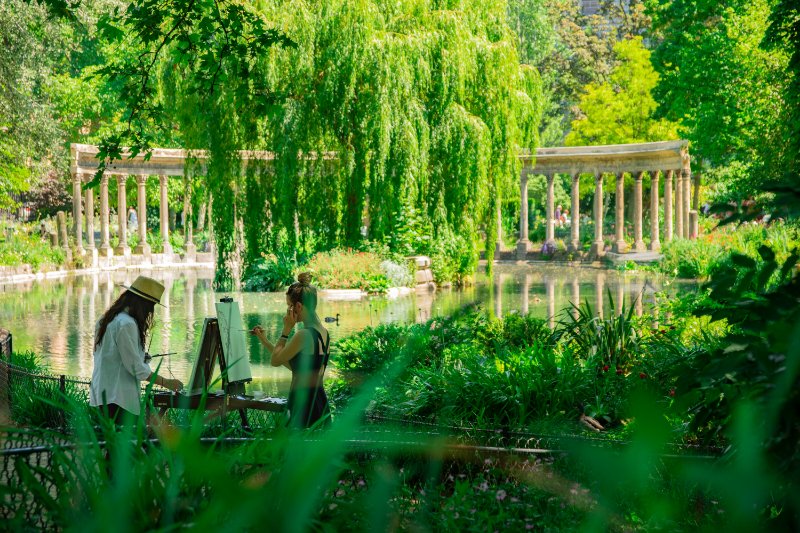
The garden\u2019s most impressive surviving feature is the grand Corinthian colonnade bordering the Naumachie, which carries profound historical significance as part of the Rotonde de Valois memorial that Marie de Médicis had constructed to commemorate Henri IV. When the Bourbons demolished this monument at Saint-Denis in 1719, the Duke of Chartres rescued these classical elements, demonstrating how landscape design could preserve architectural heritage while serving contemporary aesthetic purposes.
<\!-- /wp:paragraph --><\!-- wp:heading {"level":3} -->
Thomas Blaikie\u2019s landscape refinement
<\!-- /wp:heading --><\!-- wp:parameter --><\!-- wp:paragraph -->
In 1781, changing garden fashions led to the engagement of Scottish landscape gardener Thomas Blaikie, renowned designer of the Jardin de Bagatelle, to transform the exotic follies into a more traditional English landscape style. Blaikie\u2019s naturalistic approach emphasized harmony between trees, lawns, and paths designed to blend into the natural landscape rather than imposing artificial geometric patterns.
<\!-- /wp:paragraph --><\!-- wp:parameter --><\!-- wp:paragraph -->
This collaboration between Carmontelle\u2019s theatrical vision and Blaikie\u2019s naturalistic expertise created a unique synthesis that preserved the garden\u2019s exotic elements while achieving the pastoral tranquility characteristic of the finest English gardens. The result influenced French landscape design while maintaining distinctive Parisian character.
<\!-- /wp:paragraph --><\!-- wp:heading {"level":3} -->
Ledoux\u2019s Pavilion de Chartres and neoclassical gateway
<\!-- /wp:heading --><\!-- wp:parameter --><\!-- wp:paragraph -->
The garden\u2019s most architecturally significant structure is Claude Nicolas Ledoux\u2019s Pavilion de Chartres, built in 1787 as part of the Wall of the Farmers-General. This circular rotunda in neoclassical Doric temple style served dual functions: the ground floor operated as a customs house, while the upper floor provided an apartment with garden views reserved for the Duke.
<\!-- /wp:paragraph --><\!-- wp:parameter --><\!-- wp:paragraph -->
Ledoux\u2019s design demonstrates how utilitarian structures could achieve architectural excellence while serving both practical and ceremonial purposes. The pavilion\u2019s later dome addition by Gabriel Davioud in the 19th century enhanced its visual prominence while maintaining Ledoux\u2019s essential neoclassical character.
<\!-- /wp:paragraph --><\!-- wp:heading {"level":3} -->
Surviving follies and romantic atmosphere
<\!-- /wp:heading --><\!-- wp:parameter --><\!-- wp:paragraph -->
Today, visitors can still discover remnants of the original follies, including the Egyptian pyramid and a small bridge modeled after Veniceu2019s Rialto Bridge, creating romantic encounters that transform ordinary park walks into cultural adventures. These surviving elements maintain the garden\u2019s original spirit as a place where architectural imagination could flourish within naturalistic landscape settings.
<\!-- /wp:paragraph --><\!-- wp:parameter --><\!-- wp:paragraph -->
The park\u2019s waterfalls, grotto, and harmonious arrangement of green spaces continue to demonstrate how English garden principles could be successfully adapted to Parisian urban contexts while serving both aesthetic and recreational purposes for diverse audiences.
<\!-- /wp:paragraph --><\!-- wp:heading {"level":3} -->
Contemporary public garden and cultural accessibility
<\!-- /wp:heading --><\!-- wp:parameter --><\!-- wp:paragraph -->
The transformation from aristocratic private garden to beloved public park demonstrates how revolutionary social changes could democratize landscape beauty while preserving essential design principles and architectural elements. Parc Monceau\u2019s accessibility ensures that the Duke of Chartres\u2019 vision of combining exotic architectural elements with naturalistic landscape design continues to serve Parisian cultural life.
<\!-- /wp:paragraph --><\!-- wp:parameter --><\!-- wp:paragraph -->
For visitors to Paris interested in landscape history, neoclassical architecture, or the evolution of public parks, Parc Monceau offers an exceptional synthesis of 18th-century aristocratic garden vision, English landscape principles, and democratic public access. The park demonstrates how the finest landscape design transcends its original social context to serve broader cultural purposes while maintaining its essential character as a place where architectural imagination enhances natural beauty.
<\!-- /wp:paragraph -->