
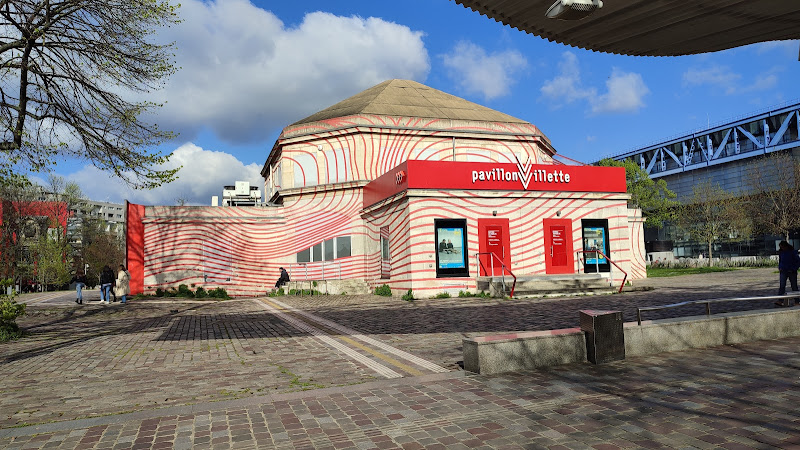
Where cattle auctions became cultural theater
In the expansive cultural landscape of Parc de la Villette, the Pavillon de la Bourse stands as a remarkable example of architectural adaptation and cultural transformation. This elegant 19th-century building, which once rang with the voices of cattle auctioneers and the bellowing of livestock, now resonates with the applause of theater audiences and the creativity of performing arts.
The heart of Napoleon III’s grand design
Constructed between 1865 and 1866 as part of Baron Haussmann’s massive urban restructuring under Napoleon III, the Pavillon de la Bourse served as the livestock exchange (“bourse aux bestiaux à la criée”) for what would become Europe’s largest centralized slaughterhouse complex. Designed under the architectural direction of Victor Baltard—famous for his iconic Les Halles pavilions—this building was the commercial heart of an operation that employed nearly 12,000 people and fed millions of Parisians.
The pavilion housed the crucial auction system where cattle, sheep, and pigs were bought and sold in public auctions that determined meat prices throughout Paris. This was where dealers, butchers, and suppliers gathered daily to conduct the business that supplied the capital with fresh meat, making the building one of the most economically important structures in 19th-century Paris.
A city within the city
During its operational period from 1867 to 1974, the Pavillon de la Bourse was the nerve center of the La Villette abattoirs, a complex so vast and important it was described as “a city within a city.” The building’s auction halls witnessed intense negotiations that determined not only meat prices but also the livelihoods of thousands of Parisians involved in the meat trade.
The architecture reflected the building’s commercial importance—robust yet refined, practical yet dignified. The structure needed to accommodate large gatherings of traders while projecting the authority and stability necessary for major financial transactions. Its design embodied the Second Empire’s vision of combining functionality with architectural dignity.
From industrial closure to cultural renaissance
When the La Villette abattoirs closed on March 15, 1974, marking the end of over a century of industrial activity, the site faced an uncertain future. Many buildings were demolished, but the Pavillon de la Bourse was among the precious few structures preserved for their architectural and historical significance.
The transformation of La Villette from industrial site to cultural park in the 1980s, under architect Bernard Tschumi’s innovative master plan, gave these historical buildings new purpose. The Pavillon de la Bourse found its perfect new role as the headquarters of the Théâtre Paris-Villette, continuing its function as a gathering place for the community, though now for cultural rather than commercial purposes.
Theater headquarters in historic walls
Today, the Pavillon de la Bourse serves as the administrative heart of the Théâtre Paris-Villette, one of the park’s important cultural institutions. From offices that once coordinated livestock auctions, theater administrators now organize performances, festivals, and cultural events that serve Paris’s diverse communities.
The theater itself, housed within the historic pavilion, underwent a major €1.1 million renovation in 2019. This careful restoration enhanced the facility’s technical capabilities while respecting its architectural heritage, improving acoustics, sightlines, and accessibility while preserving the building’s neoclassical character and historic archway backdrop.
Architectural heritage preserved
The Pavillon de la Bourse stands alongside other preserved structures from the abattoir era, including the magnificent Grande Halle, the Pavillon Janvier, the Pavillon du Charolais, and the Fontaine aux Lions. Together, these buildings form a historical ensemble that tells the story of Paris’s industrial past while serving contemporary cultural needs.
The building’s Second Empire architecture, with its characteristic blend of functionality and formal dignity, represents an important period in Parisian urban development. Its preservation ensures that future generations can understand the scale and importance of the La Villette industrial complex while enjoying its modern cultural amenities.
Cultural continuity
What makes the Pavillon de la Bourse particularly significant is how it maintains the building’s essential character as a place of gathering and exchange. While livestock has been replaced by theatrical performances, the building continues to serve its community as a place where value is created, culture is exchanged, and Parisians come together for shared experiences.
The headquarters function of the Théâtre Paris-Villette ensures that the building remains an active, working part of the park’s ecosystem rather than a static monument. This living heritage approach demonstrates how historical preservation can be both respectful of the past and relevant to contemporary needs.
Key information
- Construction: 1865-1866
- Architectural direction: Victor Baltard
- Original function: Livestock exchange and auction house
- Operating period: 1867-1974 (abattoir era)
- Current use: Headquarters of Théâtre Paris-Villette
- Architectural style: Second Empire, industrial neoclassical
- Recent renovation: 2019 (€1.1 million upgrade)
Visiting context
- Location: Parc de la Villette, 19th arrondissement
- Cultural significance: Part of the preserved abattoir complex
- Nearby attractions: Grande Halle, Pavillon Janvier, Cité des Sciences
- Access: Accessible as part of general park visits
- Theater programming: Contemporary performances and cultural events
Living heritage
The Pavillon de la Bourse exemplifies successful architectural adaptation and cultural continuity. Its transformation from livestock exchange to theater headquarters demonstrates how historical buildings can maintain their essential social function while serving entirely new purposes. For visitors to Parc de la Villette, it represents the layers of Parisian history, where the echoes of 19th-century commerce blend with 21st-century creativity, all within the walls of a building that has continuously served its community for over 150 years.