
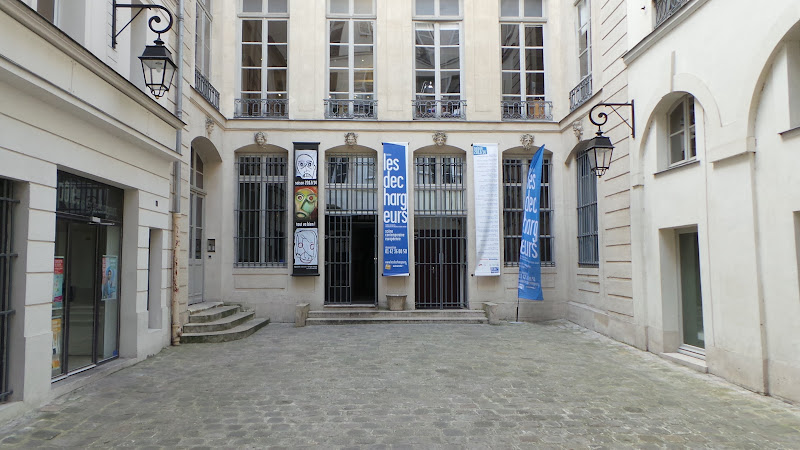
A neoclassical survivor in Paris’s cultural park
Standing elegantly amid the modern landscape of Parc de la Villette, the Pavillon Janvier serves as a tangible link between Paris’s industrial past and its cultural present. This distinguished neoclassical building, constructed in 1865, has witnessed the dramatic transformation of the 19th arrondissement from Europe’s largest slaughterhouse complex to one of Paris’s most innovative cultural spaces.
Birth of an administrative center
The Pavillon Janvier emerged during Baron Haussmann’s massive urban renovation of Paris in the 1860s. Designed by architect Jules de Mérindol, a student of the renowned Victor Baltard, with assistance from Louis-Adolphe Janvier (who lent his name to the building), this elegant structure was purpose-built to serve the administrative needs of the new centralized abattoirs de la Villette.
Opened on January 1, 1867, alongside the massive slaughterhouse complex, the Pavillon Janvier housed essential services for what would become one of Europe’s most important meat markets. The building accommodated the postal services and police offices necessary to manage the vast 39-hectare complex that replaced five older Parisian slaughterhouses.
Heart of industrial operations
For over a century, from 1867 to 1974, the Pavillon Janvier stood at the center of intense commercial activity. As the administrative headquarters of the abattoirs, it oversaw operations that processed meat for millions of Parisians. The building’s police offices maintained order in what was essentially a small city within Paris, while its postal services handled the enormous volume of correspondence generated by one of Europe’s busiest commercial centers.
The neoclassical architecture of the pavilion, with its dignified façade and balanced proportions, provided a civilized counterpoint to the industrial nature of the surrounding slaughterhouse activities. This architectural choice reflected the Second Empire’s desire to bring order and beauty even to utilitarian structures.
Transformation and preservation
When the last ox was slaughtered at La Villette on March 15, 1974, it marked the end of an era. The closure of the abattoirs could have meant demolition for many of the site’s buildings, but the Pavillon Janvier’s architectural merit and historical significance saved it from the wrecking ball. Recognized as an important example of 19th-century institutional architecture, it was registered as a supplementary historic monument, ensuring its preservation.
During the 1980s transformation of La Villette into a cultural park under architect Bernard Tschumi’s master plan, the Pavillon Janvier found new purpose. Rather than being relegated to museum status, it was given a vital administrative role that echoed its original function.
Modern administrative hub
Today, the Pavillon Janvier serves as the headquarters of the Établissement Public du Parc et de la Grande Halle de la Villette (EPPGHV), the public institution that manages Parc de la Villette. This continuity of administrative function across more than 150 years gives the building a unique position in the park’s ecosystem—it remains what it always was: the organizational heart of La Villette.
From its offices, administrators now coordinate cultural events, exhibitions, and performances rather than livestock arrivals and meat distribution. The transformation from industrial to cultural administration reflects the broader evolution of Paris from a 19th-century manufacturing center to a 21st-century cultural capital.
Architectural heritage
The Pavillon Janvier stands alongside other preserved structures from the abattoir era, including the magnificent Grande Halle (now an exhibition space), the Pavillon de la Bourse, and the Pavillon du Charolais. Together, these buildings form an architectural ensemble that tells the story of Paris’s industrial heritage while serving contemporary cultural needs.
Its neoclassical design, featuring symmetrical facades, elegant proportions, and refined decorative elements, represents the architectural ambitions of the Second Empire period. The building demonstrates how even functional structures were given aesthetic consideration, reflecting a belief that beauty and utility could coexist.
Key information
- Construction: 1865
- Architects: Jules de Mérindol with Louis-Adolphe Janvier
- Original function: Administrative offices, police station, and post office for the abattoirs
- Operating period: 1867-1974 (abattoir era)
- Current use: Headquarters of EPPGHV (Parc de la Villette management)
- Heritage status: Registered supplementary historic monument
Visiting context
- Location: Parc de la Villette, 19th arrondissement
- Architectural style: Neoclassical, Second Empire
- Nearby attractions: Grande Halle, Cité des Sciences, Philharmonie de Paris
- Historical significance: One of the few surviving buildings from the La Villette abattoir complex
Living heritage
The Pavillon Janvier embodies the successful adaptation of historical architecture to contemporary use. Unlike many heritage buildings that become static museums, it continues to fulfill an active administrative role, proving that preservation and functionality need not be mutually exclusive. For visitors to Parc de la Villette, it offers a glimpse into the layers of Parisian history, where the ghosts of the industrial past coexist with the vibrant cultural present, all housed within the elegant walls of a building that has served its community for over 150 years.