
Paris performs. For over a century, the French capital has served as cinema’s most photogenic backlot—a city where golden light strikes limestone facades at precisely the right angle, turning every street corner into a potential masterpiece. From the rain-slicked melancholy of 1920s dramas to the neon-lit chases of modern thrillers, directors have deployed Paris not merely as a backdrop, but as a lead character.
This guide moves beyond superficial tourism. Each entry dissects how filmmakers used these locations, the historical context behind them, and practical strategies for experiencing them yourself—complete with photography tips and insider logistics.
1. Café des Deux Moulins: the Amélie shrine
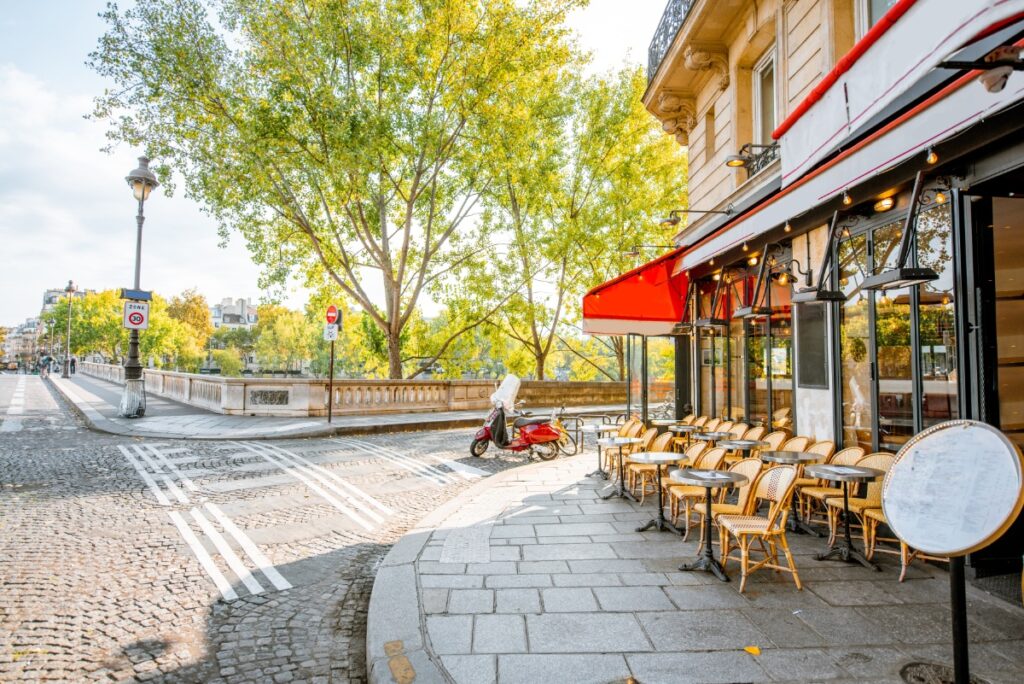
As seen in: Amélie (2001)
Address: 15 Rue Lepic, 18th arrondissement
Jean-Pierre Jeunet‘s whimsical romance transformed this working-class brasserie into a global pilgrimage site. The café serves as workplace to the titular character—a space where eccentrics gather, neuroses are indulged, and the simple act of cracking a crème brûlée becomes almost spiritual.
What’s real, what’s changed: The zinc bar, yellow ceiling molding, and lace curtains remain remarkably faithful to the 2001 film. The tobacco counter that played a central role (operated by the hypochondriac Georgette) was removed in 2002 when ownership changed. A small shrine near the restrooms displays movie memorabilia, including the traveling gnome.
The history: The café’s name (“Two Windmills”) references the nearby Moulin Rouge and Moulin de la Galette. Montmartre was originally a village outside Paris, known for windmills, vineyards, and cheaper tax-free wine. That independent, bohemian spirit pervades both the film and the neighborhood.
The ritual: The menu explicitly lists the Crème Brûlée d’Amélie. The custard is vanilla-heavy and classic—not avant-garde gastronomy, but it delivers the textural contrast the film fetishizes.
Best approach: Arrive when doors open (around 7:00 AM) to avoid the tourist crush. Morning light filtering through the lace curtains captures the film’s sepia nostalgia. Afterward, walk to 56 Rue des Trois Frères to find Monsieur Collignon’s grocery store, still functioning as a bodega called Maison Collignon.
2. Pont de Bir-Hakeim: the bridge that folds reality
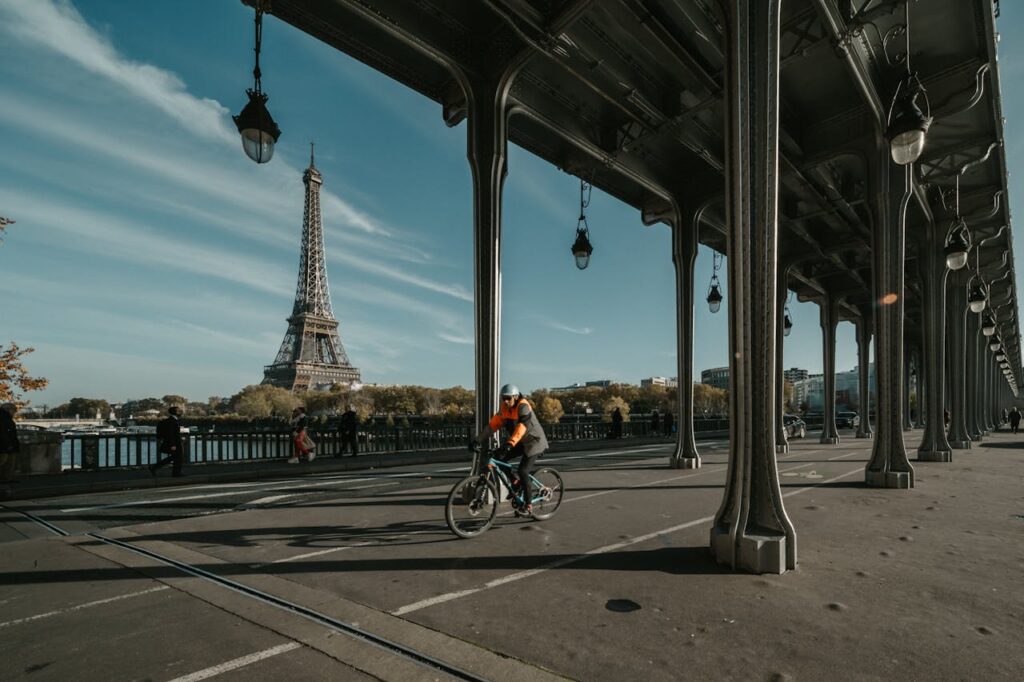
As seen in: Inception (2010), Last Tango in Paris (1972)
Location: Connecting the 15th and 16th arrondissements
In Christopher Nolan’s mind-bending thriller, this bridge becomes a classroom where Ariadne (Elliot Page) learns to manipulate dreamscapes. The steel colonnades create a mesmerizing, repetitive visual rhythm—Ariadne “folds” the bridge using mirrored doors, and the architecture seems designed for exactly that illusion.
Engineering the dream: The bridge’s symmetry is real, but the infinite reflection was achieved through VFX. Still, standing between the columns, the natural perspective lines are so strong that the bridge feels like an optical illusion even without CGI. Built between 1903 and 1905, it replaced an older footbridge and features a two-level design: the lower deck accommodates pedestrians, cyclists, and cars, while the upper level carries Metro Line 6.
The name: Originally called Pont de Passy, it was renamed in 1948 to commemorate the Battle of Bir Hakeim, where Free French forces fought the German Afrika Korps in Libya during World War II.
The Eiffel Tower angle: This bridge offers one of the most dynamic views of the Iron Lady. Because you’re slightly removed from the tower, you can frame it perfectly between the steel pillars—far superior to the crowded Trocadéro for photography.
Best approach: Visit at golden hour. The bridge runs roughly northwest-southeast, and low sun shoots through the metal columns, creating dramatic shadows. Rain is also ideal—the pedestrian walkway sits beneath the metro viaduct (covered), and wet pavement doubles the “dream” effect.
3. Steps of Saint-Étienne-du-Mont: the midnight portal
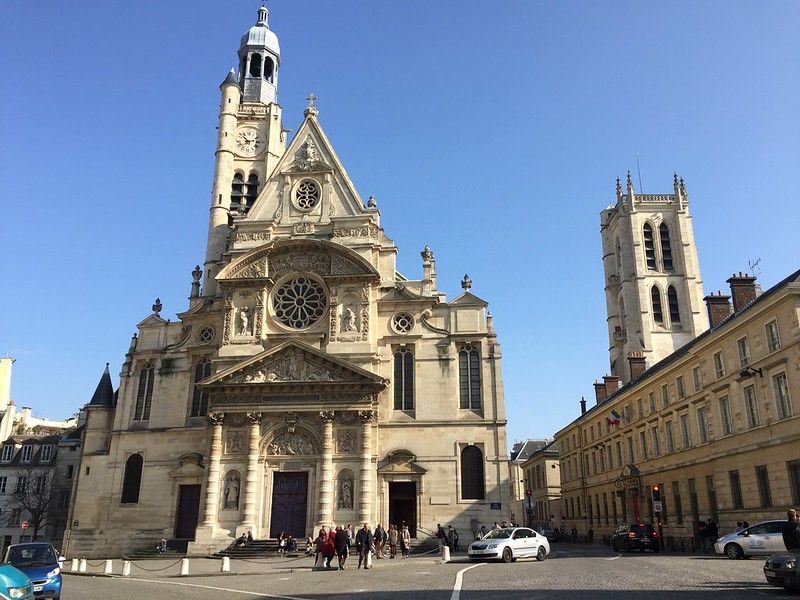
As seen in: Midnight in Paris (2011)
Location: North side of Église Saint-Étienne-du-Mont, 5th arrondissement
Woody Allen‘s love letter to nostalgia hinges on these steps. Gil Pender (Owen Wilson), slightly drunk and lost, sits here as the clock strikes midnight. A vintage 1920 Peugeot pulls up, and he’s whisked to the Jazz Age to party with Hemingway and the Fitzgeralds.
Why this corner: The specific steps face the Rue de la Montagne Sainte-Geneviève—one of the oldest streets in Paris, dating to Roman times. Allen chose this spot for its “timeless” quality: the stone walls and cobblestones have barely changed in centuries. Unlike grand boulevards lined with modern shops, this corner feels intimate and preserved.
The church interior: Most fans only visit the steps, but the interior of Saint-Étienne-du-Mont is arguably more impressive. It contains the only surviving rood screen (jubé) in Paris—a partition between the chancel and nave consisting of an intricate stone archway with spiral staircases that resembles lace carved from rock.
Best approach: Go at night. The street lamps cast a warm yellow glow that mimics the film’s color grading. Walk afterward to The Bombardier (an English pub across the road) or down to Place de la Contrescarpe for wine.
4. Shakespeare and Company: the literary nerve center
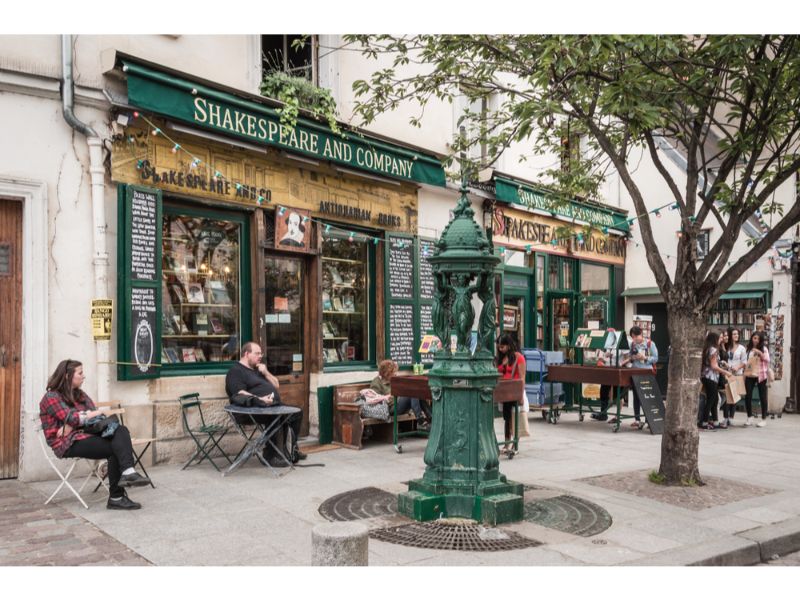
As seen in: Before Sunset (2004), Midnight in Paris (2011)
Address: 37 Rue de la Bûcherie, 5th arrondissement
In Richard Linklater’s Before Sunset, Jesse (Ethan Hawke) gives a reading here of his book—based on his night with Celine. She (Julie Delpy) appears in the periphery, sparking their reunion and their real-time walk through Paris.
The history: George Whitman opened this English-language bookstore in 1951, originally called Le Mistral. He renamed it in 1964 to honor Sylvia Beach’s original Shakespeare and Company—the legendary 1920s haven for Hemingway, Joyce, and Fitzgerald. The shop is a labyrinth of tumbling stacks, narrow corridors, and the smell of old paper.
The Tumbleweeds: The store maintains a tradition of letting writers sleep there free in exchange for working a few hours daily, reading a book a day, and writing a one-page autobiography. These guests are called “Tumbleweeds.” More than 30,000 people have slept in the shop since it opened.
The scent: The shop engages your olfactory senses—vanilla from degrading lignin in old paper, dust, and timber. It’s tactile; you’re encouraged to pull books off shelves and sit on mismatched furniture.
Important: Photography is generally forbidden inside to preserve the quiet atmosphere. Take exterior shots of the iconic green and yellow facade. The adjacent Shakespeare and Company Café serves coffee and vegetarian food with Notre-Dame views.
5. The Louvre and the Pyramid: conspiracy meets reality
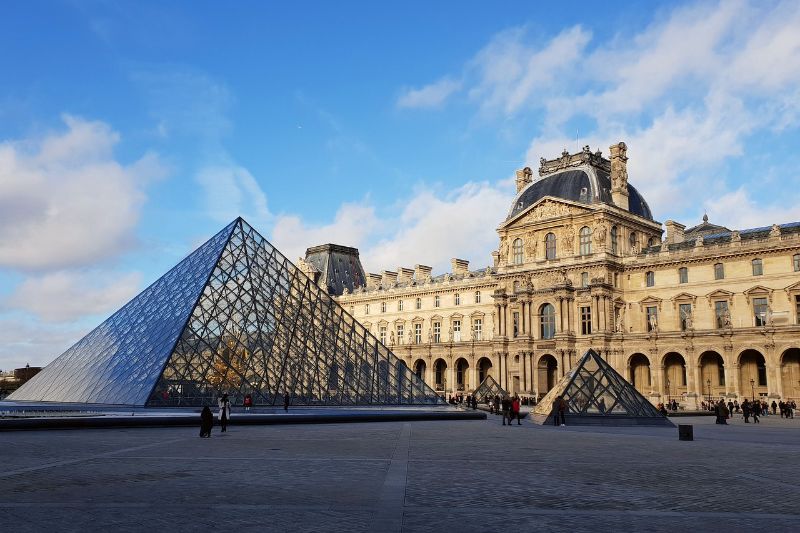
As seen in: The Da Vinci Code (2006), John Wick: Chapter 4 (2023)
Location: Cour Napoléon, 1st arrondissement
For The Da Vinci Code, the Louvre is the catalyst—where curator Jacques Saunière is murdered and Robert Langdon begins his quest. The film closes with a revelation about the Inverted Pyramid in the underground mall. In John Wick 4, the Marquis holds court in the galleries, the setting underscoring his connection to old money and power.
The 666 myth, debunked: Dan Brown’s novel claims the pyramid contains 666 panes of glass—the “number of the beast”—supposedly commissioned by President Mitterrand. This is false. The pyramid actually contains 673 panes (603 rhombi and 70 triangles). The myth originated from a brochure typo in the 1980s.
The “Mary Magdalene” spot: At The Da Vinci Code‘s end, the camera pans to the Inverted Pyramid (La Pyramide Inversée) in the Carrousel du Louvre shopping mall. In reality, there’s no secret chamber beneath it—just the concrete floor of a mall. Tourists still touch the small stone pyramid below for luck.
Filming constraints: The production was strictly forbidden from shining bright lights on paintings (to prevent damage) and couldn’t spill fake blood on the floor. Many “Louvre” scenes were actually filmed on sets at Pinewood Studios.
Best approach: Visit the Cour Napoléon at night. The pyramid glows from within against the dark Renaissance palace—hauntingly beautiful and usually empty of crowds.
6. Place de la Concorde: fashion’s liberation point
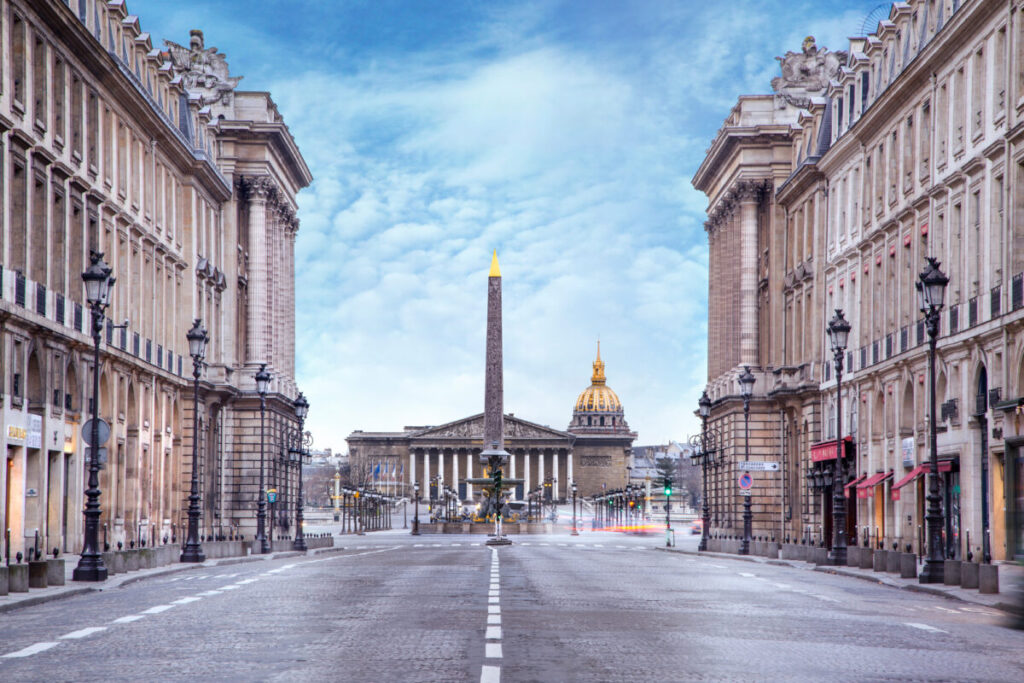
As seen in: The Devil Wears Prada (2006)
Location: 8th arrondissement
This is the climax of Andy Sachs’ (Anne Hathaway) arc. After realizing high fashion is stripping away her soul, she exits Miranda Priestly’s limousine during Paris Fashion Week. Standing near the fountain, she receives a call from Miranda—and throws her phone into the basin, turning her back on Runway magazine.
Which fountain: There are two. Andy tosses her phone into the Fontaine des Fleuves (Fountain of River Commerce and Navigation), the one closer to the north side near the Hôtel de Crillon. The statues represent the Rhône and Rhine rivers.
The dark history: This is the largest square in Paris. During the French Revolution (when it was called Place de la Révolution), Louis XVI, Marie Antoinette, and Robespierre were guillotined here.
The geometry: Walk to the center near the Luxor Obelisk (a 3,300-year-old gift from Egypt). From here, you have 360-degree alignment: the Madeleine Church to the north, the Assemblée Nationale to the south, the Tuileries/Louvre to the east, and the Champs-Élysées/Arc de Triomphe to the west.
Traffic warning: The square functions as a massive roundabout with intense traffic. Use pedestrian crossings.
7. Le Caveau de la Huchette: the jazz cellar that inspired La La Land
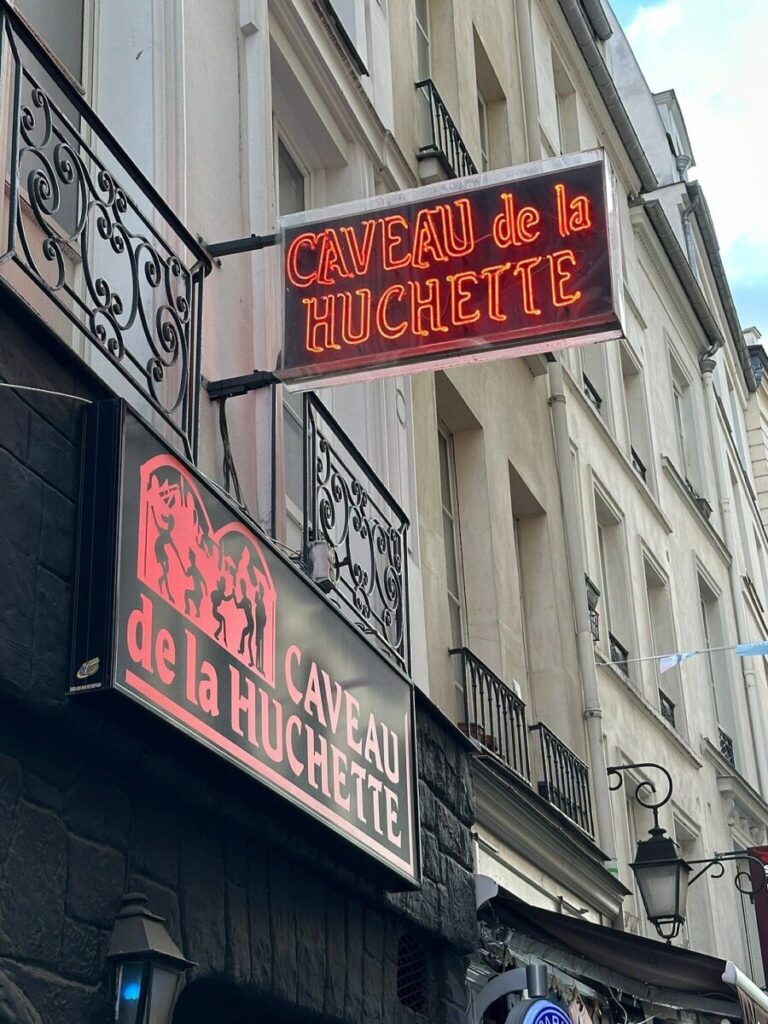
As seen in: La La Land (2016)
Address: 5 Rue de la Huchette, 5th arrondissement
During La La Land‘s “what if” dream sequence, Mia and Sebastian enjoy hot jazz in a crowded, cavernous club in Paris. This location symbolizes Sebastian’s dream realized—a place where jazz thrives, untainted by commercialism.
The real deal: Housed in a 16th-century building, Le Caveau de la Huchette has operated as a jazz club since 1946. Jazz greats including Lionel Hampton, Count Basie, and Art Blakey have played here. The club allegedly inspired the Cavern Club in Liverpool (where the Beatles started).
The layout: A bar occupies the ground floor, but the magic happens downstairs in the stone cellar. The space creates a natural acoustic chamber—dark, humid, and loud. The club focuses on swing and big band jazz, emphasizing joy and movement over brooding bebop.
The Ryan Gosling effect: Since the film’s release, the club has seen surging visitor numbers. Despite this, it has retained its authenticity—locals still swing dance here with serious skill, and you’re welcome to join.
Logistics: No reservations—first-come, first-served. Arrive around 9:00 PM (concerts usually begin at 9:30 PM) for a table near the band. The entrance fee runs around €14-16. Expect heat and movement; dress comfortably.
8. Bistrot La Renaissance: Tarantino’s time capsule
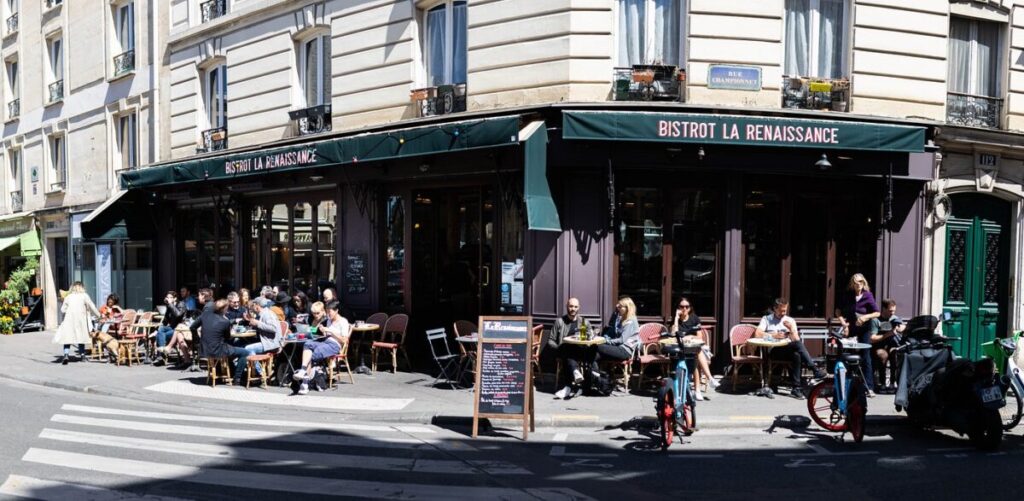
As seen in: Inglourious Basterds (2009)
Address: 112 Rue Championnet, 18th arrondissement
In Quentin Tarantino‘s revisionist war film, Shosanna Dreyfus (Mélanie Laurent) realizes she’s being courted by a German war hero. The scene is tense, layered with dramatic irony—and it’s the only scene in the movie actually filmed in Paris (most “Paris” scenes were shot in Germany).
Why here: Tarantino found this bistro while scouting and loved that it required almost no set dressing. The Art Deco interior—etched glass, ceramic tiles, 1930s woodwork—has remained nearly untouched. He reportedly discovered it after seeing it in a Claude Chabrol film.
The neighborhood: Located in the Jules Joffrin area, this is deep 18th arrondissement territory, removed from tourist Montmartre. It’s a working-class, diverse, and authentic neighborhood. The menu delivers traditional bistro fare—steak tartare, confit de canard—at reasonable prices.
Best approach: Request a window seat or a table near the large mirrors to capture the stained glass reflections, mimicking the film’s cinematography. Bring a book, order a glass of rouge, and soak in the 1940s atmosphere.
9. Palais Garnier: phantoms and assassins
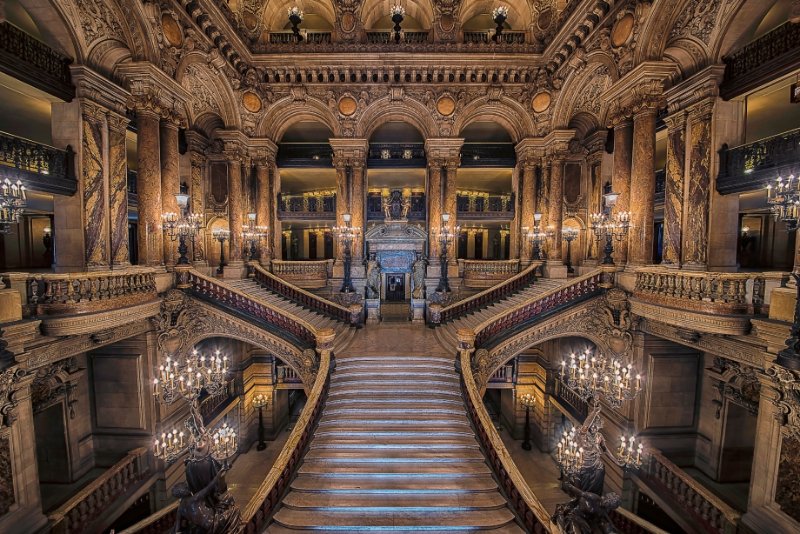
As seen in: The Phantom of the Opera (various), John Wick: Chapter 4 (2023), Emily in Paris
Location: Place de l’Opéra, 9th arrondissement
In John Wick 4, the assassin Caine meets the Marquis in the Grand Foyer—a space dripping with gold leaf and chandeliers that illustrates the High Table’s immense wealth. The Palais Garnier is also inextricably linked to The Phantom of the Opera, from the specific Box 5 reserved for the Phantom to the underground “lake.”
Fact inspiring fiction: Gaston Leroux’s novel drew from real events. In 1896, a counterweight from the grand chandelier fell, killing a construction worker (not the whole chandelier, as dramatized). There’s an actual underground water tank beneath the opera house—used by Paris firefighters for diving training—which inspired the Phantom’s lair.
The architecture: Built by Charles Garnier from 1861 to 1875, this Neo-Baroque opera house represents the peak of Napoleon III style. The Grand Foyer was designed to act as a drawing room for Paris society, more spectacular even than the auditorium itself.
Box 5: You can visit Box 5 (Loge 5), which often has a plaque indicating it “belongs” to the Phantom of the Opera. It offers excellent stage views.
Access: You don’t need an opera ticket to see the interior. Visitor tickets (approximately €14) allow you to roam the foyer, the staircase, and usually peek into the auditorium.
10. Rue Foyatier: the Sisyphean climb
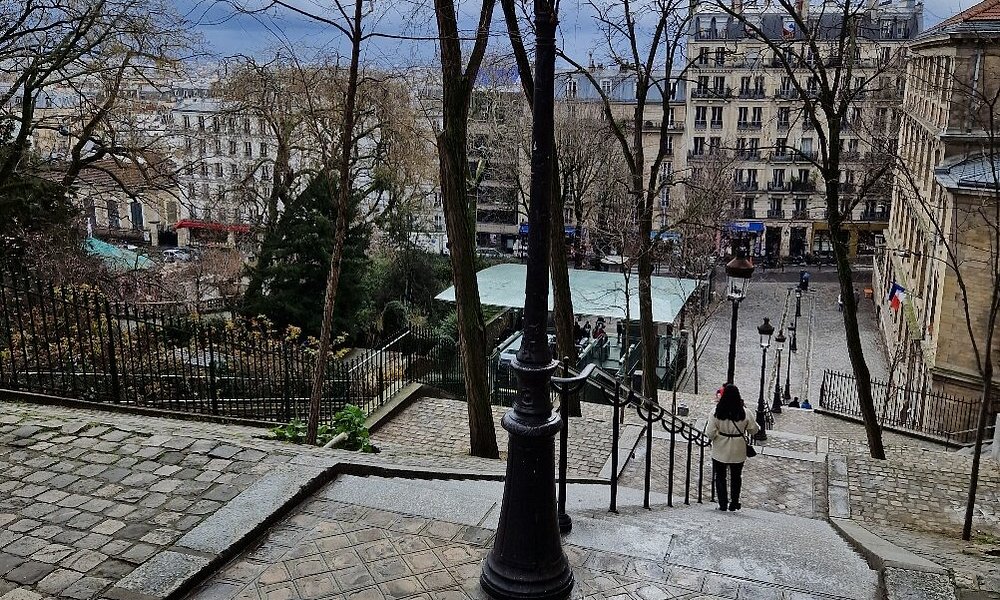
As seen in: John Wick: Chapter 4 (2023)
Location: Montmartre, 18th arrondissement
In John Wick 4‘s climactic sequence, John (Keanu Reeves) must ascend 222 steps to reach the Sacré-Cœur for his duel at sunrise. He fights his way up, tossing enemies aside, only to be kicked back to the bottom—a visceral metaphor evoking the myth of Sisyphus.
The stunt: Keanu Reeves performed most of the fighting going up the stairs, but the brutal fall back down was performed by stunt double Vincent Bouillon. The production filmed over five nights, and Bouillon completed the full fall in just his second take—no digital effects other than removing the tracking camera.
Director’s inspiration: Chad Stahelski was scouting the Sacré-Cœur (drawn by its appearance in Amélie) when he saw the foggy stairs at night. Reminded of the famous steps in The Exorcist, he decided immediately that John Wick had to suffer on them.
The timer: In the movie, John has minutes to reach the top before sunrise. In reality, you can take the Funiculaire de Montmartre (using a standard metro ticket) to avoid the climb.
Best approach: For the most cinematic experience, visit at sunrise. You’ll get the view of the city waking up from the top—and you’ll avoid the swarms of tourists that clog the steps by 10:00 AM. For coffee afterward, head to KB CaféShop (53 Avenue Trudaine).
Quick reference: planning your itinerary
Location | Film | Best time | Cost |
|---|---|---|---|
Café des Deux Moulins | Amélie | 7:00 AM | € (coffee/dessert) |
Pont de Bir-Hakeim | Inception | Golden hour / rain | Free |
Steps of St-Étienne | Midnight in Paris | Midnight | Free |
Shakespeare & Co. | Before Sunset | Early morning / evening | Free (browsing) |
Louvre Pyramid | The Da Vinci Code | Night (illuminated) | Free (exterior) |
Place de la Concorde | The Devil Wears Prada | Daytime | Free |
Caveau de la Huchette | La La Land | 9:00 PM onward | €€ (cover) |
Bistrot La Renaissance | Inglourious Basterds | Lunch/dinner | €€ |
Palais Garnier | Phantom / John Wick | Daytime tours | €€ (ticket) |
Rue Foyatier | John Wick 4 | Sunrise | Free |
All locations are subject to standard business hours and may have changed since publication. Some filming locations are private residences or businesses—please respect local residents and staff.
Find Things to Do in Paris
Find Accommodation

Continue Planning Your Paris Trip
How Many Hours to Actually Spend in the Louvre?
How long do you really need in the Louvre? With 35,000+ works you can't see it all, so…
Read Guide →11 Best Proposal Spots in Paris: A Local’s Guide to the Most Romantic Locations for Popping the Question
Where to propose in Paris? A local's 11 picks, from cliff-top parks and hidden rooftops to quiet garden…
Read Guide →
Promenade Plantée Walk: Paris’ Unique Elevated Garden Adventure
Paris has a ton of famous walks, but the Promenade Plantée still feels like one of the city’s…
Read Guide →