
<\!-- wp:heading -->
An industrial cathedral pioneering sacred architecture
<\!-- /wp:heading --><\!-- wp:paragraph -->
At 59 rue Vercingetorix in the 14th arrondissement, the Église Notre-Dame-du-Travail stands as one of Paris\u2019s most revolutionary religious buildings. Constructed between 1897 and 1902 for the working-class population of the Plaisance neighborhood, this remarkable church boldly integrates industrial materials and aesthetics into sacred architecture, creating a space that speaks directly to the souls of laborers.
<\!-- /wp:paragraph --><\!-- wp:parameter --><\!-- wp:paragraph -->
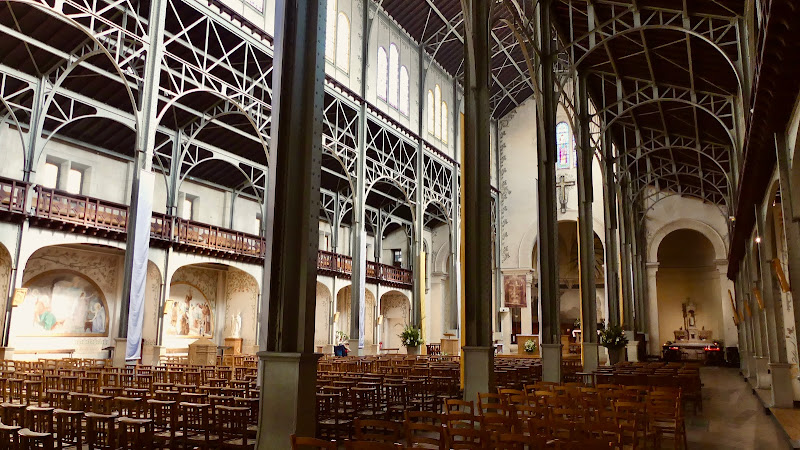
Architect Jules Astruc designed this church with the radical intention that “it would call to the mind of the worker his factory, surrounded by a familiar milieu.” This vision resulted in a building where traditional Romanesque exterior conceals a breathtaking industrial interior that celebrates rather than disguises its structural elements.
<\!-- /wp:paragraph --><\!-- wp:heading {"level":3} -->
Revolutionary use of industrial materials
<\!-- /wp:heading --><\!-- wp:paragraph -->
The church\u2019s most striking feature is its exposed steel framework requiring 135 tonnes of iron and steel. According to historical accounts, much of this material was recovered from the demolished Palace of Industry from the 1855 Paris Universal Exposition, giving the church a direct connection to French industrial heritage and the age of progress.
<\!-- /wp:paragraph --><\!-- wp:paragraph -->
The grandiose metal structure creates an extraordinary interior where columns and arches rise like cathedral buttresses, but in honest steel rather than carved stone. This visible reinforcement system transforms what could have been merely functional architecture into a celebration of the beauty inherent in industrial design and engineering.
<\!-- /wp:paragraph --><\!-- wp:heading {"level":3} -->
Art Nouveau meets industrial aesthetics
<\!-- /wp:heading --><\!-- wp:paragraph -->
To balance the industrial framework with spiritual contemplation, the lateral chapels feature large Art Nouveau murals that soften the church\u2019s metallic environment. This thoughtful integration demonstrates how the church successfully merges different artistic movements to create a cohesive and spiritually uplifting space.
<\!-- /wp:paragraph --><\!-- wp:paragraph -->
The combination represents an fascinating evolution from Art Nouveau toward early 20th-century modernism, showing how sacred architecture could embrace contemporary artistic and industrial developments while maintaining its essential spiritual function.
<\!-- /wp:paragraph --><\!-- wp:heading {"level":3} -->
Social Catholicism in architectural form
<\!-- /wp:heading --><\!-- wp:paragraph -->
Notre-Dame-du-Travail embodies the principles of social Catholicism, a movement that sought to address the spiritual needs of industrial workers during rapid urbanization. By incorporating the visual language of factories and workshops into sacred space, the church demonstrated that holiness could be found in everyday labor and industrial life.
<\!-- /wp:paragraph --><\!-- wp:paragraph -->
This architectural philosophy represented a radical departure from traditional church design, arguing that workers should feel at home in their house of worship rather than alienated by unfamiliar aristocratic or medieval references. The church thus became a powerful statement about the dignity of work and the sacred nature of industrial society.
<\!-- /wp:paragraph --><\!-- wp:heading {"level":3} -->
Architectural innovation and historic recognition
<\!-- /wp:heading --><\!-- wp:paragraph -->
The church\u2019s groundbreaking design makes it one of the earliest examples of honest structural expression in religious architecture, predating similar developments in modernist church design by several decades. The decision to leave the steel framework exposed rather than concealed shows remarkable architectural courage and vision.
<\!-- /wp:parameter --><\!-- wp:paragraph -->
Recognition of the church\u2019s significance came in 2016 when it was registered as a historic monument in its entirety. This designation acknowledges both its architectural innovation and its importance as a document of social and religious history during France\u2019s industrial transformation.
<\!-- /wp:paragraph --><\!-- wp:heading {"level":3} -->
A unique spiritual-industrial synthesis
<\!-- /wp:heading --><\!-- wp:paragraph -->
Today, Notre-Dame-du-Travail continues to serve the Plaisance community while attracting visitors fascinated by its unique architectural approach. The church demonstrates how innovative design can honor both spiritual tradition and contemporary social reality, creating a space that is simultaneously ancient in purpose and modern in expression.
<\!-- /wp:paragraph --><\!-- wp:paragraph -->
For architecture enthusiasts, the church offers an extraordinary example of how industrial materials can create sacred atmosphere. For those interested in social history, it provides insight into how religious institutions adapted to serve urban working populations. The church stands as a testament to the possibility of creating authentic spiritual architecture that speaks directly to its community\u2019s lived experience.
<\!-- /wp:paragraph -->