
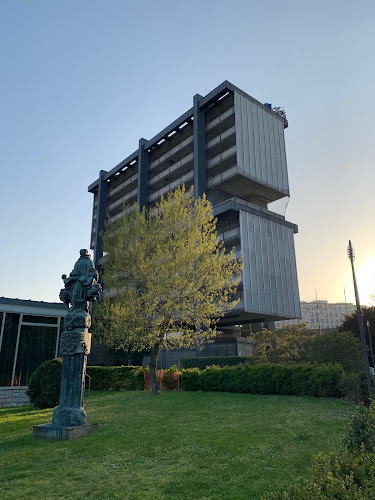
The Fondation Avicenne is a student residence at 27 D boulevard Jourdan, 75014 Paris, on the campus of the Cité internationale universitaire de Paris. Built as the Maison de l’Iran and inaugurated in November 1969, it is the tallest building on the campus at 38 metres and one of the very few buildings in France whose living space hangs from an external steel frame rather than resting on the ground. It has been an inscribed monument historique since 29 October 2008. After closing to residents in 2007, it reopened in September 2024 with 111 rooms following a rehabilitation by Béguin & Macchini. It is a working residence, not a museum: you can see the exterior for free from the campus park at any time, but the inside is reached only on a booked guided tour.
Fondation Avicenne at a glance
Address | 27 D boulevard Jourdan, 75014 Paris |
Nearest stations | Cité Universitaire (RER B); Cité Universitaire (tram T3a); buses 21 and 216 |
Phone | +33 (0)1 43 13 26 87 |
Reception hours | Monday to Friday, 10:00 to 13:00 and 14:00 to 18:00. Closed at weekends |
Inaugurated | November 1969, as the Maison de l’Iran |
Architects | Claude Parent and engineer André Bloc, with Mohsen Foroughi and Heydar Ghiai; team also included Claude Colle and René Sarger |
Height | 38 m (125 ft) porticos; the tallest building at the Cité internationale |
Heritage status | Inscribed monument historique, 29 October 2008 (ref. PA75140012) |
Rooms | 111, over eight floors, up from 96 before the works |
Rents (2026) | Individual studios €430 to €590 per month; double studios €650 to €660 |
Can you go inside? | Not as a walk-in visitor. Interiors are seen on booked Cité internationale guided tours |
Can you visit the Fondation Avicenne?
You can look at it whenever you like, and you can go inside only with a booking. The Fondation Avicenne stands in the open park of the Cité internationale, which is free to walk through, so the exterior costs nothing to see. The building itself houses 111 students and researchers and keeps a staffed reception, so there is no ticket desk and no drop-in tour.
The Cité internationale runs themed guided tours that go inside three of its houses, chosen from the campus and subject to availability on the day. Tours last about two hours and are by reservation only. For individuals, themed tours run on Sundays at 14:30, roughly two Sundays a month. Groups need at least 10 people and must book at least 20 days ahead; visits can be arranged mornings between 10:00 and 12:00 or afternoons between 14:00 and 18:00, and guides work in English, Spanish and Italian as well as French. External guides bringing their own group pay an entrance fee of €7 per visitor to the heritage centre. The Fondation Avicenne has also appeared in the guided-visit programmes for France’s heritage and architecture weekends, which is the most reliable way to get inside a building that is otherwise residential.
One correction worth making, because it is repeated widely online: L/OBLIQUE, the campus heritage centre, opened on the ground floor of the Fondation Avicenne in April 2013, and many listings still say so. The Cité internationale now gives the heritage centre’s address as the Maison internationale, 21 boulevard Jourdan, open daily from 11:00 to 21:00, on +33 1 76 21 26 96. If you are travelling specifically to see the exhibition, go to number 21, not number 27.
How do you get to the Fondation Avicenne?
Take RER B to Cité Universitaire. The station sits directly opposite the campus on boulevard Jourdan, so you cross one road and you are in the park. Tram T3a stops at the same name, and buses 21 and 216 serve the boulevard. The RER B station has lifts to the platforms.
Once inside the park, the Fondation Avicenne is the easiest building on campus to find. It is the tall one with the black steel frame and the external spiral staircase, and it is visible from the boulevard périphérique, which runs along the southern edge of the site. If you are coming from central Paris and want to make a half day of it, the Parc Montsouris sits immediately north of the boulevard, a two-minute walk away.
Why is the building suspended in the air?
Because the rooms hang from a steel skeleton instead of sitting on foundations. Three porticos, each built from welded sheet-metal caissons and rising about 38 metres, carry the load. A secondary frame hangs from them, and that frame supports two four-storey blocks of rooms, separated by a recessed storey that was originally the director’s flat. A second, independent building tucks underneath the first and holds the shared services; lifts link the two.
The design solves a specific problem. The site backs onto the périphérique, so the west facade and the two blind gable ends are treated as an acoustic screen, and only the fully glazed facade takes natural light. The visual signature comes from the contrast between black structural steel and recessed white facades, and from the staircase: it is the building’s only stair, pushed outside the envelope, where it becomes a monumental steel double inverted spiral. Treating the only stair as sculpture is what makes the building recognisable at a glance from the ring road.
Claude Parent was the driving figure. The commission helped build the reputation of an architect later elected to the Académie des beaux-arts in 2005, and it owes a debt to the experimental house at Cap d’Antibes that Parent and André Bloc were designing at the same time. It is a very different proposition from the city’s better-known historical landmarks, and it is free.
Why was it built as the Maison de l’Iran?
It was Iran’s national pavilion, financed by the Iranian state, and it exists partly because an empress had lived on the campus herself. Farah Diba, Shahbanou of Iran, had been a resident of the Collège néerlandais at the Cité internationale, and she wanted her country represented in the park. The government of Shah Mohammad Reza Pahlavi paid for a house of 100 rooms for Iranian students, at a moment when Iran was opening up internationally and cultivating cultural ties with France.
The building also closed a chapter. For more than 40 years afterwards it was the last house constructed at the Cité internationale, marking the end of the campus’s second wave of post-war building.
Why did Iran give the building up?
Because the house that was meant to advertise the regime quickly became a base for opposing it. Iranian students in Paris turned the pavilion into a focal point of opposition to the Shah’s government. The house was closed, and Iran then formally abandoned it.
The Cité internationale took the building over and reopened it in 1972 under a new name: Fondation Avicenne, after Avicenna, the Persian physician and philosopher known in Persian as Ibn Sina, who lived from 980 to 1037. The choice kept the Persian connection while detaching the building from the government that had paid for it. From that point it stopped being reserved for one nationality, which is the single fact most often got wrong about it today.
Is it still a residence for Iranian students?
No. It has not been an Iranian house since the handover in 1972. The Fondation Avicenne is run by the Fondation nationale of the Cité internationale and takes students and researchers of any nationality; the Cité currently counts 10 nationalities in the house. The Persian name is a tribute to a scholar, not a nationality requirement.
What happened during the 2019 to 2024 renovation?
The building was stripped back and rebuilt to modern standards without changing what it looks like. It had closed to residents in 2007 because it was too dilapidated to house anyone. Works began at the end of 2019, the rehabilitation itself ran roughly three years under the Béguin & Macchini agency, and the house reopened in September 2024 and was formally inaugurated on 28 November 2024.
Because the building is protected, the team worked in consultation with an architect of the Bâtiments de France and historians of contemporary architecture, restoring the facades to their original condition. The changes are mostly invisible from outside:
- Capacity rose from 96 to 111 rooms, spread over eight floors.
- Communal kitchens, showers and toilets were removed; every room now has its own kitchenette and shower room.
- Thermal and acoustic insulation was rebuilt, and the restored facades are now highly insulating.
- Double-flow ventilation was installed, improving both air quality and energy use.
- The building was brought up to current safety standards.
The money came from the Régie immobilière de la ville de Paris and the City of Paris, with support from the national recovery plan and the DRAC Île-de-France. The result is now cited as a model for retrofitting protected heritage to meet energy targets, which is a harder problem than it sounds when you are not allowed to alter the envelope.
Can you live at the Fondation Avicenne?
Yes, if you are an international student or researcher accepted by the Cité internationale. Rooms are not let to tourists and the house does not take short stays. Applications go through the Cité’s central accommodation service rather than the house itself, and the contact form on the house page explicitly is not for housing requests.
Published 2026 rates: individual studios of 15 to 27 m² cost between €430 and €590 a month, and double studios of 17 to 27 m² cost €650 to €660. Rooms come with a bed, desk, kitchenette, bathroom, balcony and wifi, and the house has a working room and a residents’ lounge. The director of the house is Francesco Torrisi. Residents elect a committee each year to run the social and cultural life of the building.
What else is worth seeing on the same walk?
The Cité internationale was founded in 1925 and its houses went up between 1925 and 1969 in a deliberate spread of national styles, so the campus works as an open-air survey of twentieth-century architecture. Two neighbours are worth the detour on their own.
Building | Architect | Built | Why go |
Fondation Avicenne | Claude Parent, André Bloc, Foroughi and Ghiai | Inaugurated 1969 | Suspended steel structure, external double spiral stair, tallest on campus |
Fondation suisse (Pavillon suisse) | Le Corbusier and Pierre Jeanneret | 1931 to 1933 | A built manifesto for collective housing; inscribed 1965 and classified monument historique in 1986 |
Collège néerlandais | Willem Marinus Dudok | 1929 to 1938 | Dudok’s only building in France; classified monument historique in 2005 |
The park itself is the second largest in Paris and is managed ecologically across 34 hectares, with 47 houses now on the site. It is a good entry point to the quieter southern edge of the city, which rarely features in a first-time itinerary; the same is true of much of the 14th arrondissement and its neighbours. For anyone photographing the building, the steel frame reads best in raking light, and the campus is one of the more rewarding architectural photography locations in Paris precisely because nobody queues for it. It also belongs on any list of the quieter corners locals actually use.
Five mistakes visitors make
- Turning up expecting a museum. It is a residence with 111 occupied rooms and a reception desk, not a ticketed monument. Book a tour or admire it from the park.
- Going to the wrong number for the exhibition. The campus heritage centre is now listed at 21 boulevard Jourdan, not on the ground floor of number 27, despite what older listings say.
- Arriving at the weekend expecting help at the desk. The reception is open Monday to Friday only.
- Searching for it as “Maison de l’Iran”. That name has not been in official use since 1972, and it will send you to historical articles rather than practical information.
- Assuming it is closed. It was shut from 2007 until 2024, and a great deal of what is written online still describes a derelict building. It reopened in September 2024.
Frequently asked questions
What is the Fondation Avicenne?
The Fondation Avicenne is a student residence and inscribed monument historique located in Paris, on the campus of the Cité internationale universitaire de Paris at 27 D boulevard Jourdan in the 14th arrondissement. It was inaugurated in 1969 as the Maison de l’Iran and holds 111 rooms.
Which arrondissement is the Fondation Avicenne in?
The 14th arrondissement, on the southern edge of Paris, at 27 D boulevard Jourdan, 75014. The nearest station is Cité Universitaire on RER B and tram T3a.
Who designed the Fondation Avicenne?
The architect Claude Parent and the engineer André Bloc, working with the Iranian architects Mohsen Foroughi and Heydar Ghiai. Claude Colle and René Sarger were also part of the team.
How tall is the Fondation Avicenne?
Its three steel porticos rise about 38 metres, or roughly 125 feet, which makes it the tallest building at the Cité internationale universitaire de Paris.
Is the Fondation Avicenne open to the public?
The exterior is, because the campus park is free and open. The interior is not open to walk-in visitors. Interiors are seen on guided tours run by the Cité internationale, which must be reserved in advance, and during heritage and architecture weekends.
When did the Fondation Avicenne reopen?
It reopened to residents in September 2024 and was formally inaugurated on 28 November 2024, after closing in 2007 and undergoing a rehabilitation that began at the end of 2019.
How much does a room at the Fondation Avicenne cost?
Individual studios of 15 to 27 m² are listed at €430 to €590 per month and double studios at €650 to €660. Rooms are for students and researchers admitted through the Cité internationale, not for short stays.
Sources and method
Address, telephone number, reception hours, room count, rents, the 38-metre height, the structural description, the director’s name and the renovation timeline were taken from the Cité internationale universitaire de Paris (ciup.fr), which owns and operates the building, and were checked against its house page and its dedicated history page. Guided-tour rules, prices and the heritage centre’s current address come from the same operator’s visits and heritage-centre pages. The monument historique inscription of 29 October 2008 and the reference PA75140012 come from the French Ministry of Culture’s Mérimée database. The founding history, the role of Farah Diba, the abandonment by Iran and the 1972 handover are drawn from the French Wikipedia entry and corroborated by the operator’s own account. Details of the Fondation suisse and the Collège néerlandais come from the Cité internationale and the Fondation Le Corbusier.
Two claims commonly repeated elsewhere were removed rather than reproduced: that the campus heritage centre still occupies this building’s ground floor, and that the house is reserved for Iranian students. Rents and opening hours change; check with the operator before travelling. Explore more of the city’s protected buildings in our Paris monuments directory.
Last updated August 2026. Verified against the Cité internationale universitaire de Paris house and heritage pages and the Mérimée heritage database.