
<\!-- wp:heading -->
Jean Androuet du Cerceau\u2019s aristocratic masterpiece for the reconciled League leader
<\!-- /wp:heading --><\!-- wp:paragraph -->
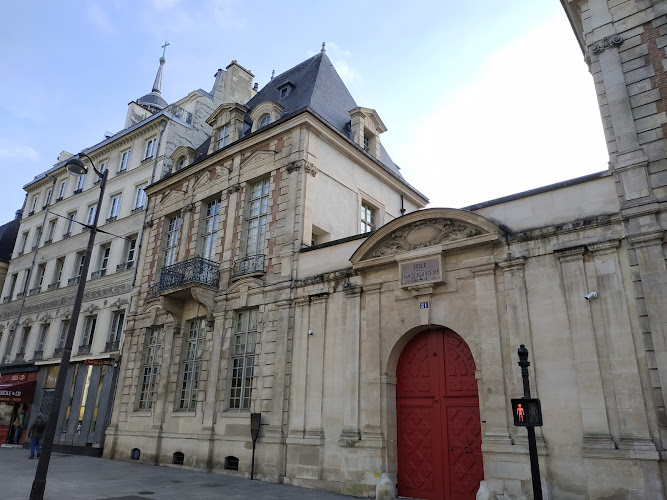
At 21 rue Saint-Antoine in the 4th arrondissement, the Hôtel de Mayenne stands as a remarkable example of early 17th-century aristocratic architecture and a fascinating document of French political reconciliation during Henri IV\u2019s reign. Built between 1606 and 1609 by Jean Androuet du Cerceau for Charles de Lorraine, duc de Mayenne—”le Gros Mayenne,” son of the famous duc de Guise—this magnificent mansion represents the architectural rewards of political submission and the successful integration of former League opponents into royal society.
<\!-- /wp:paragraph --><\!-- wp:parameter --><\!-- wp:paragraph -->
The dukeu2019s acquisition of the property in 1605 using funds received for his submission to Henri IV demonstrates how architectural patronage could serve political reconciliation while creating lasting monuments to the stability and prosperity that emerged from successful conflict resolution and national unification under Bourbon rule.
<\!-- /wp:paragraph --><\!-- wp:heading {"level":3} -->
Androuet du Cerceau\u2019s architectural excellence and Marais development
<\!-- /wp:heading --><\!-- wp:parameter --><\!-- wp:paragraph -->
Jean Androuet du Cerceau\u2019s design, executed by master masons Jean Geoffroy and Christophe Deschamps from 1606 to 1609, created comprehensive residential architecture featuring a grand staircase overlooking the garden and an imposing façade on rue Saint-Antoine. The building\u2019s completion by the duke\u2019s son Henri de Mayenne after 1611 demonstrates family commitment to architectural excellence across generations.
<\!-- /wp:paragraph --><\!-- wp:parameter --><\!-- wp:paragraph -->
The mansion\u2019s resemblance to the Hôtel de Sully, built later by the same architect, shows du Cerceau\u2019s mastery of the “hôtel between courtyard and garden” typology that would define Marais aristocratic architecture. The grand stone and brick façade with lateral pavilions connected by monumental street portal established architectural vocabulary that influenced noble residential design throughout the district.
<\!-- /wp:paragraph --><\!-- wp:heading {"level":3} -->
Medieval heritage and royal transformation
<\!-- /wp:heading --><\!-- wp:parameter --><\!-- wp:paragraph -->
The site\u2019s medieval origins as the 14th-century Hôtel du Petit-Musc, part of King Charles V\u2019s Hôtel Saint-Pol estate, establishes deep royal connections that were renewed through Claude Gouffier\u2019s 1567-1569 reconstruction and ultimately Charles de Lorraine\u2019s early 17th-century transformation. This architectural continuity demonstrates how prime Parisian real estate could serve successive generations of royal and aristocratic families.
<\!-- /wp:paragraph --><\!-- wp:parameter --><\!-- wp:paragraph -->
The progression from medieval royal domain through 16th-century noble reconstruction to early 17th-century League leader reconciliation creates a comprehensive narrative of French political and architectural evolution within a single site, showing how buildings can embody complex historical transformations.
<\!-- /wp:paragraph --><\!-- wp:heading {"level":3} -->
Germain Boffrand\u2019s 18th-century enhancement
<\!-- /wp:heading --><\!-- wp:parameter --><\!-- wp:paragraph -->
The major modernization and embellishment work carried out between 1707-1709 by Germain Boffrand for Prince Charles-Henri de Lorraine of Vaudémont demonstrates how 17th-century aristocratic architecture could be sensitively enhanced to meet 18th-century aesthetic preferences while preserving essential character and architectural distinction.
<\!-- /wp:paragraph --><\!-- wp:parameter --><\!-- wp:paragraph -->
Boffrand\u2019s interior improvements show how successive generations could adapt historic residences to serve contemporary living requirements while maintaining the dignity and cultural significance that made these buildings architecturally important and socially prestigious.
<\!-- /wp:paragraph --><\!-- wp:heading {"level":3} -->
Educational adaptation and architectural preservation
<\!-- /wp:heading --><\!-- wp:parameter --><\!-- wp:paragraph -->
The mansion\u2019s contemporary use as the École des Francs-Bourgeois demonstrates how historic aristocratic residences can be successfully adapted to serve educational purposes while preserving architectural heritage that documents French noble culture and political history. This educational function maintains the building\u2019s essential character as a place dedicated to human development and cultural advancement.
<\!-- /wp:paragraph --><\!-- wp:parameter --><\!-- wp:paragraph -->
For visitors to the Marais interested in early 17th-century architecture, political reconciliation history, or the evolution of aristocratic residential design, the Hôtel de Mayenne offers insight into how Jean Androuet du Cerceau\u2019s architectural vision served both practical residential needs and broader social reconciliation during Henri IV\u2019s reign. The mansion demonstrates that great residential architecture emerges when political stability enables architectural patronage, creating buildings that serve both individual family needs and broader cultural purposes while establishing architectural models that influence subsequent urban development and aristocratic lifestyle throughout French society.
<\!-- /wp:paragraph -->