
<\!-- wp:heading -->
A Belle Époque dining palace celebrating the golden age of rail travel
<\!-- /wp:heading --><\!-- wp:paragraph -->
Within the magnificent Gare de Lyon in the 12th arrondissement, Le Train Bleu stands as one of Paris\u2019s most spectacular dining destinations and a living monument to the Belle Époque\u2019s unbridled optimism about technology, travel, and French cultural supremacy. Originally opened in 1901 as the “Buffet de la Gare de Lyon” for the Universal Exhibition, this restaurant was designed to embody the spirit of affluent, artistic, and innovative France for provincial and international visitors arriving in the capital.
<\!-- /wp:paragraph --><\!-- wp:paragraph -->
Designed by architect Marius Toudoire for the Paris-Lyon-Méditerranée (PLM) railway company, the restaurant was inaugurated by President Émile Loubet on April 7, 1901. The establishment aimed to provide a dining experience that reflected the grandeur of the era, ensuring that rail travel began with an encounter with French artistic and culinary excellence.
<\!-- /wp:paragraph --><\!-- wp:heading {"level":3} -->
A painted journey through France
<\!-- /wp:heading --><\!-- wp:paragraph -->
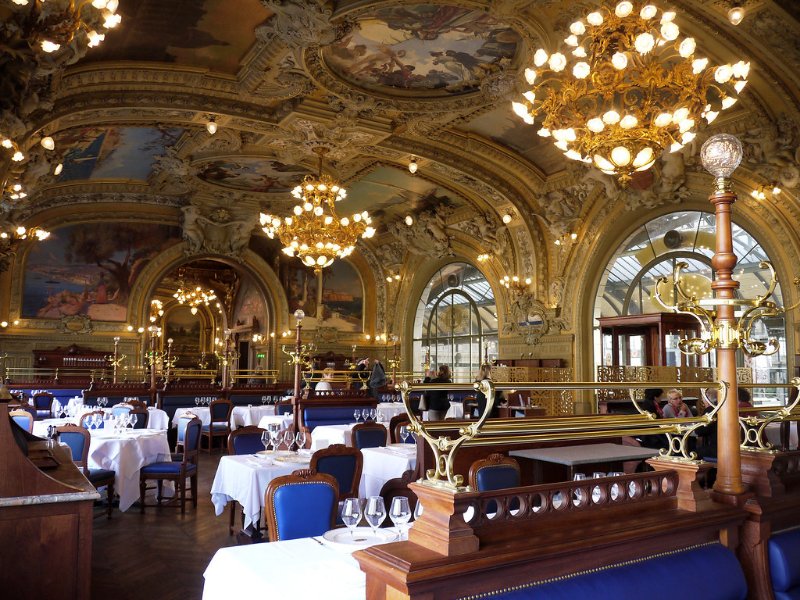
The restaurant\u2019s most extraordinary feature is its collection of 41 enormous paintings that transform dining into a virtual journey through France. These masterworks depict scenes from key railway destinations along the Paris-Lyon-Marseille route, with particular emphasis on the French Riviera where most diners were destined after their meals.
<\!-- /wp:paragraph --><\!-- wp:paragraph -->
Renowned Belle Époque artists including Flameng, Debuffe, and Saint-Pierre were commissioned to create the three magnificent ceiling frescoes in the main dining room. These paintings, reaching eight meters high, celebrate France\u2019s diverse landscapes and prestigious cities, creating an immersive environment that celebrates national geography and cultural achievement.
<\!-- /wp:paragraph --><\!-- wp:heading {"level":3} -->
Neo-baroque architectural splendor
<\!-- /wp:heading --><\!-- wp:parameter --><\!-- wp:paragraph -->
The restaurant\u2019s neo-baroque and Belle Époque decoration creates an atmosphere of unprecedented luxury within a railway station. The lavish frescoes, ornate paneling, soaring ceilings, and gilded details transform a functional dining space into a palace-like environment that rivals the greatest Parisian restaurants of the period.
<\!-- /wp:paragraph --><\!-- wp:paragraph -->
This architectural approach reflected the PLM company\u2019s understanding that rail travel represented more than transportation—it was a cultural experience that should begin the moment passengers entered the station. The opulent decoration served to establish France\u2019s reputation for artistic sophistication and culinary excellence among international travelers.
<\!-- /wp:paragraph --><\!-- wp:heading {"level":3} -->
Historic monument recognition and celebrity patronage
<\!-- /wp:heading --><\!-- wp:paragraph -->
In 1972, Le Train Bleuu2019s dining halls, gold lounge, Tunisian and Algerian lounges, along with their decorative schemes, were classified as historical monuments. This recognition acknowledges the restaurant\u2019s significance as both architectural achievement and cultural institution during France\u2019s Belle Époque golden age.
<\!-- /wp:paragraph --><\!-- wp:paragraph -->
The restaurant\u2019s legendary status attracted generations of celebrities, from Coco Chanel and Jean Cocteau to Salvador Dalí and Brigitte Bardot. This patronage by cultural luminaries reinforced Le Train Bleu\u2019s role as more than a restaurant—it became a stage where French cultural life was performed and celebrated.
<\!-- /wp:paragraph --><\!-- wp:heading {"level":3} -->
The legendary Train Bleu connection
<\!-- /wp:heading --><\!-- wp:paragraph -->
The restaurant\u2019s 1963 renaming honored the legendary “Train Bleu” (Paris-Vintimille line), which began service in 1868 as the prestigious train serving Mediterranean coastal towns of the French Riviera. This connection to luxury rail travel reinforced the restaurant\u2019s identity as a gateway to France\u2019s most glamorous destinations.
<\!-- /wp:paragraph --><\!-- wp:paragraph -->
The Train Bleu represented the pinnacle of elegant travel, carrying wealthy passengers to fashionable resorts like Nice, Cannes, and Monte Carlo. Dining at the restaurant before departure became an essential ritual that extended the luxury experience beyond the train itself.
<\!-- /wp:paragraph --><\!-- wp:heading {"level":3} -->
Living Belle Époque experience
<\!-- /wp:heading --><\!-- wp:paragraph -->
Today, Le Train Bleu continues to offer an authentic Belle Époque experience, maintaining its original décor while serving classic French cuisine that honors culinary traditions established over a century ago. The restaurant demonstrates how historic venues can maintain their cultural significance while adapting to contemporary hospitality standards.
<\!-- /wp:paragraph --><\!-- wp:paragraph -->
For visitors seeking to understand the intersection of transportation, gastronomy, and French cultural identity, Le Train Bleu offers an unparalleled immersion in Belle Époque aesthetics and social history. The restaurant stands as proof that functional spaces, when designed with vision and artistry, can transcend their utilitarian purpose to become enduring monuments to cultural achievement and national pride.
<\!-- /wp:paragraph -->