
<\!-- wp:heading -->
A Belle Époque railway cathedral crowned by Paris\u2019s most famous clock tower
<\!-- /wp:heading --><\!-- wp:paragraph -->
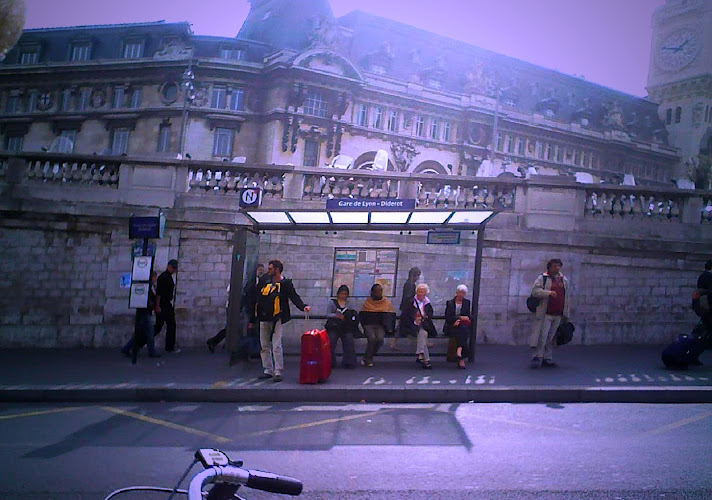
In the 12th arrondissement, Gare de Lyon stands as one of Paris\u2019s most magnificent railway stations and a testament to the Belle Époque\u2019s faith in technological progress and architectural grandeur. Originally built in 1855 and completely redesigned by architect Marius Toudoire for the 1900 Universal Exhibition, this station exemplifies how transportation infrastructure can achieve the status of cultural monument through visionary design and meticulous craftsmanship.
<\!-- /wp:paragraph --><\!-- wp:paragraph -->
The station\u2019s transformation for the exposition reflected France\u2019s determination to showcase its engineering capabilities and aesthetic sophistication to international visitors. The collaboration between Toudoire and Charles Garnier (designer of the Paris Opera) for the clock tower demonstrates the level of artistic talent applied to functional railway architecture during this golden age of French design.
<\!-- /wp:paragraph --><\!-- wp:heading {"level":3} -->
The iconic clock tower by Charles Garnier
<\!-- /wp:heading --><\!-- wp:paragraph -->
Rising 67 meters above the 12th arrondissement, the station\u2019s clock tower has become one of Paris\u2019s most recognizable landmarks. Designed by Charles Garnier in Haussmannian style, the tower features four clock faces, each measuring 6.5 meters in diameter and adorned with hand-painted brass Roman numerals that create an atmosphere of timeless elegance.
<\!-- /wp:paragraph --><\!-- wp:paragraph -->
The tower\u2019s nighttime illumination, originally achieved through oil lamps until 1929 and now electric, creates a beacon that can be seen across southeastern Paris. This luminous presence reinforces the station\u2019s role as both practical infrastructure and urban landmark that orients travelers and residents throughout the arrondissement.
<\!-- /wp:paragraph --><\!-- wp:heading {"level":3} -->
Industrial architecture meets Belle Époque luxury
<\!-- /wp:heading --><\!-- wp:paragraph -->
The station\u2019s interior showcases the sophisticated integration of industrial engineering with decorative artistry characteristic of Belle Époque design. The vast ironwork structure, extending over 200 meters from front to back and 45 meters wide, is topped with an enormous glass roof that floods the space with natural light while creating cathedral-like atmosphere.
<\!-- /wp:paragraph --><\!-- wp:paragraph -->
This monument to late 19th-century ironwork demonstrates how functional railway architecture could achieve aesthetic excellence through careful attention to proportion, light, and spatial drama. The glass roof\u2019s engineering represents cutting-edge technology of the period while creating an environment worthy of the luxury travel that defined Belle Époque railway culture.
<\!-- /wp:paragraph --><\!-- wp:heading {"level":3} -->
Gateway to Mediterranean dreams
<\!-- /wp:heading --><\!-- wp:paragraph -->
Gare de Lyon served as the departure point for trains to the French Riviera and Mediterranean destinations, making it the starting point for countless journeys to luxury resorts like Nice, Cannes, and Monte Carlo. The station\u2019s opulent design reflected the glamorous destinations it served, with every architectural detail calculated to begin the luxury travel experience from the moment passengers entered the building.
<\!-- /wp:paragraph --><\!-- wp:paragraph -->
The famous Le Train Bleu restaurant, created in 1901 within the station, epitomizes this approach to luxury travel, providing Belle Époque dining experiences that matched the elegance of the destinations travelers would reach. This integration of hospitality with transportation infrastructure demonstrates the comprehensive approach to passenger experience that characterized the finest railway design.
<\!-- /wp:paragraph --><\!-- wp:heading {"level":3} -->
Historic monument status and preservation
<\!-- /wp:heading --><\!-- wp:paragraph -->
Classified as a Historic Monument since 1972, Gare de Lyon represents one of France\u2019s most significant examples of Belle Époque railway architecture. The designation protects not only the building\u2019s structural elements but also its decorative features, ensuring that future generations can experience the luxuriant atmosphere that defined turn-of-the-century travel.
<\!-- /wp:paragraph --><\!-- wp:paragraph -->
The preservation of paintings, moldings, chandeliers, and architectural details maintains the station\u2019s function as both working transportation facility and living museum of Belle Époque design philosophy. This careful stewardship demonstrates how historic buildings can continue serving their original purpose while preserving their cultural and artistic value.
<\!-- /wp:paragraph --><\!-- wp:heading {"level":3} -->
Contemporary relevance and enduring grandeur
<\!-- /wp:heading --><\!-- wp:paragraph -->
Today, Gare de Lyon continues to serve as a major transportation hub while maintaining its role as an architectural treasure that embodies French excellence in design and engineering. The station demonstrates how functional buildings, when conceived with vision and executed with craftsmanship, can transcend their utilitarian purpose to become beloved urban landmarks.
<\!-- /wp:paragraph --><\!-- wp:paragraph -->
For visitors to Paris, the station offers more than convenient transportation—it provides an immersive experience of Belle Époque elegance and the golden age of railway travel. The combination of Garnier\u2019s clock tower, Toudoire\u2019s architectural design, and the preserved luxury of Le Train Bleu creates one of Paris\u2019s most complete and accessible examples of how the city successfully integrated beauty with functionality during its period of greatest cultural confidence.
<\!-- /wp:paragraph -->