
<\!-- wp:heading -->
The only museum entirely conceived by its subject: Gustave Moreau\u2019s symbolist sanctuary
<\!-- /wp:heading --><\!-- wp:parameter -->
At 14 rue de la Rochefoucauld in the 9th arrondissement, the Musée Gustave Moreau stands as the only museum in Paris entirely conceived by its own subject and a unique testament to how great artists can ensure their legacy through visionary institutional planning. In 1895, symbolist painter Gustave Moreau (1826-1898) commissioned young architect Albert Lafon to transform his family home from private hôtel particulier into a comprehensive museum that would preserve not only his artistic output but also the intimate creative environments where his revolutionary symbolist masterpieces were conceived and executed.
<\!-- /wp:paragraph --><\!-- wp:parameter -->
Moreau\u2019s 1897 bequest of the house and its contents to the French nation reflected his hope that preservation “in total would allow the public to appreciate the culmination of the artist\u2019s lifelong work and labour,” creating unprecedented artist-designed museum environments that maintain authentic connections between artistic creation and public appreciation.
<\!-- /wp:paragraph --><\!-- wp:heading {"level":3} -->
Albert Lafon\u2019s architectural transformation and spiral staircase masterpiece
<\!-- /wp:heading --><\!-- wp:parameter -->
Lafon\u2019s architectural intervention created sophisticated museum environments through the addition of dedicated gallery spaces, preservation of private domestic quarters, and construction of expansive studios on second and third floors connected by the museum\u2019s most striking feature—the famous spiral staircase that provides dramatic vertical circulation while creating architectural focal point worthy of the artistic treasures it serves.
<\!-- /wp:paragraph --><\!-- wp:parameter -->
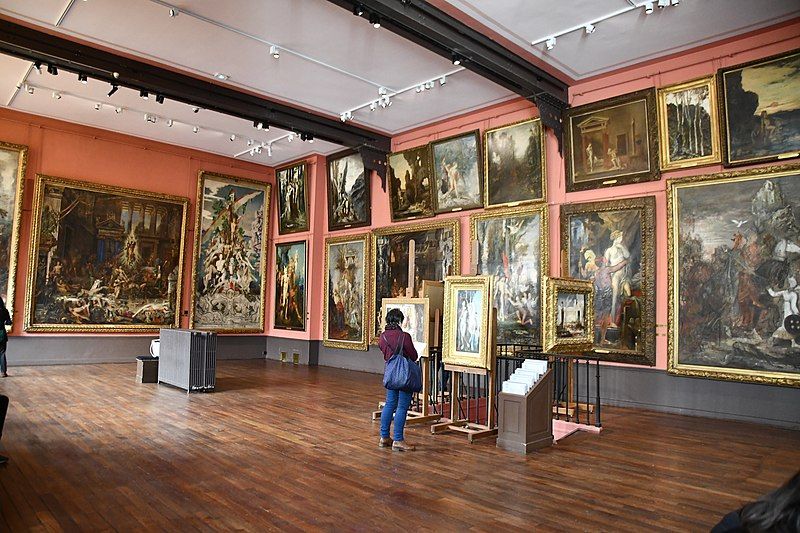
The two large studios with connecting small staircase accommodate hundreds of paintings and thousands of drawings while maintaining intimate scale that allows visitors to experience Moreau\u2019s creative environment rather than merely viewing artworks in generic museum settings, creating immersive experiences that enhance understanding of artistic process and creative development.
<\!-- /wp:paragraph --><\!-- wp:heading {"level":3} -->
Comprehensive artistic legacy and symbolist masterpieces
<\!-- /wp:heading --><\!-- wp:parameter -->
The museum\u2019s extraordinary collection of 14,000 works at its 1903 inauguration—including masterpieces like “Jupiter and Semele,” “The Abduction of Europa,” “Prometheus,” and “The Unicorns”—demonstrates Moreau\u2019s extraordinary productivity while providing comprehensive documentation of symbolist artistic development and the creative processes that produced some of 19th-century art\u2019s most psychologically complex and visually stunning achievements.
<\!-- /wp:paragraph --><\!-- wp:parameter -->
The current display of 1,200 oil paintings, pastels, watercolors, and drawings throughout the museum creates comprehensive artistic environments where visitors can trace Moreau\u2019s artistic evolution while understanding how symbolist art sought to express spiritual and psychological truths through visual beauty and mythological symbolism.
<\!-- /wp:paragraph --><\!-- wp:heading {"level":3} -->
Preserved domestic spaces and artistic intimacy
<\!-- /wp:heading --><\!-- wp:parameter -->
The first-floor apartment\u2019s preservation—including sea-green dining room with wood panels and Louis XVI chairs purchased in 1852, bedroom, den, hallway, and office-library—provides visitors with intimate access to the artist\u2019s personal life and domestic environments that fostered artistic creation, creating unique museum experiences that balance public cultural access with preservation of private artistic spaces.
<\!-- /wp:paragraph --><\!-- wp:parameter -->
The ground floor\u2019s six small rooms overlooking the garden, featuring drawings and sketches dedicated to Italian masters, demonstrate Moreau\u2019s comprehensive artistic education and influence while creating contemplative spaces where visitors can understand the classical foundations that informed his revolutionary symbolist innovations.
<\!-- /wp:paragraph --><\!-- wp:heading {"level":3} -->
Living artistic heritage and museum innovation
<\!-- /wp:heading --><\!-- wp:parameter -->
The museum\u2019s preservation virtually unchanged since its 1903 opening demonstrates Moreau\u2019s remarkable prescience in creating museum environments that continue serving their original educational and cultural purposes while providing visitors with authentic access to symbolist artistic heritage within the actual creative spaces where artistic masterpieces were conceived and executed.
<\!-- /wp:paragraph --><\!-- wp:parameter -->
For visitors to Paris interested in symbolist art, artist house museums, or the intersection of domestic architecture with artistic creation, the Musée Gustave Moreau offers an unparalleled encounter with how great artists can ensure their legacy through comprehensive institutional vision. The museum demonstrates that artist-conceived cultural institutions can achieve lasting significance by preserving not only artistic output but also the creative environments and personal contexts that foster artistic excellence, creating museums that serve both aesthetic education and broader understanding of how artistic genius emerges from specific cultural and personal circumstances that can inspire contemporary creative development.
<\!-- /wp:paragraph -->