
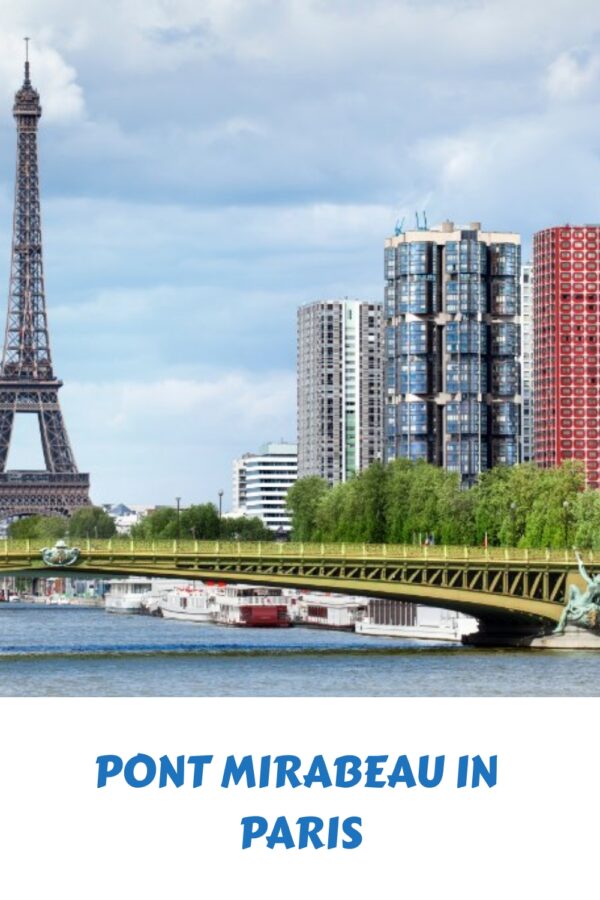
Pont Mirabeau
Imp. Mirabeau is a Paris historic landmark located in the 15 arrondissement. Where poetry immortalized love and loss Spanning the Seine between the 15th and 16th arrondissements, Pont Mirabeau stands as one of Paris’s most romantically charged bridges, where engineering excellence meets literary immortality. Built between 1895 and 1897 by engineers Paul Rabel, Jean Resal, […]
Imp. Mirabeau is a Paris historic landmark located in the 15 arrondissement.
Where poetry immortalized love and loss
Spanning the Seine between the 15th and 16th arrondissements, Pont Mirabeau stands as one of Paris’s most romantically charged bridges, where engineering excellence meets literary immortality. Built between 1895 and 1897 by engineers Paul Rabel, Jean Resal, and Amédée Alby, this elegant arch bridge gained eternal fame through Guillaume Apollinaire’s melancholic 1912 poem that transformed a functional river crossing into one of the world’s most celebrated expressions of love, loss, and the passage of time.
Belle Époque engineering and urban modernization
The bridge’s construction represented part of the massive infrastructure modernization that transformed late 19th-century Paris. Named after Honoré Gabriel Riqueti de Mirabeau, the great orator of the French Revolution, the bridge demonstrates how Third Republic engineering could honor revolutionary heritage while serving contemporary urban needs.
The three metal arches—a central span of 93 meters flanked by two 32.4-meter side arches—create elegant proportions across the bridge’s 173-meter length. The 20-meter width accommodates both vehicular and pedestrian traffic while providing viewing platforms for the spectacular Seine vistas that inspired Apollinaire’s poetic vision.
Apollinaire’s heartbreak becomes eternal poetry
Guillaume Apollinaire’s poem “Le Pont Mirabeau,” written in 1912 following his separation from painter Marie Laurencin, transformed this infrastructure into one of literature’s most famous symbols of romantic loss. The poet’s daily crossings to meet Marie created personal associations that he transmuted into universal meditation on love’s fragility and time’s inexorable passage.
Published in his 1913 collection “Alcools,” the poem’s famous refrain “Sous le pont Mirabeau coule la Seine / Et nos amours” (Under the Mirabeau bridge flows the Seine / And our loves) creates eternal connection between physical place and emotional experience, demonstrating how great poetry can transform urban landmarks into monuments of human feeling.
Literary pilgrimage and romantic symbolism
The bridge has become a pilgrimage destination for poetry lovers and romantics from around the world who come to experience the setting that inspired one of French literature’s most moving expressions of lost love. Apollinaire’s transformation of engineering into poetry demonstrates how great writers can infuse urban landscapes with emotional significance that transcends their original practical purpose. The bridge’s continuing role as both functional infrastructure and romantic symbol proves that great cities are shaped as much by literary imagination as by architectural achievement, where poets and engineers collaborate across time to create landmarks that serve both practical and emotional needs.Connecting neighborhoods and cultural experiences
The bridge’s connection between Javel (15th arrondissement) and Auteuil (16th arrondissement) links different aspects of Parisian urban character—from the industrial heritage of the Left Bank to the suburban elegance of the Right Bank. This geographical bridging creates opportunities for visitors to experience contrasting neighborhood characters within a single walking journey. The proximity to major tourist destinations including the Eiffel Tower creates spectacular viewing opportunities, while the bridge’s literary significance adds cultural depth to Seine river experiences that combine architectural appreciation with poetic meditation.Timeless poetry in iron and stone
Today’s Pont Mirabeau continues to attract both practical users and cultural pilgrims, where engineering functionality serves romantic symbolism beneath iron arches that have witnessed over a century of Seine flow and human emotion. The bridge demonstrates how great urban infrastructure can achieve multiple forms of immortality—through practical service and poetic transformation.Essential information
- Construction: 1895-1897
- Engineers: Paul Rabel, Jean Resal, Amédée Alby
- Namesake: Honoré Gabriel Riqueti de Mirabeau
- Dimensions: 173m length, 20m width
- Structure: Three metal arches (93m central, 32.4m sides)
- Connection: 15th arrondissement (Javel) to 16th arrondissement (Auteuil)
- Literary fame: Guillaume Apollinaire’s 1912 poem
Literary and cultural significance
- Poetic inspiration: Apollinaire’s lost love for Marie Laurencin
- Publication: “Alcools” collection (1913)
- Universal theme: Love, loss, and passage of time
- Cultural pilgrimage: Destination for poetry and romance enthusiasts
- Romantic symbolism: Global recognition through literary immortality
Engineering meets poetry
Pont Mirabeau embodies the magical transformation of utilitarian infrastructure into cultural icon through the power of poetic imagination, where Guillaume Apollinaire’s heartbreak created one of literature’s most beautiful meditations on love and time. This remarkable bridge demonstrates how great cities become repositories of both practical function and emotional resonance, creating landmarks that serve multiple generations through engineering excellence and literary immortality. For poetry lovers, Seine river enthusiasts, or anyone seeking to understand how literature shapes our experience of urban space, Pont Mirabeau offers an extraordinary encounter with romantic symbolism, where every crossing recreates Apollinaire’s journey between love and loss beneath iron arches that continue to frame the flowing Seine and the flowing emotions that make Paris the eternal city of romance and artistic inspiration.