
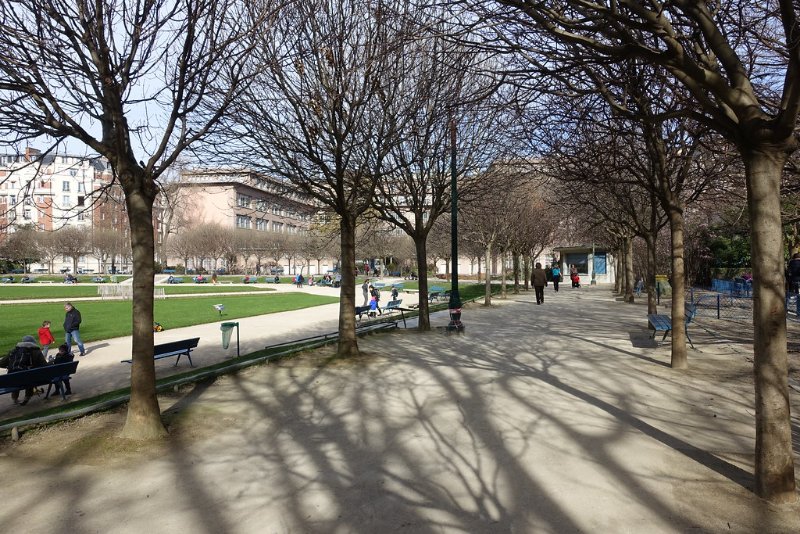
Art Deco garden oasis where gasworks became green sanctuary
At 2 rue Jean Formigé in the 15th arrondissement, Square Saint-Lambert stands as a remarkable example of 1930s urban renewal, where industrial infrastructure transformed into one of Paris’s most charming Art Deco gardens. Created in 1933 by architect George Sébille on the site of the old Vaugirard gasworks, this extraordinary public space demonstrates how visionary urban planning can convert industrial wasteland into community sanctuary that serves both aesthetic appreciation and neighborhood recreation.
George Sébille’s Art Deco vision
Architect George Sébille designed the square as a comprehensive Art Deco ensemble featuring three distinct zones organized around a central water feature. The amphitheater design incorporates two symmetrical lawns and a fan-shaped terrace that create elegant geometric relationships characteristic of 1930s landscape architecture.
Sébille’s vision transformed the former gasworks site into a neighborhood jewel that demonstrates how Art Deco principles could be applied to public garden design, creating spaces that combined modernist aesthetic innovation with practical community needs for recreation and relaxation.
Central water feature and ornamental splendor
The garden’s most impressive feature is its ornamental pond with fountain, creating a central focal point that provides both visual beauty and cooling microclimate within the urban environment. The miniature lake surrounded by landscaped gardens demonstrates how water features can anchor public space design while providing recreational opportunities for all ages.
The fountain and pond create peaceful gathering spaces where neighborhood residents can find tranquility within one of Paris’s most densely populated arrondissements, proving that thoughtful public space design can provide essential quality of life improvements through beauty and natural elements.Sculptural program and artistic integration
The square features an integrated sculptural program including René Paris’s “Dog” (1928), Victor Peter’s “Bear cubs” (1928) and “Two Bears” (1938), and Auguste Guénot’s bas-relief of dancing children (1939). These artworks create an outdoor sculpture gallery that demonstrates how public art can enhance garden experiences while providing cultural education. The sculptural elements reflect 1930s artistic tastes and the period’s commitment to integrating fine art into public spaces, ensuring that working-class neighborhoods could access artistic beauty through daily garden visits rather than only through museum attendance.Family recreation and community gathering
The square’s comprehensive recreational programming includes well-maintained children’s playgrounds with swings, slides, sandpit, and carousel, creating multigenerational community space where families can gather while children play safely within beautiful garden settings. This approach demonstrates how public space design can strengthen neighborhood social fabric. The integration of recreational amenities with Art Deco landscape design creates environments that serve both aesthetic appreciation and practical community needs, proving that great public spaces can achieve multiple purposes through thoughtful planning and generous design.Art Deco neighborhood and Eiffel Tower views
The square’s setting within a neighborhood of beautiful Art Deco buildings creates comprehensive 1930s architectural experience, while views of the Eiffel Tower connect the intimate scale of neighborhood life to Paris’s most iconic landmarks. This juxtaposition demonstrates how great public spaces can provide both local community service and tourist cultural experience.Essential information
- Creation: 1933
- Architect: George Sébille
- Previous site: Vaugirard gasworks
- Location: 2 rue Jean Formigé, 15th arrondissement
- Design style: Art Deco landscape architecture
- Heritage status: Listed monument
- Metro access: Commerce and Vaugirard stations
- Special feature: Eiffel Tower views
Garden features and artworks
- Water feature: Ornamental pond with central fountain
- Layout: Three zones with symmetrical lawns and fan-shaped terrace
- Sculptures: René Paris “Dog” (1928), Victor Peter bears, Guénot dancing children
- Children’s amenities: Playgrounds, carousel, swings, sandpit
- Art Deco context: Surrounded by 1930s architectural ensemble
Industrial transformation into community sanctuary
Square Saint-Lambert embodies the successful transformation of industrial sites into community green spaces, where George Sébille’s Art Deco vision converted former gasworks into one of Paris’s most beloved neighborhood gardens. This remarkable square demonstrates how great urban planning can reclaim industrial land for public benefit while creating beautiful environments that serve multiple generations of residents. For Art Deco enthusiasts, urban planning historians, or anyone seeking peaceful retreat within the city, Square Saint-Lambert offers an extraordinary encounter with 1930s landscape architecture, where modernist design principles created community spaces that honor both aesthetic innovation and practical family needs beneath sculptures that celebrate the joy of childhood and the beauty of nature within the urban environment.