
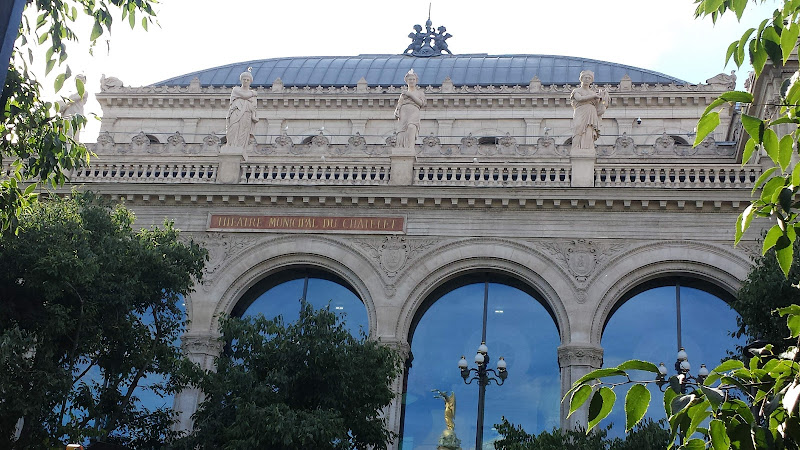
Where Sarah Bernhardt reigned as theater queen
At Place du Châtelet in the 4th arrondissement, Théâtre de la Ville stands as one of Paris’s most storied cultural institutions, where theatrical legend and architectural resilience combine to create a venue that has shaped French performing arts for over 160 years. Originally inaugurated in 1862 as the Théâtre Lyrique and later transformed by the incomparable Sarah Bernhardt, this remarkable theater embodies the evolution of Parisian cultural life from Second Empire grandeur to contemporary artistic innovation.
Haussmann’s theatrical vision and Davioud’s design
Designed by Gabriel Davioud as part of Baron Haussmann’s massive urban renovation, the theater represents one of two venues built opposite each other at Place du Châtelet to serve Paris’s expanding cultural needs. The 1862 inauguration as Théâtre Lyrique positioned the venue at the forefront of contemporary musical theater, establishing its mission to present innovative performances for sophisticated Parisian audiences.
The theater’s early years saw dramatic upheavals, including near-complete destruction by fire on May 21, 1871, during the government recapture of Paris at the end of the Paris Commune. The careful reconstruction to original specifications demonstrated the building’s importance to Parisian cultural life and the city’s commitment to preserving its theatrical heritage.
Opéra-Comique residency and musical premieres
From 1887 to 1898, the theater housed the Opéra-Comique after fire destroyed their previous home, creating one of the most significant periods in French musical theater history. During this residency, the company premiered several operas by Massenet, including “Esclarmonde” (1889) and “Sapho” (1897), while presenting the first Paris performances of “Werther” (1893) and “La Navarraise” (1895).
This period established the theater’s reputation for musical excellence and artistic innovation, creating the foundation for its later association with cutting-edge performance that would define its character throughout the 20th century.
Sarah Bernhardt’s theatrical empire
In 1899, the divine Sarah Bernhardt took control of the theater, renaming it after herself and undertaking major renovations that transformed it into her personal artistic kingdom. For 24 years until her death in 1923, Bernhardt ran the venue “with great panache,” presenting her legendary interpretations of classic roles while nurturing new theatrical works.
Bernhardt opened her tenure with a revival of “La Tosca,” one of her signature roles, and presented the premiere of Edmond Rostand’s “L’Aiglon,” where she portrayed Napoleon’s son. The theater also hosted Diaghilev’s Ballets Russes, including premieres of Stravinsky’s “Apollon musagète” (1928) and works by Prokofiev, establishing its international reputation for artistic excellence.
Wartime persecution and postwar resurrection
During the German Occupation, the theater’s name was changed from Sarah-Bernhardt to Théâtre de la Cité due to Bernhardt’s Jewish ancestry, reflecting the systematic cultural persecution that accompanied political oppression. The restoration of Bernhardt’s name in 1947 symbolized France’s return to democratic values and cultural freedom.
This period demonstrates how cultural institutions can become battlegrounds for broader political and social conflicts, where theater names become statements about national identity and artistic heritage.
Modern reconstruction and contemporary mission
In 1966, the City of Paris embarked on major rebuilding that preserved only Davioud’s original façade while completely reconstructing the interior with modern raked seating for 1,000 spectators. Architects Valentin Fabre and Jean Perrottet created contemporary performance spaces within the historic shell, ensuring the theater could serve 21st-century artistic needs.
Today’s programming focuses on contemporary dance, innovative theater, and world music, maintaining the venue’s tradition of artistic excellence while expanding its cultural mission to serve Paris’s increasingly diverse creative community and international audience.
Essential information
- Original opening: 1862 (Théâtre Lyrique)
- Architect: Gabriel Davioud
- Sarah Bernhardt era: 1899-1923
- Modern reconstruction: 1966 (Fabre and Perrottet)
- Capacity: 1,000 spectators
- Location: Place du Châtelet, 4th arrondissement
- Historical trauma: Fire 1871, wartime name change 1940-1947
Cultural legacy
- Musical premieres: Massenet operas, Stravinsky ballets
- Bernhardt legacy: 24 years of legendary theatrical leadership
- Contemporary programming: Dance, theater, world music
- International reputation: Ballets Russes performances, global artists
- Architectural preservation: Historic façade with modern interior
Theatrical heritage and cultural resilience
Théâtre de la Ville embodies the resilience and continuity of French theatrical culture, where each era has added to rather than replaced the venue’s artistic legacy. This remarkable theater demonstrates how great cultural institutions can honor their historic mission while adapting to serve contemporary artistic needs and diverse audiences. For theater enthusiasts, French cultural historians, or anyone seeking to understand how performance venues shape artistic life, the Théâtre de la Ville offers an extraordinary encounter with theatrical heritage, where Sarah Bernhardt’s legendary presence continues to inspire performances beneath reconstructed spaces that honor both architectural tradition and contemporary artistic innovation at the heart of Paris’s cultural district.