
Franco-Brazilian modernist collaboration creates cultural embassy
At the Cité internationale universitaire in the 14th arrondissement, Maison du Brésil stands as a remarkable testament to international architectural collaboration and cultural diplomacy. Inaugurated in 1959 and designed through the complex partnership of Le Corbusier and Brazilian architect Lúcio Costa, this extraordinary building demonstrates how modernist architecture could serve both practical student housing needs and broader cultural missions that strengthen international understanding through daily residential experience and cultural programming.
Presidential vision and architectural diplomacy
Commissioned in 1952 by Brazilian President Juscelino Kubitschek, the project aimed to provide residence for Brazilian graduate students in Paris while promoting cultural relations between France and Brazil. The selection of Lúcio Costa—architect famous for planning Brasília—demonstrated Brazil’s commitment to showcasing its modernist architectural leadership on the international stage.
Although Costa created the initial sketch, Le Corbusier’s collaboration fundamentally altered the design, creating tensions that eventually led to Costa removing his name from the project. This creative conflict reflects the challenges of international architectural collaboration while producing a building that synthesized both architects’ modernist visions.
Béton brut innovation and architectural expression
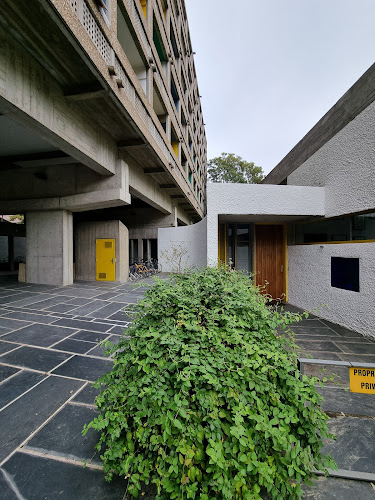
The building exemplifies Le Corbusier’s mature modernist approach, featuring a five-story concrete volume elevated on concrete stilts that create covered outdoor spaces below. The concrete throughout employs ‘béton brut’—raw concrete that retains the wood grain pattern of its formwork—creating the rough, sculptural surfaces that would define the Brutalist movement.
The irregular ground floor houses administrative spaces in the west wing and communal facilities—library, theater, exhibition space, and gathering areas—in the east wing, connected by a curvilinear passage that creates both internal circulation and external boundary for outdoor arcades that demonstrate Le Corbusier’s mastery of complex spatial relationships.
Cultural embassy and Brazilian heritage center
Beyond student housing, Maison du Brésil functions as a cultural embassy that promotes Brazilian culture through exhibition spaces and archival resources. Since 1959, it has welcomed distinguished Brazilian visitors including filmmaker Joaquim Pedro de Andrade, urbanist Jaime Lerner, photographer Sebastião Salgado, and numerous other cultural figures who have contributed to Franco-Brazilian cultural exchange.
This dual function—residential and cultural—demonstrates how student housing can serve broader diplomatic and educational missions that extend the building’s influence far beyond its immediate residents to encompass international cultural relationships and artistic exchange.
Historic monument and preservation legacy
The building’s 1985 designation as a French historic monument recognizes its architectural significance within Le Corbusier’s body of work and its role in developing Brutalist architecture that would influence international design. The 1997 major renovation restored the building’s original character while ensuring continued functionality for contemporary students.
Today’s Maison du Brésil welcomes hundreds of annual visitors—architects, students, and architecture enthusiasts—who can tour the hall and a preserved student room featuring original Corbusier design, demonstrating how historic buildings can serve both active residential and educational tourism purposes.
Essential information
- Inauguration: 1959
- Architects: Le Corbusier, Lúcio Costa (original sketch)
- Commission: President Juscelino Kubitschek (1952)
- Function: Brazilian student residence and cultural center
- Structure: Five-story concrete volume on stilts
- Innovation: Béton brut (raw concrete) technique
- Heritage status: French historic monument (1985)
- Renovation: 1997 restoration
Cultural and architectural significance
- Notable residents: Sebastião Salgado, Joaquim Pedro de Andrade, Jaime Lerner
- Cultural facilities: Library, theater, exhibition spaces
- Architectural influence: Prototype for Brutalist movement
- International cooperation: Franco-Brazilian cultural exchange
- Tourism: Preserved Corbusier student room open for visits
Modernist cultural diplomacy
Maison du Brésil embodies the power of architecture to serve cultural diplomacy while advancing modernist innovation, where Le Corbusier’s Brutalist experimentation met Brazilian cultural ambition to create a building that strengthens international understanding through daily residential experience. This remarkable structure demonstrates how student housing can achieve architectural significance while serving broader cultural missions that extend far beyond accommodation to encompass education, cultural exchange, and artistic inspiration. For Le Corbusier enthusiasts, Brazilian culture admirers, or anyone interested in how architecture facilitates international cooperation, the Maison du Brésil offers an extraordinary encounter with cultural architecture, where modernist innovation serves diplomatic purposes through spaces designed to prove that the finest residential design can honor both individual student needs and broader national cultural representation within the international educational community.