Art Nouveau guardian of royal memory
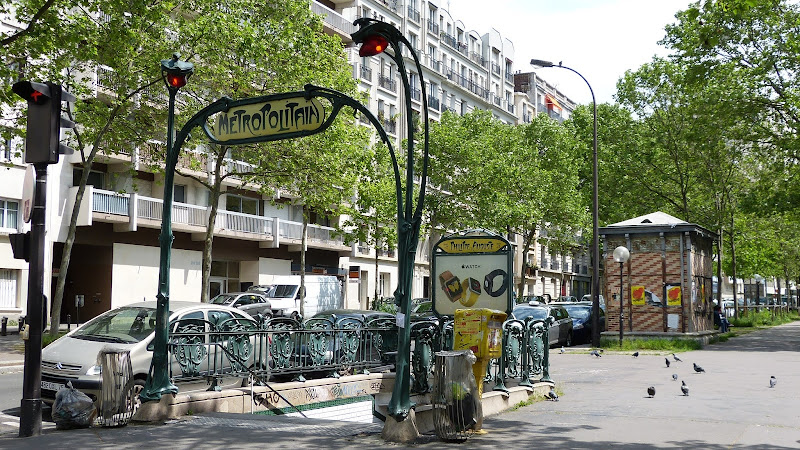
At the Philippe Auguste Metro station in the 11th arrondissement, one of Hector Guimard\s surviving Art Nouveau masterpieces stands as both functional infrastructure and artistic monument. This remarkable édicule, created during Guimards revolutionary redesign of Paris Metro entrances between 1900 and 1913, represents the intersection of Belle Époque artistic innovation and the practical needs of modern urban transportation, while honoring the memory of Frances most celebrated medieval king.
Revolutionary commission for Metro aesthetics
The Philippe Auguste édicule emerged from Guimard\s groundbreaking commission to transform Paris Metro entrances from utilitarian necessities into works of art. When the metropolitan railway was created in 1900, the City of Paris sought aesthetic solutions that would shelter users while enhancing the urban landscape rather than detracting from it.
Guimard\s revolutionary approach combined cast iron, glass, and enameled lava into organic forms that seemed to grow naturally from Parisian streets. His signature green paint, evocative of oxidized brass, created a distinctive color identity that made Metro entrances instantly recognizable while harmonizing with the urban environment.
Organic architecture meets urban function
The Philippe Auguste station entrance exemplifies Guimard\s genius for creating entourages (open railings) that combined practical function with sculptural beauty. The ornamental green-painted iron railings feature his signature abstract vegetal forms, while two high pylons frame the entrance with organic lamp fixtures and the distinctive “Métropolitain” lettering in Guimard\s custom typeface.
Every element of the entrance demonstrates Art Nouveau\s core principle that functional objects should embody natural beauty. The sinuous lines and organic shapes transform the mundane act of entering the Metro into an encounter with living sculpture that celebrates both technological progress and artistic innovation.
Honoring Philippe Auguste\s legacy
The station takes its name from Philippe Auguste (Philip II of France, 1165-1223), making it the only Paris Metro station named for French royalty. This medieval king transformed Paris from a small fortified town into a major European capital, establishing many of the urban foundations that would eventually support Guimard\s modern Metro system centuries later.
The pairing of Philippe Auguste\s name with Guimard\s Art Nouveau entrance creates a poetic dialogue between medieval urban vision and Belle Époque artistic innovation, where the king who first expanded Paris\s boundaries is honored by the artist who beautified its modern transportation.
Survival against modernization pressures
The Philippe Auguste édicule stands among the precious survivors of Guimard\s original 167 Metro entrance creations. Beginning in 1904, the Paris Metro Company began dismantling Guimards works, replacing them with more economical stone or wrought iron alternatives, leaving only 86 entrances surviving today as protected historic monuments.
The preservation of this entrance reflects the eventual recognition of Guimard\s artistic contribution to Parisian identity, demonstrating how public appreciation for Art Nouveau evolved from initial skepticism to proud celebration of Belle Époque creativity.
Living art in daily service
What makes the Philippe Auguste édicule particularly special is its continued function as an active Metro entrance, allowing contemporary Parisians and visitors to experience Guimard\s artistic vision in its original context. This living heritage proves that great design transcends its historical period to serve new generations with continued relevance and beauty.
Essential information
- Designer: Hector Guimard
- Construction period: 1900-1913 (Metro entrance program)
- Architectural style: Art Nouveau
- Type: Entourage (open railing design)
- Materials: Cast iron, glass, enameled lava
- Heritage status: Protected historic monument (1978)
- Royal namesake: Philippe Auguste (Philip II, 1165-1223)
Visiting experience
- Location: Philippe Auguste Metro station, 11th arrondissement
- Best appreciation: External viewing of organic ironwork and signature green coloring
- Historical context: One of 86 surviving Guimard entrances from original 167
- Photography: Classic Art Nouveau details and distinctive Métropolitain lettering
- Functional art: Experience Belle Époque design in daily Metro use
Art Nouveau legacy
The Édicule Guimard of the Philippe Auguste station embodies the Belle Époque\s revolutionary belief that beauty should enhance every aspect of urban life, from the grandest monuments to the most utilitarian infrastructure. This precious survivor of Guimard\s Metro entrance program demonstrates how great artists can transform ordinary urban experiences into encounters with living art. For Art Nouveau enthusiasts, architecture lovers, or anyone seeking to understand how artistic vision shaped modern Paris, this remarkable entrance offers an authentic connection to Belle Époque creativity, where the royal legacy of medieval urban expansion meets the artistic innovation that defined the modern city, all beneath ironwork that continues to welcome Parisians into the underground with the same organic grace that revolutionized public design over a century ago.