
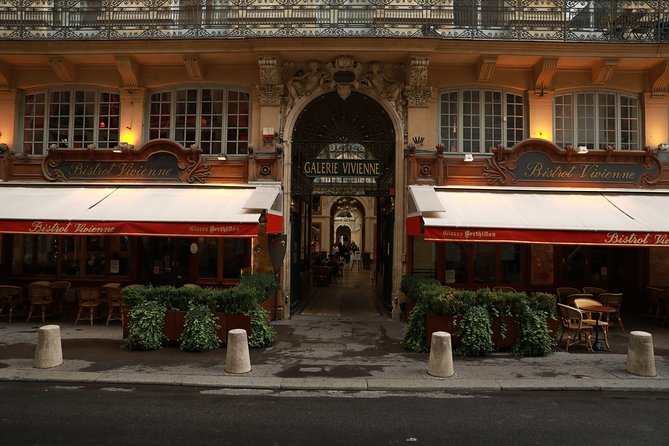
Description
Galerie Vivienne, located in the 2nd arrondissement of Paris, is a hidden gem that is often overlooked by tourists. This stunning covered arcade, built in the 19th century, is a true masterpiece of architecture and design. The Galerie Vivienne is located at the intersection of 4 rue des Petits-Champs, 6 rue Vivienne, and 5-7 rue de la Banque. Its striking glass roof and mosaic floors provide a unique and breathtaking atmosphere that transports visitors back in time. As you wander through the arcade, you will discover a variety of high-end boutiques, antique shops, and art galleries. The Galerie Vivienne is a perfect destination for those seeking a luxurious and refined shopping experience. But the Galerie Vivienne is not just a shopping destination. It is also a cultural landmark that has played a significant role in the history of Paris. The arcade was once home to the famous publishing house, Galignani, which published many important literary works. Today, the Galerie Vivienne continues to attract visitors from all over the world who are drawn to its unique beauty and charm. Whether you are a history buff, a fashion lover, or simply seeking a peaceful escape from the bustling streets of Paris, the Galerie Vivienne is a must-see destination.
Key Features
- Galerie Vivienne is a covered mall built in 1823 according to the plans by architect François-Jean Delanno, now housing luxury shops.
- It is renowned for its historical significance and architectural charm, making it a must-see attraction in the 2nd arrondissement.
Accessibility and Amenities
- The museum offers accessibility features to accommodate visitors with disabilities.
- Amenities include restrooms, dining options, and a variety of shops, including art galleries, bookstores, boutiques, and home goods stores.
- Visitors can also enjoy the services of restaurants, a consignment shop, and a tourist attraction within the premises.
Planning Your Visit
- The best times to visit are during weekdays to avoid large crowds, especially in the afternoons.
- On average, visitors spend between 15 minutes to 1 hour exploring the Galerie Vivienne, making it an ideal stop for a brief yet enriching experience.
Galerie Vivienne: a landmark covered passage
Galerie Vivienne is one of Paris’s defining covered passages: a 176-metre interior street where architecture, commerce and strolling meet under a glass roof. Constructed in 1823, it retains an unusually complete decorative identity, from its coloured mosaic floor to its neoclassical Pompeian-style ornament. The imposing dome gives the route a distinct sense of arrival rather than simply functioning as a shortcut between streets.
Listed as a historic monument since 1974, the gallery is best approached as both an architectural stop and a working address. Its appeal lies in the details visible at walking pace: the patterned pavement, the rhythm of the covered space and the changing views towards the glasswork overhead. It is a rewarding counterpoint to Paris’s grand boulevards, offering a compact look at the nineteenth-century tradition of the passage couvert.
Location and neighbourhood context
Galerie Vivienne sits in the 2nd arrondissement, with entrances at 4 rue des Petits-Champs, 6 rue Vivienne, and 5 and 7 rue de la Banque. This is central Right Bank Paris, in an area of close-set streets where it is easy to combine a passage visit with an unhurried walk through the surrounding quarter. The gallery’s multiple openings are part of the experience: enter from one street, follow the mosaics beneath the canopy, and emerge onto another.
The address is particularly useful for visitors building a walk around Parisian urban design rather than treating the gallery as a standalone destination. Keep your route flexible and allow time to look upward as well as along the shopfronts. The passage is covered, but it remains an active commercial setting rather than a museum interior.
Visitor highlights
- The mosaic floor: coloured paving provides the visual thread through the full length of the gallery.
- The glass roof and dome: these are the essential architectural features to pause beneath and view from several angles.
- Neoclassical Pompeian-style décor: a strong choice for visitors interested in nineteenth-century Parisian interiors and design.
- Shops and places to eat: the gallery includes grocers, tea rooms, restaurants, high-end ready-to-wear and decoration shops.
- A compact cultural stop: well suited to architecture-minded walkers, photographers who work respectfully around businesses, and travellers seeking a change of scale from major monuments.
Practical planning tips
Visit in daylight if the glass roof is a priority, since natural light helps define the roof structure and reveals the colour in the mosaics. Early in the day or later in the afternoon can make it easier to slow down and study the decoration without interrupting the flow through the passage. Rainy weather is also a natural moment to include a covered gallery in a walking itinerary.
There is no need to rush the route. Walk it once for the overall sequence, then retrace a short section to notice the floor, dome and decorative vocabulary. If you plan to shop, have tea or eat in the gallery, check the official Galerie Vivienne website and individual businesses before setting out, as merchants may keep their own schedules. Keep doorways and shopfronts clear, particularly when stopping for photographs.
Frequently asked questions
What is Galerie Vivienne known for?
It is known for being a well-preserved nineteenth-century covered passage, with a glass roof, dome, neoclassical Pompeian-style décor and coloured mosaic floor.
Where are the entrances to Galerie Vivienne?
The gallery connects rue des Petits-Champs, rue Vivienne and rue de la Banque in Paris’s 2nd arrondissement.
Is Galerie Vivienne only for shopping?
No. Its shops, tea rooms, restaurants and grocers are part of the visit, but the architecture and historic decorative scheme are equally central to the experience.