
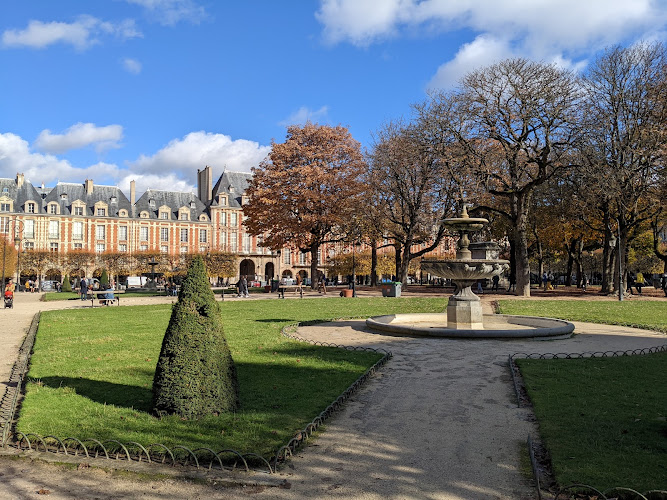
Europe\s first royal urban masterpiece
In the heart of the Marais, straddling the 3rd and 4th arrondissements, Place des Vosges stands as one of Europe\s most beautiful and historically significant squares. Commissioned by King Henri IV in 1605 and completed in 1612, this perfectly symmetrical space represents the birth of modern urban planning, where royal vision transformed medieval Paris into a model of classical elegance that would influence city design across Europe for centuries.
Henri IV\s visionary urban planning
Originally named Place Royale, this extraordinary square emerged from Henri IV\s ambitious program to modernize Paris through systematic urban planning. The kings vision created one of Europes earliest examples of formal urban design, predating similar royal squares and establishing principles that would later influence the creation of Place Vendôme and Place de la Concorde.
Though Henri IV was assassinated in 1610 before seeing his project completed, the square was inaugurated in 1612 with the celebration of Louis XIII\s engagement to Anne of Austria, marking both architectural achievement and dynastic continuity through one of Europe\s most magnificent public spaces.
Architectural perfection in Louis XIII style
The square\s revolutionary design creates perfect symmetry through 36 uniform buildings arranged around a 140 x 140 meter space. The distinctive red-brick facades with white stone trim, topped by steep slate roofs dotted with dormer windows, established the Louis XIII architectural style that would define French residential elegance for generations.
The continuous vaulted arcades running through the ground floor colonnades unite all pavilions into a harmonious ensemble, creating covered walkways that encourage strolling and social interaction while providing protection from weather. Two taller pavilions on the north and south sides offer formal entrances through triple arches, emphasizing the square\s ceremonial importance.
From Place Royale to Place des Vosges
The square\s name change in 1800 reflects broader French political transformation. Napoleon renamed it Place des Vosges in gratitude to the Vosges département, which was the first in France to pay revolutionary war taxes, demonstrating how architectural spaces can embody political values and national recognition.
This transformation from royal to republican symbolism shows how great public spaces can adapt their meaning while maintaining their essential character, serving successive political systems through their enduring beauty and functional excellence.
Cultural heart of the Marais
Today\s Place des Vosges serves as both active residential neighborhood and major tourist destination, housing art galleries, antique shops, and cafés beneath its historic arcades. The square\s Victor Hugo Museum preserves the memory of the great writer who lived here, while contemporary galleries ensure that the space continues its tradition of supporting French cultural life.
The central garden provides a peaceful oasis where visitors can appreciate the architectural harmony Henri IV envisioned, creating moments of tranquility that demonstrate how great urban planning can enhance daily life through beauty, proportion, and human-scaled design.
Model for European urban planning
Place des Vosges\s influence extended far beyond Paris, inspiring royal squares throughout Europe and establishing principles of urban design that continue to inform contemporary city planning. The square\s success proved that thoughtful public space design could enhance both property values and quality of life, creating environments where architectural beauty serves social function.
Essential information
- Commission: King Henri IV (1605)
- Construction: 1605-1612
- Original name: Place Royale
- Current name: Place des Vosges (since 1800)
- Dimensions: 140 x 140 meters (perfectly symmetrical)
- Buildings: 36 uniform pavilions
- Architectural style: Louis XIII (red brick, white stone, slate roofs)
Urban planning legacy
Place des Vosges stands as the birthplace of modern urban planning, where Henri IV\s royal vision created a template for European city design that prioritized both beauty and functionality. This remarkable square proves that great public spaces can successfully combine architectural magnificence with practical daily use, creating environments that enhance urban life across centuries. For urban planning enthusiasts, architecture lovers, or anyone seeking to understand how visionary design shapes city life, Place des Vosges offers an unparalleled lesson in creating public spaces that serve both aesthetic and social purposes, where royal ambition produced democratic beauty that continues to enrich Parisian life over 400 years after Henri IV first envisioned transforming medieval streets into classical urban poetry.