
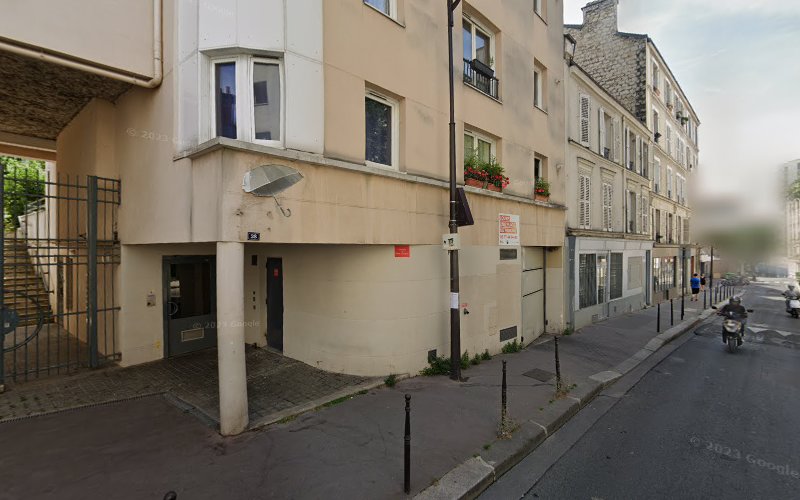
Headquarters of the French Communist Party
Union des Etudiants Communistes is a Paris Siège Social landmark located in the 19 arrondissement. Table of ContentsBrazilian modernism meets French revolutionary architectureExile, politics, and architectural opportunitySerpentine design and symbolic innovationContemporary relevance and cultural adaptationEssential informationRevolutionary architecture achieves eternal relevanceNearby in 19 Brazilian modernism meets French revolutionary architecture At 2 place du Colonel-Fabien in the […]
Union des Etudiants Communistes is a Paris Siège Social landmark located in the 19 arrondissement.
Table of Contents
Brazilian modernism meets French revolutionary architecture
At 2 place du Colonel-Fabien in the 19th arrondissement, the Headquarters of the French Communist Party stands as Oscar Niemeyer’s first European masterpiece, where Brazilian architectural genius merged with French political symbolism to create one of Paris’s most extraordinary modernist buildings. Designed between 1967-1980 during Niemeyer’s exile from Brazil’s military dictatorship, this serpentine concrete structure demonstrates how political conviction can inspire architectural innovation that transcends national boundaries while embodying revolutionary ideals through radical design that challenges conventional building aesthetics.
Exile, politics, and architectural opportunity
Oscar Niemeyer’s 1965 exhibition at the Musée des Arts Décoratifs, showcasing his Brasília projects to record-breaking Parisian crowds, created the perfect opportunity for architectural collaboration when Brazil’s military coup forced the communist architect into French exile. Establishing his office on the Champs-Élysées, Niemeyer found kindred spirits in the French Communist Party leadership who recognized how revolutionary architecture could serve political expression through buildings that embodied ideological principles rather than conventional institutional aesthetics.
This political alignment enabled Niemeyer to create his most symbolically charged European project, where personal exile and political conviction generated architectural innovation that proved how forced displacement can inspire creative achievement when talent meets receptive institutions committed to revolutionary cultural expression.
Serpentine design and symbolic innovation
The building’s six-story serpentine office block, supported by paired columns housing service ducts, creates dynamic visual movement that breaks conventional institutional architecture through curved concrete forms that suggest organic growth rather than bureaucratic rigidity. This undulating design demonstrates how modernist architecture can embody political philosophy through forms that reject authoritarian geometry in favor of fluid shapes suggesting democratic flexibility and revolutionary transformation.
The dramatic underground auditorium, crowned by an 11-meter aluminum dome clad in thousands of light-diffusing anodized blades, creates a futuristic meeting space that Niemeyer described as representing a pregnant woman—symbolizing the party’s role in birthing revolutionary social change through architectural metaphor that transforms political discourse into spatial experience.
Contemporary relevance and cultural adaptation
The 2007 classification as a monument historique and the 2008 transformation into Espace Niemeyer, hosting cultural events and exhibitions while renting commercial space, demonstrates how revolutionary architecture can adapt to changing political contexts while maintaining cultural relevance through adaptive reuse that honors original design integrity. This evolution proves that great architecture transcends its original political purpose to serve broader cultural missions.
Essential information
- Architect: Oscar Niemeyer (Brazilian modernist master)
- Design period: 1966-1967, construction 1968-1980
- Location: 2 place du Colonel-Fabien, 19th arrondissement
- Inauguration: Main building 1971, dome completed 1980
- Recognition: Monument historique (2007)
- Current name: Espace Niemeyer (cultural venue)
Revolutionary architecture achieves eternal relevance
The Headquarters of the French Communist Party embodies the transformative power of architectural vision when political conviction meets creative genius, where Oscar Niemeyer’s Brazilian exile generated his first European masterpiece that proved revolutionary architecture can transcend ideological boundaries to achieve universal aesthetic appreciation. For architecture enthusiasts, political history admirers, or anyone interested in how modernist design can embody revolutionary ideals, this serpentine concrete masterpiece offers an unparalleled encounter with architectural symbolism, where curved forms suggest organic transformation rather than bureaucratic rigidity, proving that the finest political buildings achieve immortality through spatial beauty that continues inspiring cultural dialogue long after their original ideological framework has evolved.