
<\!-- wp:heading -->
A Flamboyant Gothic masterpiece with extraordinary twisted palm tree columns
<\!-- /wp:heading --><\!-- wp:paragraph -->
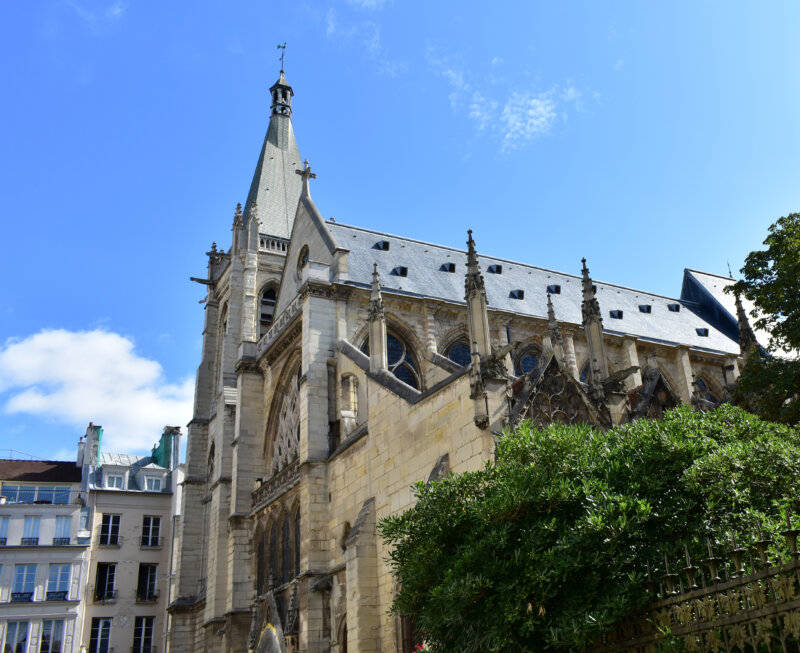
In the heart of the Latin Quarter in the 5th arrondissement, the Église Saint-Séverin stands as one of Paris\u2019s most architecturally spectacular churches and the finest example of Flamboyant Gothic style in the capital. Originally constructed beginning in 1230 as the parish church for University of Paris students, this remarkable building was transformed after a devastating 1448 fire into a masterpiece of late Gothic innovation that showcases the last and most ornate iteration of Gothic architectural development in France.
<\!-- /wp:paragraph --><\!-- wp:paragraph -->
Guillaume d\u2019Estouteville\u2019s decision to rebuild in the contemporary Flamboyant Gothic style created a church that demonstrates how traditional Gothic structural principles could be enhanced with elaborate stonework, intricate window tracery, and decorative innovations that pushed Gothic artistry to its ultimate expression.
<\!-- /wp:paragraph --><\!-- wp:heading {"level":3} -->
The miraculous twisted columns: stone palm trees reaching toward heaven
<\!-- /wp:heading --><\!-- wp:paragraph -->
The church\u2019s most celebrated architectural feature is the extraordinary twisted central pillar in the ambulatory, added in 1489, which rises like a stone palm tree whose branches spread upward into the intricate web of Flamboyant vaults. This surreal architectural element, reminiscent of nature\u2019s organic growth patterns, creates one of Gothic architecture\u2019s most innovative and emotionally powerful spatial experiences.
<\!-- /wp:paragraph --><\!-- wp:paragraph -->
The surrounding columns, designed to resemble palm tree trunks, work together with the central twisted pillar to create what appears to be a grove of stone trees supporting the elaborate vault system. This organic architectural metaphor demonstrates how Flamboyant Gothic architects could transform structural necessity into poetic architectural expression that enhances spiritual experience through natural symbolism.
<\!-- /wp:paragraph --><\!-- wp:heading {"level":3} -->
Flamboyant Gothic innovation and decorative mastery
<\!-- /wp:heading --><\!-- wp:paragraph -->
The church\u2019s Flamboyant Gothic elements showcase the style\u2019s characteristic features: traditional pointed arches enhanced with flame-like decorative patterns, star-burst decorative ribbing in the vaults, and elaborate window tracery that demonstrates the technical and artistic sophistication achieved during Gothic architecture\u2019s final developmental phase.
<\!-- /wp:paragraph --><\!-- wp:paragraph -->
The semi-circular apse and ambulatory, with their dramatic columns, arches, and vaults surrounding the spectacular spiral central pillar, create spatial complexity that invites contemplation while demonstrating French Gothic architects\u2019 mastery of both structural engineering and aesthetic innovation during the late medieval period.
<\!-- /wp:paragraph --><\!-- wp:heading {"level":3} -->
Stained glass heritage spanning centuries
<\!-- /wp:heading --><\!-- wp:paragraph -->
The church houses an exceptional collection of stained glass spanning multiple historical periods, including rare 14th-century windows that survived the 1448 fire, 15th and 16th-century additions that complement the Flamboyant Gothic reconstruction, and contemporary works by Jean René Bazaine (1970) inspired by the seven sacraments of the Catholic church.
<\!-- /wp:paragraph --><\!-- wp:paragraph -->
This chronological span of stained glass artistry demonstrates how religious buildings can accommodate artistic innovations from different periods while maintaining visual and spiritual coherence, creating comprehensive artistic environments that serve both historical documentation and ongoing liturgical function.
<\!-- /wp:paragraph --><\!-- wp:heading {"level":3} -->
University parish heritage and student spiritual life
<\!-- /wp:heading --><\!-- wp:paragraph -->
As the historic parish church for University of Paris students, Saint-Séverin played a crucial role in the spiritual life of the Latin Quarter\u2019s academic community for centuries. This function connected the church to broader intellectual movements while ensuring its continued relevance to successive generations of students and scholars who found spiritual support within its extraordinary architectural environment.
<\!-- /wp:paragraph --><\!-- wp:paragraph -->
The church\u2019s survival as one of the oldest remaining churches on the Left Bank demonstrates how religious institutions can maintain their essential spiritual mission while adapting to serve evolving community needs and changing architectural tastes.
<\!-- /wp:paragraph --><\!-- wp:heading {"level":3} -->
Architectural pilgrimage and Gothic appreciation
<\!-- /wp:heading --><\!-- wp:paragraph -->
Today, Saint-Séverin continues to serve both its religious function and its role as an architectural destination where visitors can experience Flamboyant Gothic innovation at its finest. The church\u2019s twisted columns have become legendary among architectural enthusiasts while maintaining their spiritual function of directing worshippers\u2019 attention toward transcendent possibilities.
<\!-- /wp:paragraph --><\!-- wp:paragraph -->
For visitors to Paris interested in Gothic architecture, medieval spiritual traditions, or innovative architectural solutions, Saint-Séverin offers an exceptional encounter with late Gothic creativity and spiritual inspiration. The church demonstrates that great religious architecture emerges when structural innovation serves spiritual purpose, creating sacred environments that inspire both aesthetic wonder and religious devotion through organic architectural metaphors that connect human spiritual aspiration with natural beauty and divine transcendence.
<\!-- /wp:paragraph -->