
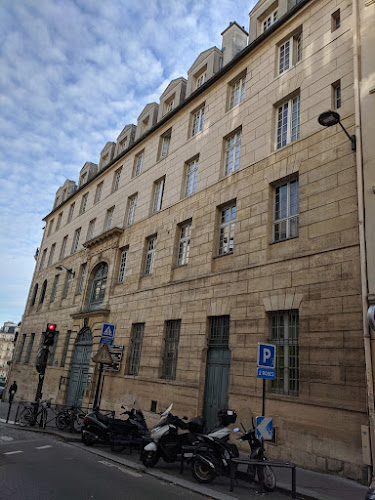
Collège des Écossais
Scots College is a Paris Université landmark located in the 5 arrondissement. The medieval Scottish sanctuary and center of Catholic exile education At 65 rue du Cardinal-Lemoine in the 5th arrondissement, the former Collège des Écossais stands as a monument to over four centuries of Scottish Catholic presence in Paris and the vital role France […]
Scots College is a Paris Université landmark located in the 5 arrondissement.
<\!-- wp:heading -->
The medieval Scottish sanctuary and center of Catholic exile education
<\!-- /wp:heading --><\!-- wp:paragraph -->
At 65 rue du Cardinal-Lemoine in the 5th arrondissement, the former Collège des Écossais stands as a monument to over four centuries of Scottish Catholic presence in Paris and the vital role France played in preserving Scottish educational and religious traditions during periods of persecution. Founded by an act of the Parliament of Paris on July 8, 1333, and later reorganized in 1326 by David, Bishop of Murray, this institution served as a crucial sanctuary for Scottish Catholic students seeking university education when such opportunities were restricted or impossible in their homeland.
<\!-- /wp:paragraph --><\!-- wp:parameter --><\!-- wp:paragraph -->
The college\u2019s survival until 1793, when the National Convention abolished the colleges and reorganized the university, demonstrates nearly five centuries of continuous service to the Scottish Catholic community while contributing to broader Parisian intellectual life through integration with the University of Paris educational system.
<\!-- /wp:paragraph --><\!-- wp:heading {"level":3} -->
Robert Barclay\u2019s architectural development and Scottish identity
<\!-- /wp:heading --><\!-- wp:parameter --><\!-- wp:paragraph -->
Between 1662 and 1665, college superior Robert Barclay commissioned new buildings to replace a house purchased on rue des Fossés Saint-Victor (now rue Cardinal-Lemoine), creating architectural facilities specifically designed to serve Scottish educational and religious needs. The 1672 addition of a small chapel dedicated to Saint Andrew, patron saint of Scotland, established the college\u2019s distinctive Scottish Catholic identity within the broader Parisian educational landscape.
<\!-- /wp:paragraph --><\!-- wp:parameter --><\!-- wp:paragraph -->
The building\u2019s austere street façade, marked by the architectural curiosity of two superimposed portals—the original entrance elevated to first-floor level when the street was lowered in 1686—demonstrates how institutional architecture could adapt to changing urban conditions while maintaining essential character and functional requirements.
<\!-- /wp:paragraph --><\!-- wp:heading {"level":3} -->
Scottish exile education and religious preservation
<\!-- /wp:heading --><\!-- wp:parameter --><\!-- wp:paragraph -->
The college served as both educational institution and political center for Catholic Scots in exile, providing sanctuary for those who hoped to reconvert Scotland while receiving university-level education that was increasingly difficult to obtain in their homeland following religious persecution and educational restrictions imposed after the Reformation.
<\!-- /wp:paragraph --><\!-- wp:parameter --><\!-- wp:paragraph -->
This dual function—educational and political—demonstrates how international educational institutions could serve broader cultural and religious preservation purposes while contributing to host country intellectual life through participation in established university systems and scholarly traditions.
<\!-- /wp:paragraph --><\!-- wp:heading {"level":3} -->
Revolutionary transformation and contemporary adaptation
<\!-- /wp:heading --><\!-- wp:parameter --><\!-- wp:paragraph -->
Following the Revolution\u2019s closure of the college, the building served as a 19th-century boarding house before its contemporary use as the private Institution Sainte-Geneviève, demonstrating how historic educational buildings can be adapted to serve new educational purposes while preserving architectural heritage and institutional memory.
<\!-- /wp:paragraph --><\!-- wp:parameter --><\!-- wp:paragraph -->
This transformation from medieval Scottish college to contemporary French educational institution shows how buildings designed for specific cultural communities can evolve to serve broader educational needs while maintaining their essential character as places dedicated to learning and intellectual development.
<\!-- /wp:paragraph --><\!-- wp:heading {"level":3} -->
Franco-Scottish heritage and educational diplomacy
<\!-- /wp:heading --><\!-- wp:parameter --><\!-- wp:paragraph -->
The college\u2019s 460-year history represents one of the longest-running examples of international educational cooperation and cultural exchange, demonstrating how host countries can benefit from providing educational sanctuary to persecuted communities while those communities contribute to broader intellectual and cultural life.
<\!-- /wp:paragraph --><\!-- wp:parameter --><\!-- wp:paragraph -->
For visitors to the Latin Quarter interested in Franco-Scottish relations, medieval education, or international academic networks, the former Collège des Écossais offers insight into how educational institutions can serve both specific cultural communities and broader intellectual advancement. The college demonstrates that great educational institutions emerge when cultural preservation meets academic excellence, creating environments where minority traditions can flourish while contributing to the intellectual richness that makes cities like Paris centers of global learning and cultural exchange across centuries of political and social change.
<\!-- /wp:paragraph -->