
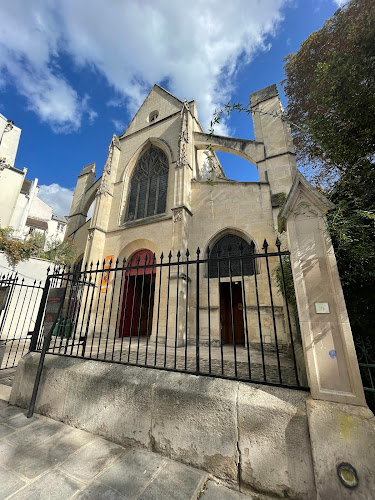
Église Saint-Médard
Église Saint-Médard is a Paris Attractions landmark located in the 5 arrondissement. The Flamboyant Gothic church where Jansenist convulsionnaires shook 18th-century Paris At 105 rue Mouffetard in the 5th arrondissement, the Église Saint-Médard stands as one of Paris\u2019s most historically layered churches and the epicenter of one of 18th-century France\u2019s most controversial religious movements. Built […]
Église Saint-Médard is a Paris Attractions landmark located in the 5 arrondissement.
<\!-- wp:heading -->
The Flamboyant Gothic church where Jansenist convulsionnaires shook 18th-century Paris
<\!-- /wp:heading --><\!-- wp:paragraph -->
At 105 rue Mouffetard in the 5th arrondissement, the Église Saint-Médard stands as one of Paris\u2019s most historically layered churches and the epicenter of one of 18th-century France\u2019s most controversial religious movements. Built over multiple centuries from medieval foundations through Flamboyant Gothic reconstruction, this remarkable church combines exceptional architectural heritage with the dramatic story of the Convulsionnaires, whose ecstatic religious practices at François de Pâris\u2019s tomb shocked and fascinated enlightenment-era France.
<\!-- /wp:paragraph --><\!-- wp:paragraph -->
The church\u2019s evolution from 9th-century chapel through 15th-century Gothic reconstruction to its role as center of 18th-century religious controversy demonstrates how sacred architecture can embody complex theological, political, and social developments while maintaining its essential function as a place of worship and community gathering.
<\!-- /wp:paragraph --><\!-- wp:heading {"level":3} -->
Medieval foundations and Flamboyant Gothic transformation
<\!-- /wp:heading --><\!-- wp:paragraph -->
Archaeological evidence of Merovingian period Christian tombs near the present church, combined with documentary evidence from Pope Alexander III\u2019s 1163 papal bull, establishes the site\u2019s continuous Christian use for over 1,400 years. The 9th-century chapel dedicated to Saint Médard, positioned near the Roman road connecting Lutetia to Lyon where it crossed the Bièvre River, created a strategic religious presence along crucial medieval transportation routes.
<\!-- /wp:paragraph --><\!-- wp:parameter --><\!-- wp:paragraph -->
The 15th-century reconstruction in Flamboyant Gothic style created the church\u2019s current architectural character, with the western front featuring a large bay filled with elaborate Flamboyant Gothic windows flanked by pinnacles, while the nave displays pointed arches supported by columns without capitals that exemplify late Gothic architectural innovation and spatial sophistication.
<\!-- /wp:paragraph --><\!-- wp:heading {"level":3} -->
François de Pâris and the birth of convulsionnaire phenomenon
<\!-- /wp:heading --><\!-- wp:parameter --><\!-- wp:paragraph -->
The church\u2019s 18th-century fame emerged from François de Pâris (1690-1727), a Jansenist deacon whose ascetic religious practices and burial in the parish cemetery created the epicenter for the convulsionnaire movement. Pilgrims touching his tomb reportedly experienced bodily contortions, miraculous healings, and religious ecstasy that challenged both Catholic orthodoxy and Enlightenment rationalism.
<\!-- /wp:paragraph --><\!-- wp:parameter --><\!-- wp:paragraph -->
The phenomenon attracted intensive attention when Catherine Maire\u2019s research revealed that of 116 people claiming miraculous healing at Pâris\u2019s tomb, 70% were women, and among 270 people experiencing or observing convulsions in 1732, 211 were women versus only 59 men. This gender disparity reveals important social dimensions of religious expression and community religious authority during the 18th century.
<\!-- /wp:paragraph --><\!-- wp:heading {"level":3} -->
Jansenist theology and political resistance
<\!-- /wp:heading --><\!-- wp:parameter --><\!-- wp:paragraph -->
The convulsionnaire movement represented more than religious enthusiasm—it embodied Jansenist theological resistance to both papal authority and royal religious policy. The practice of religious convulsions, speaking in tongues, and miraculous healing claims challenged official Catholic doctrine while providing alternative spiritual experiences that attracted those dissatisfied with established religious authority.
<\!-- /wp:paragraph --><\!-- wp:parameter --><\!-- wp:paragraph -->
The governmentu2019s eventual suppression of cemetery gatherings and the 1875 removal of the cemetery to create a park reflects ongoing political sensitivity about religious movements that could challenge established authority while serving social needs unmet by official institutions.
<\!-- /wp:paragraph --><\!-- wp:heading {"level":3} -->
Artistic treasures and cultural synthesis
<\!-- /wp:heading --><\!-- wp:parameter --><\!-- wp:paragraph -->
The church houses exceptional artistic works including Charles-Joseph Natoire\u2019s “Jesus chasing the merchants from the Temple,” Francisco de Zurbarán\u2019s “The promenade of Saint Joseph and the Infant Jesus,” Pierre-Jacques Cazes\u2019s “Saint Cecilia,” and Alexandre-François Caminade\u2019s “The Marriage of the Virgin.” These masterpieces create comprehensive artistic environments that enhance liturgical function while demonstrating how parish churches could attract major artistic patronage.
<\!-- /wp:paragraph --><\!-- wp:parameter --><\!-- wp:paragraph -->
The integration of multiple architectural periods—from medieval foundations through Flamboyant Gothic innovation to Renaissance choir completion (1562-1620)—creates comprehensive sacred environments that document French religious architectural development while serving ongoing community spiritual needs.
<\!-- /wp:paragraph --><\!-- wp:heading {"level":3} -->
Hidden treasure of Mouffetard and contemporary spiritual life
<\!-- /wp:heading --><\!-- wp:parameter --><\!-- wp:paragraph -->
Despite its extraordinary historical significance, Saint-Médard remains relatively unknown to tourists, creating authentic parish atmosphere where visitors can experience both architectural beauty and living religious tradition without overwhelming tourist crowds. The church\u2019s position on the historic rue Mouffetard places it within one of Paris\u2019s most charming market streets.
<\!-- /wp:paragraph --><\!-- wp:parameter --><\!-- wp:paragraph -->
For visitors to Paris interested in Jansenist history, Flamboyant Gothic architecture, or 18th-century religious movements, Saint-Médard offers an exceptional encounter with how parish churches can serve as centers of both architectural achievement and social religious innovation. The church demonstrates that great religious buildings achieve lasting significance by providing communities with both beautiful worship environments and spaces where spiritual experimentation can flourish, creating institutions that serve both traditional religious needs and evolving spiritual expression while maintaining architectural dignity appropriate to sacred purpose and community identity.
<\!-- /wp:paragraph -->