
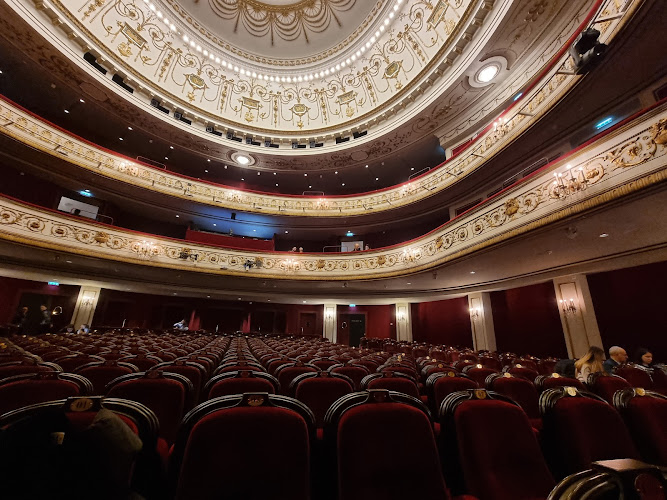
Théâtre Marigny
Marigny Theater is a Paris Salle De Spectacles landmark located in the 8 arrondissement. Charles Garnier\u2019s panorama transformed by Édouard Niermans into a Champs-Élysées theatrical jewel At Carré Marigny in the 8th arrondissement, near the junction of Champs-Élysées and Avenue Marigny, Théâtre Marigny stands as a unique testament to 19th-century entertainment evolution and architectural adaptation […]
Marigny Theater is a Paris Salle De Spectacles landmark located in the 8 arrondissement.
<\!-- wp:heading -->
Charles Garnier\u2019s panorama transformed by Édouard Niermans into a Champs-Élysées theatrical jewel
<\!-- /wp:heading --><\!-- wp:parameter -->
At Carré Marigny in the 8th arrondissement, near the junction of Champs-Élysées and Avenue Marigny, Théâtre Marigny stands as a unique testament to 19th-century entertainment evolution and architectural adaptation by two of France\u2019s greatest theatre architects. Originally built in 1883 by Charles Garnier—architect of the legendary Palais Garnier—as a venue for panorama displays, this circular structure was brilliantly transformed in 1894 by Édouard Niermans into a theatre-in-the-round that would become one of Paris\u2019s most distinctive and beloved performance venues.
<\!-- /wp:paragraph --><\!-- wp:parameter -->
The theatre\u2019s evolution from panorama exhibition space to musical theatre represents broader 19th-century entertainment transformation while demonstrating how great architectural structures can adapt to serve evolving cultural needs without compromising essential design integrity and aesthetic excellence.
<\!-- /wp:paragraph --><\!-- wp:heading {"level":3} -->
Garnier\u2019s circular architecture and Niermans\u2019 theatrical innovation
<\!-- /wp:heading --><\!-- wp:parameter -->
Charles Garnier\u2019s original circular architecture, designed to optimize panorama viewing experiences, provided ideal foundations for Édouard Niermans\u2019 1894 conversion to theatre-in-the-round that created unprecedented intimacy between performers and audiences while maintaining the visual grandeur appropriate to Champs-Élysées cultural programming.
<\!-- /wp:paragraph --><\!-- wp:parameter -->
Niermans\u2019 adaptation for summer musical spectacles demonstrated how theatrical architecture could embrace innovative performance formats while preserving architectural distinction and acoustic excellence that enhanced rather than compromised artistic presentation and audience engagement within sophisticated urban entertainment contexts.
<\!-- /wp:paragraph --><\!-- wp:heading {"level":3} -->
Léon Volterra\u2019s expansion and post-war cultural leadership
<\!-- /wp:heading --><\!-- wp:parameter -->
The theatre\u2019s reconstruction in 1925 by Léon Volterra, who installed comfortable and spacious auditorium facilities, established the venue\u2019s reputation for luxurious theatrical experiences while the 1950s leadership under Simone Volterra positioned the theatre among the city\u2019s leading venues during the post-war cultural explosion that redefined Parisian entertainment culture.
<\!-- /wp:parameter --><\!-- wp:parameter -->
This expansion and modernization demonstrates how historic theatres can enhance their facilities while preserving essential character and continuing their mission of providing Parisian audiences with world-class theatrical experiences within prestigious cultural districts that attract both local and international audiences.
<\!-- /wp:paragraph --><\!-- wp:heading {"level":3} -->
Contemporary renovation and dual venue programming
<\!-- /wp:heading --><\!-- wp:parameter -->
The comprehensive 2013-2018 renovation that closed the theatre for five years resulted in spectacular restoration that enhanced the venue\u2019s capacity to serve both large-scale Broadway performances in the 1,024-seat main theatre and experimental works in the 300-seat smaller studio, demonstrating how historic venues can adapt to serve diverse contemporary theatrical needs.
<\!-- /wp:paragraph --><\!-- wp:parameter -->
This dual programming approach reflects understanding that great theatres should provide platforms for both established productions and emerging artistic works while maintaining architectural excellence and performance standards that honor both theatrical tradition and contemporary artistic innovation.
<\!-- /wp:paragraph --><\!-- wp:heading {"level":3} -->
Champs-Élysées cultural prestige and international programming
<\!-- /wp:heading --><\!-- wp:parameter -->
The theatre\u2019s position as one of few Parisian venues to welcome historic Broadway performances reflects its unique role in bringing international musical theatre to French audiences while maintaining distinctive French theatrical character and cultural sophistication that enhances rather than replaces local theatrical traditions.
<\!-- /wp:paragraph --><\!-- wp:parameter -->
The venue\u2019s location within the Champs-Élysées cultural district ensures access to international audiences while contributing to broader neighborhood cultural programming that makes the 8th arrondissement a comprehensive destination for visitors seeking world-class entertainment within historically significant architectural settings.
<\!-- /wp:paragraph --><\!-- wp:heading {"level":3} -->
Architectural legacy and theatrical excellence
<\!-- /wp:heading --><\!-- wp:parameter -->
Today, Théâtre Marigny continues honoring Charles Garnier\u2019s architectural vision and Édouard Niermans\u2019 theatrical innovation while serving contemporary entertainment needs through programming that balances classical excellence with contemporary artistic development, demonstrating how great cultural institutions can maintain historical integrity while embracing ongoing artistic evolution.
<\!-- /wp:paragraph --><\!-- wp:parameter -->
For visitors to the Champs-Élysées interested in theatrical architecture, French entertainment history, or international musical theatre, Théâtre Marigny offers an exceptional encounter with how Garnier\u2019s panorama vision evolved into Niermans\u2019 theatrical excellence within one of Paris\u2019s most prestigious cultural districts. The theatre demonstrates that great performance venues emerge when architectural distinction meets programming excellence, creating cultural institutions that serve both immediate entertainment needs and broader cultural purposes while establishing lasting monuments to artistic collaboration and theatrical innovation that enrich urban cultural life across generations of performers and audiences.
<\!-- /wp:paragraph -->