
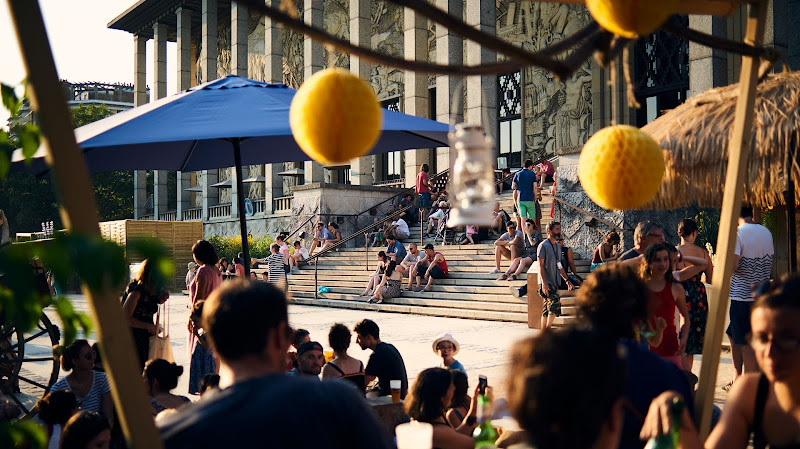
Palais de la Porte Dorée
Palais de la Porte Dorée is a Paris Museums landmark located in the 12 arrondissement. An Art Deco masterpiece transformed from colonial showcase to immigration memorial At 293 avenue Daumesnil in the 12th arrondissement, the Palais de la Porte Dorée stands as one of Paris\u2019s most significant Art Deco monuments and a powerful symbol of […]
Palais de la Porte Dorée is a Paris Museums landmark located in the 12 arrondissement.
<\!-- wp:heading -->
An Art Deco masterpiece transformed from colonial showcase to immigration memorial
<\!-- /wp:heading --><\!-- wp:paragraph -->
At 293 avenue Daumesnil in the 12th arrondissement, the Palais de la Porte Dorée stands as one of Paris\u2019s most significant Art Deco monuments and a powerful symbol of how architecture can evolve to serve new social purposes. Built for the 1931 Paris Colonial Exposition, this “Art Deco jewel” has been transformed from a celebration of French colonial empire into a thoughtful examination of immigration and cultural diversity.
<\!-- /wp:paragraph --><\!-- wp:paragraph -->
Designed by architects Albert Laprade, Léon Jaussely, and Léon Bazin, the palace exemplifies the Art Deco movement\u2019s emphasis on stylized forms, geometric purity, large volumes, and spatial symmetry. The building\u2019s creation brought together the era\u2019s finest decorative artists in a comprehensive collaborative work that integrated cabinet-making, sculpture, ironwork, mosaic, fresco, painting, and glasswork.
<\!-- /wp:paragraph --><\!-- wp:heading {"level":3} -->
Sculptural mastery by Alfred Janniot
<\!-- /wp:heading --><\!-- wp:paragraph -->
The palace\u2019s most striking feature is Alfred Janniot\u2019s extraordinary bas-relief covering 1,200 square meters of the building\u2019s exterior. These sculptures portray ships, oceans, and exotic wildlife including antelopes, elephants, zebras, and serpents, creating a visual narrative that originally celebrated French colonial territories but now serves as historical documentation of the period\u2019s worldview.
<\!-- /wp:paragraph --><\!-- wp:parameter --><\!-- wp:paragraph -->
Janniot\u2019s work represents some of the finest example of Art Deco sculptural art, demonstrating how decorative elements could be integrated into architectural design to create unified artistic statements. The scale and sophistication of these reliefs reflect the enormous resources and artistic ambition invested in the 1931 exposition.
<\!-- /wp:paragraph --><\!-- wp:heading {"level":3} -->
Artistic collaboration and decorative arts
<\!-- /wp:heading --><\!-- wp:paragraph -->
The palace\u2019s interior showcases the collaborative genius of leading Art Deco artists: ironwork by Brandt, Schenk, Bagués, Poillerat, and Prouvé; lighting by Subes; lacquer work by Dunand; frescoes by Ducos de la Haille, Bouquet, and the Lemaître brothers; and furniture by Ruhlmann and Printz for the corner salons.
<\!-- /wp:paragraph --><\!-- wp:paragraph -->
This unprecedented artistic collaboration created interior spaces that rival the greatest Art Deco achievements worldwide. The integration of decorative arts with architectural design demonstrates the movement\u2019s commitment to total artistic environments where every element contributes to a unified aesthetic vision.
<\!-- /wp:paragraph --><\!-- wp:heading {"level":3} -->
Historical transformation and contemporary purpose
<\!-- /wp:heading --><\!-- wp:paragraph -->
Since 2007, the palace has housed the Musée National de l\u2019Histoire de l\u2019Immigration, creating an ironic but meaningful transformation of a building originally designed to celebrate colonial expansion into a space honoring the immigrant communities who have enriched French society. This adaptive reuse demonstrates how historical monuments can address contemporary social issues while preserving their architectural integrity.
<\!-- /wp:paragraph --><\!-- wp:paragraph -->
The basement continues to house the tropical aquarium installed for the original exposition, maintaining one element of the building\u2019s original program while adapting the main spaces to serve new educational and cultural purposes. This combination allows visitors to experience both the building\u2019s historical context and its contemporary relevance.
<\!-- /wp:paragraph --><\!-- wp:heading {"level":3} -->
Historic monument recognition and preservation
<\!-- /wp:heading --><\!-- wp:parameter --><\!-- wp:paragraph -->
In 1987, recognition of the palace\u2019s artistic and historical value led to its classification as a historic monument, with particular protection for the façades, Hall of Honor, salons, and Forum. This designation acknowledges the building\u2019s significance as both architectural achievement and historical document of 1930s French attitudes toward empire and global relations.
<\!-- /wp:paragraph --><\!-- wp:paragraph -->
The preservation efforts ensure that future generations can study both the artistic excellence of Art Deco design and the complex historical context that shaped the building\u2019s original purpose. The palace serves as a monument that honestly confronts its colonial origins while embracing its role in contemporary discussions about diversity and inclusion.
<\!-- /wp:paragraph --><\!-- wp:heading {"level":3} -->
Living witness to historical evolution
<\!-- /wp:heading --><\!-- wp:paragraph -->
Today, the Palais de la Porte Dorée represents the possibility of historical redemption through thoughtful adaptive reuse. The building demonstrates how monuments associated with problematic historical periods can find new purpose by honestly addressing their past while serving contemporary social needs.
<\!-- /wp:paragraph --><\!-- wp:paragraph -->
For visitors interested in Art Deco architecture, French colonial history, or contemporary immigration issues, the palace offers a unique opportunity to examine how cultural institutions can evolve while maintaining their architectural and artistic integrity. The transformation from colonial showcase to immigration memorial exemplifies Paris\u2019s capacity for historical reflection and social progress.
<\!-- /wp:paragraph -->