
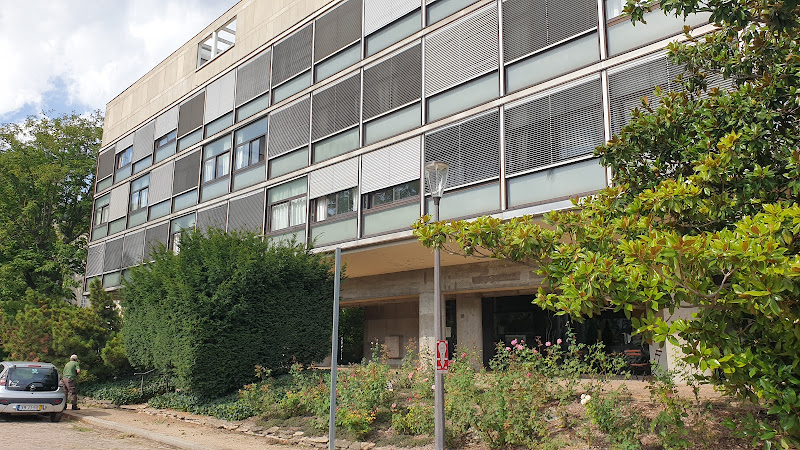
Pavillon de la Suisse
Fondation Suisse / Pavillon Le Corbusier is a Paris Centre D'hébergement Pour Étudiants landmark located in the 14 arrondissement. Le Corbusier’s revolutionary “machine for living” At the Cité internationale universitaire in the 14th arrondissement, the Pavillon de la Suisse stands as one of Le Corbusier’s most influential architectural achievements, where modernist theory met practical student […]
Fondation Suisse / Pavillon Le Corbusier is a Paris Centre D'hébergement Pour Étudiants landmark located in the 14 arrondissement.
Le Corbusier’s revolutionary “machine for living”
At the Cité internationale universitaire in the 14th arrondissement, the Pavillon de la Suisse stands as one of Le Corbusier’s most influential architectural achievements, where modernist theory met practical student housing needs to create a building that revolutionized both university architecture and residential design. Completed in July 1933 by Le Corbusier and Pierre Jeanneret, this extraordinary “machine for living” established the prototype for post-war social housing while demonstrating how modernist architecture could serve international educational cooperation and progressive social ideals.
Five points of modern architecture realized
The Swiss Pavilion exemplifies Le Corbusier’s “five points of new architecture” coined in 1927: pilotis clearing the ground floor, roof terrace connected to living areas, open plan ground floor, long windows, and free curtain-wall façade. This comprehensive application of modernist principles created a building that served as architectural manifesto while providing practical student accommodation.
The engineering tour de force anchors the four-story main pavilion on six massive reinforced concrete pilotis fixed 19 meters down into the quarry bottom, demonstrating how modernist architects could solve difficult site conditions through innovative structural solutions that enhanced rather than compromised architectural expression.
Swiss modernist identity and international cooperation
As the first explicitly modern building at the Cité internationale, the pavilion stood apart from folk styles and academic traditions that characterized other national pavilions, projecting the modern Swiss identity that the country sought to present at international events during the 1930s. This architectural diplomacy demonstrated how building design could serve national cultural representation.
The pavilion’s completion in 1933 established Switzerland’s commitment to modernist architecture and progressive educational values while providing practical housing for Swiss students studying in Paris, creating environments that supported both academic achievement and cultural exchange.Le Corbusier’s design created 46 student rooms, each measuring 6 meters deep by 2.80 meters wide, equipped with hand basin, toilet, shower, and closets that provided complete private facilities within compact but dignified spaces. This approach revolutionized student housing by proving that modernist efficiency could enhance rather than compromise living quality. The building combined private accommodation with community spaces that fostered interaction among international students, creating architectural environments that supported both individual study and cultural exchange that advanced international understanding through daily residential experience.
The Swiss Pavilion served as the prototype for Le Corbusier’s post-war Cités radieuses constructed in Marseille, Nantes, Briey, Firminy, and Berlin, proving that modernist architecture could address mass housing needs while maintaining architectural quality and social vision that honored human dignity through design excellence. Siegfried Giedion’s recognition of the building as “one of Le Corbusier’s freest and most imaginative creations” acknowledges its significance as both architectural achievement and starting point for the architect’s development as plastic artist and pioneer of “new brutalism” that would influence 1950s architecture worldwide.
Historic monument and architectural legacy
The pavilion’s 1986 designation as Historic Monument recognizes both its architectural significance and its role in establishing modernist principles that influenced international architecture. This protection ensures that future generations can experience how Le Corbusier’s visionary approach to residential design created environments that served both practical needs and social ideals.Essential information
- Completion: July 1933
- Architects: Le Corbusier and Pierre Jeanneret
- Innovation: First modern building at Cité internationale
- Structure: Four-story pavilion on six 19-meter pilotis
- Capacity: 46 student rooms
- Heritage status: Historic Monument (1986)
- Location: Cité internationale universitaire, 14th arrondissement
- Legacy: Prototype for post-war Cités radieuses
- Architectural manifesto: Five points of modern architecture demonstrated
- Social innovation: Private accommodation with community spaces
- International cooperation: Swiss identity through modernist design
- Student facilities: Complete private amenities in efficient layouts
- Influence: Starting point for “new brutalism” and social housing
Modernist revolution in student housing
Pavillon de la Suisse embodies Le Corbusier’s belief that modernist architecture could solve social problems while creating beautiful environments that honor human dignity through innovative design. This remarkable building demonstrates how architectural theory can achieve practical application that serves both individual needs and broader social ideals, creating prototypes that influence international development. For modernist architecture enthusiasts, social housing historians, or anyone interested in how innovative design shapes educational environments, the Swiss Pavilion offers an extraordinary encounter with architectural revolution, where Le Corbusier’s visionary principles created student housing that proved modernist efficiency could enhance rather than compromise quality of life, establishing design standards that continue to influence contemporary residential architecture through spaces that combine private dignity with community cooperation.