
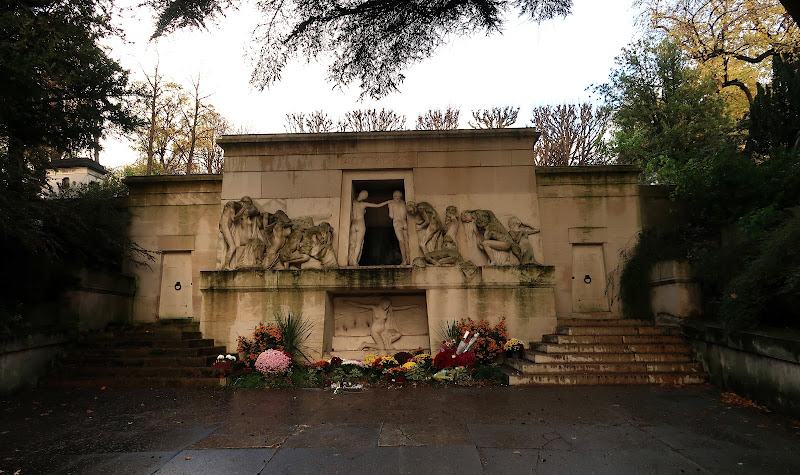
Monument aux morts du Père-Lachaise
Monument aux morts is a Paris Cemetery landmark located in the 20 arrondissement. A tribute to the Great War’s fallen heroes The Monument aux morts du Père-Lachaise stands as a hauntingly beautiful tribute to the victims of the First World War, representing one of the most moving war memorials in Paris. Located within the world-famous […]
Monument aux morts is a Paris Cemetery landmark located in the 20 arrondissement.
A tribute to the Great War’s fallen heroes
The Monument aux morts du Père-Lachaise stands as a hauntingly beautiful tribute to the victims of the First World War, representing one of the most moving war memorials in Paris. Located within the world-famous Père-Lachaise Cemetery in the 20th arrondissement, this neoclassical masterpiece serves as both artistic achievement and solemn reminder of the enormous sacrifice made by an entire generation of French soldiers.
Neoclassical artistry in service of memory
The monument exemplifies the finest traditions of French commemorative sculpture, featuring a large stone structure topped by a statue of a woman holding a wreath—a classical representation of victory and remembrance. Two statues of soldiers flank the sides of the monument, their presence adding gravitas to the already solemn atmosphere of this sacred space.
The neoclassical design reflects the period’s artistic conventions for war memorials, combining allegorical figures with realistic military representations. The monument’s scale and sculptural quality demonstrate the importance French society placed on honoring those who gave their lives for their country, transforming grief into lasting artistic testament.
Memorial within a memorial
The monument’s location within Père Lachaise Cemetery creates a powerful layering of memory and significance. The cemetery itself, established in 1804, serves as the final resting place of many notable figures including Oscar Wilde, Édith Piaf, and Jim Morrison. Within this context of celebrated lives, the Monument aux morts provides a counterpoint—honoring not individual achievement but collective sacrifice.
The juxtaposition between the famous graves that draw millions of visitors and this memorial to unknown soldiers creates a profound meditation on different forms of remembrance. While tourists seek out celebrity graves, this monument quietly insists on the equal importance of those who died young in service to their nation.
Symbol of remembrance and reflection
The Monument aux morts serves as more than historical marker—it provides a space for contemplating the impact of war on French society. The First World War devastated France, claiming the lives of over 1.3 million French soldiers and leaving deep scars on the national psyche. This monument, like countless others throughout France, represents the nation’s attempt to give meaning to incomprehensible loss.
Visitors can take a moment to pay their respects to the fallen soldiers and reflect on the ongoing impact of warfare. The monument serves as a reminder of the sacrifices made by so many, and the crucial importance of honoring their memory while working to prevent future conflicts.
Artistic and historical significance
The monument represents an important example of early 20th-century commemorative art, demonstrating how French sculptors adapted classical traditions to address contemporary tragedy. The combination of allegorical and realistic elements creates a work that is both emotionally affecting and artistically sophisticated.
The monument’s presence within Père Lachaise also contributes to the cemetery’s role as a comprehensive museum of French history and culture. Alongside graves of artists, writers, and musicians, this war memorial ensures that military sacrifice remains part of the national cultural narrative.
Key features
- Commemorates soldiers who lost their lives in World War I and World War II
- Features striking neoclassical sculptures with intricate carvings and symbolic motifs
- Central female figure representing victory and remembrance, holding a commemorative wreath
- Flanking soldier statues provide realistic military representation
- Large stone structure demonstrating the scale of national loss and remembrance
Visiting experience
- Location: Père Lachaise Cemetery, 20th arrondissement
- Best visiting times: Early morning or late afternoon for peaceful reflection
- Recommended duration: 1-2 hours including broader cemetery exploration
- Nearby attractions: Famous graves throughout Père Lachaise Cemetery
- Accessibility: Accessible via cemetery’s main pathways
Cultural significance
For visitors interested in history, art, or the profound human cost of war, the Monument aux morts du Père-Lachaise offers an unforgettable experience. Its powerful symbolism and stunning neoclassical design create a space where art and memory converge, ensuring that the sacrifice of the Great War generation continues to speak to contemporary visitors. Within the broader context of Père Lachaise’s celebrated residents, this monument insists on the equal importance of honoring those who gave their lives in service to their nation and the values of democracy and freedom.