
<\!-- wp:heading -->
<\!-- /wp:heading --><\!-- wp:paragraph -->
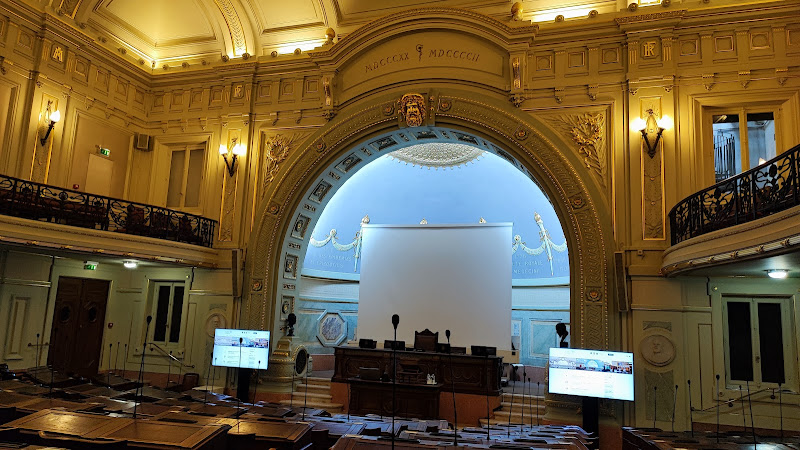
At 16 rue Bonaparte in the 6th arrondissement, the Académie nationale de médecine occupies one of Paris\u2019s most distinguished institutional buildings and serves as France\u2019s highest medical authority. Created in 1820 by King Louis XVIII at the urging of Baron Antoine Portal, this prestigious academy represents nearly two centuries of French medical excellence while operating from Justin Rochet\u2019s impressive Belle Époque building constructed between 1899 and 1902.
<\!-- /wp:paragraph --><\!-- wp:paragraph -->
The academy\u2019s mission to promote international cooperation in medical education, research, and innovation has made it a global center for medical advancement while its architectural setting demonstrates how institutional buildings can embody the dignity and cultural significance appropriate to institutions that serve humanity\u2019s health and wellbeing.
<\!-- /wp:paragraph --><\!-- wp:heading {"level":3} -->
Royal foundation and medical institutional development
<\!-- /wp:heading --><\!-- wp:paragraph -->
Louis XVIII\u2019s 1820 establishment of the academy reflected post-Napoleonic France\u2019s commitment to rebuilding national institutions that could advance scientific knowledge while serving broader public health needs. Baron Portal\u2019s advocacy for creating a national medical academy demonstrated understanding that medical advancement required both individual research excellence and coordinated institutional support for comprehensive health policy development.
<\!-- /wp:heading --><\!-- wp:paragraph -->
The academy\u2019s evolution from royal initiative to contemporary international medical authority shows how institutions founded with clear public service missions can maintain their essential character while adapting to serve evolving health challenges and scientific advancement across multiple historical periods.
<\!-- /wp:paragraph --><\!-- wp:heading {"level":3} -->
Justin Rochet\u2019s architectural vision for medical excellence
<\!-- /wp:heading --><\!-- wp:paragraph -->
Rochet\u2019s Belle Époque design creates an institutional building worthy of the academy\u2019s scientific mission while maintaining the architectural dignity appropriate to an institution that advises government on health policy and coordinates international medical cooperation. The building\u2019s completion between 1899 and 1902 reflects Third Republic commitment to creating impressive institutional architecture that could serve both practical administrative needs and symbolic representation of French medical excellence.
<\!-- /wp:heading --><\!-- wp:paragraph -->
The architectural approach demonstrates how institutional buildings can embody the values they serve—scientific rigor, cultural sophistication, and commitment to public service—while creating environments that facilitate both administrative function and scholarly collaboration among France\u2019s leading medical authorities.
<\!-- /wp:paragraph --><\!-- wp:heading {"level":3} -->
Medical heritage and comprehensive collections
<\!-- /wp:heading --><\!-- wp:paragraph -->
The academy\u2019s extensive collections of medical artifacts, rare books, manuscripts, and historical instruments provide comprehensive documentation of medical evolution while serving ongoing educational and research functions. The impressive library, containing over 600,000 books and documents, demonstrates how medical institutions can preserve historical knowledge while advancing contemporary medical understanding.
<\!-- /wp:paragraph --><\!-- wp:parameter --><\!-- wp:paragraph -->
The public accessibility of these research resources reflects the academy\u2019s commitment to democratic access to medical knowledge, ensuring that historical medical wisdom remains available to researchers, medical professionals, and interested members of the public who seek to understand medical development and current health challenges.
<\!-- /wp:paragraph --><\!-- wp:heading {"level":3} -->
<\!-- /wp:heading --><\!-- wp:parameter --><\!-- wp:paragraph -->
As France\u2019s premier medical institution, the academy continues to fulfill its founding mission of advancing medical knowledge while serving as advisor to government on health policy and maintaining international cooperation in medical research and education. This dual role demonstrates how historic institutions can maintain both scholarly excellence and practical public service while adapting to contemporary health challenges.
<\!-- /wp:paragraph --><\!-- wp:parameter --><\!-- wp:paragraph -->
For visitors to Paris interested in medical history, institutional architecture, or the evolution of public health policy, the Académie nationale de médecine offers insight into how France has maintained medical leadership through institutional excellence that combines rigorous scientific standards with commitment to public service. The academy proves that great medical institutions emerge when architectural dignity supports scientific mission, creating environments where medical knowledge can advance while serving the broader goal of improving human health and wellbeing across national and international boundaries.
<\!-- /wp:paragraph -->