
<\!-- wp:heading -->
<\!-- /wp:heading --><\!-- wp:parameter -->
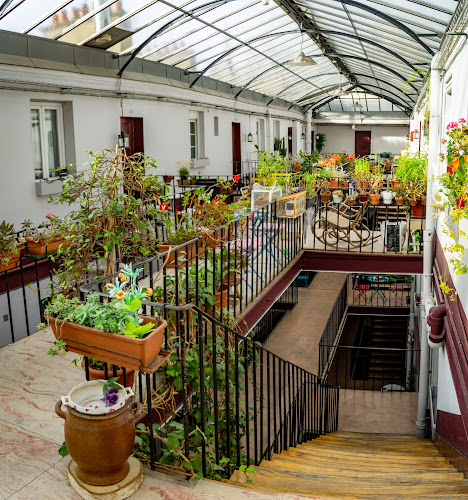
At 58 rue de Rochechouart in the 9th arrondissement, the Cité Napoléon stands as a groundbreaking monument to 19th-century social reform and the first workers\u2019 housing estate in Paris. Built between 1849 and 1851 by architect Marie-Gabriel Veugny at the personal initiative of Louis-Napoléon Bonaparte (later Napoleon III), this pioneering complex represents the earliest systematic attempt to create decent housing for working classes while addressing the catastrophic housing crisis that accompanied rapid industrial growth in mid-19th-century Paris.
<\!-- /wp:paragraph --><\!-- wp:parameter -->
Napoleon III\u2019s personal financial contribution and successful persuasion of other investors to support the project reflects his paternalistic belief that careful management of working-class habitations could lead people away from poverty while creating model communities that would demonstrate enlightened social policy and urban planning innovation.
<\!-- /wp:paragraph --><\!-- wp:heading {"level":3} -->
Fourier\u2019s phalanstère inspiration and architectural innovation
<\!-- /wp:heading --><\!-- wp:parameter -->
Inspired by Charles Fourier\u2019s concept of the phalanstère—utopian communities designed to promote social harmony through cooperative living—Veugny\u2019s design organized four buildings around a central garden with fountain, housing 400 families in 86 dwellings while providing communal facilities including laundry, crèche, and workshops that could serve both practical needs and social integration.
<\!-- /wp:paragraph --><\!-- wp:parameter -->
This architectural arrangement demonstrates early understanding of how housing design could serve both individual family needs and broader community social functions while creating environments that fostered cooperation, mutual support, and cultural development rather than mere residential accommodation.
<\!-- /wp:paragraph --><\!-- wp:heading {"level":3} -->
Industrial context and urban housing crisis
<\!-- /wp:heading --><\!-- wp:parameter -->
The complex\u2019s construction during a period when Paris\u2019s population exploded from 400,000 in 1845 to 1 million in 1848, alongside its strategic placement near a gas factory in a district desperate for worker housing, demonstrates how social housing could address urgent urban challenges while serving broader industrial development and economic growth that required stable, healthy worker populations.
<\!-- /wp:heading --><\!-- wp:parameter -->
The chosen location near industrial infrastructure reflects systematic thinking about how worker housing should relate to employment opportunities while creating comprehensive urban planning that coordinated residential, industrial, and transportation development within unified neighborhood improvement strategies.
<\!-- /wp:paragraph --><\!-- wp:heading {"level":3} -->
Social experiment outcomes and urban planning lessons
<\!-- /wp:heading --><\!-- wp:parameter -->
Despite housing over 200 apartments within the original plan for much larger development across the capital, the Cité soon came to be regarded as unsuccessful due to concerns about negative influences arising from “large barracks” concentrations of working-class families, leading to abandonment of plans for similar constructions throughout Paris.
<\!-- /wp:paragraph --><\!-- wp:parameter -->
This mixed outcome demonstrates both the visionary nature of early social housing experimentation and the complex challenges involved in creating successful working-class communities that require ongoing support and careful planning to achieve intended social and cultural benefits rather than merely providing minimal shelter.
<\!-- /wp:paragraph --><\!-- wp:heading {"level":3} -->
<\!-- /wp:heading --><\!-- wp:parameter -->
The Cité Napoléon\u2019s significance extends beyond its immediate success or failure to encompass its role as precedent for all subsequent social housing development, establishing architectural and social principles that would be refined and improved through generations of urban planning innovation and social policy development.
<\!-- /wp:paragraph --><\!-- wp:parameter -->
For visitors to the 9th arrondissement interested in social housing history, Napoleon III\u2019s urban policies, or early urban planning experimentation, the Cité Napoléon offers insight into how visionary social reform can inspire architectural innovation while revealing the complex challenges involved in creating successful working-class communities. The cité demonstrates that great social experiments emerge when political leadership meets architectural vision in service of humanitarian purposes, creating institutions that serve both immediate housing needs and broader social development while establishing precedents for ongoing urban improvement and social housing innovation that continue influencing contemporary approaches to affordable housing and community development.
<\!-- /wp:paragraph -->